
In Mexico, between October 2024 and September 2025, 75 attacks against 23 women human rights defenders were documented, with harassment, threats, and surveillance being the most frequent forms of violence. Additionally, three femicides of women dedicated to this work were recorded, according to the National Network of Women Human Rights Defenders in Mexico (RNDDHM).
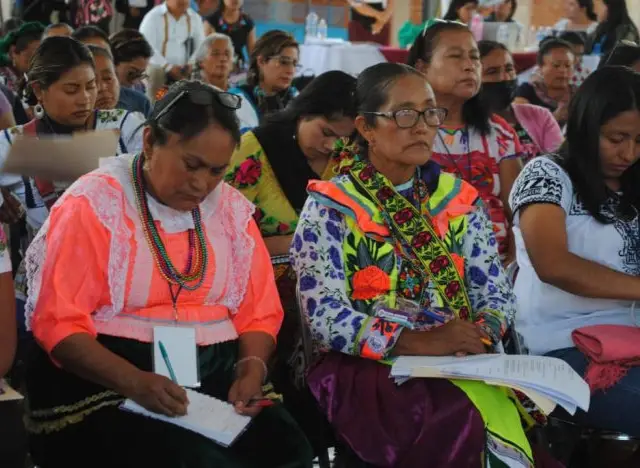
It is important to note that Indigenous women defenders face a triple risk: for being women, due to sexist and patriarchal violence; for being Indigenous, due to racism and structural discrimination; and for their advocacy work, which exposes them to criminalization and attacks for protecting their territories and rights.
Despite this scenario faced by Indigenous women human rights defenders, it contrasts sharply with the official discourse of Claudia Sheinbaum’s government, which declared 2025 the Year of Indigenous Women with the aim of recognizing and honoring their historical and cultural role, highlighting their leadership, and celebrating their legacy in defending the rights of Indigenous peoples.
Despite this designation, the Indigenous women who faced the highest levels of violence during the past year were those who defend truth, justice, and reparations (30%), followed by those who fight for labor rights (21%), and those who promote women’s right to a life free from violence (20%).
In most cases, the attacks were perpetrated by unidentified individuals (29%), as well as by state and municipal authorities and police (28%).
Oaxaca, the most dangerous state for women human rights defenders, with three femicides recorded
Almost half of the attacks recorded against Indigenous women human rights defenders occurred in the state of Oaxaca, governed by Salomón Jara, accounting for 45%. In the last year, extremely violent incidents were recorded in the state, such as the collective attack against eight women defenders in Elexochitlán de Flores Magón.
This situation of extreme risk for women human rights defenders had already been highlighted by organizations such as the Mexican Center for Environmental Law, which identified that, from 2012 to 2018, Oaxaca was the state with the highest number of attacks against human rights defenders, with 79 cases nationwide, concentrated mainly in the Juchitán area.
It is also important to note that Governor Salomón Jara has been repeatedly criticized for failing to address femicide in the state. According to the Femicide Observatory of the Rosario Castellanos Women’s Studies Group (GESMujer), 273 femicides have occurred in the state of Oaxaca during the current administration, 14 of which took place in 2025, according to data from the Executive Secretariat of the National Public Security System.
Sandra Domínguez
During this period, as recorded by the National Network of Women’s Rights Defenders (RNDDHM), three women from Oaxaca were murdered. One of them was Sandra Domínguez, a human rights defender and Ayuuk lawyer, who was found dead in April after having been missing for six months, having last been seen in Oaxaca.
Before her disappearance, Sandra Estefanía Domínguez publicly denounced Donato Vargas Jiménez, then coordinator of Social Peace Delegates, for his alleged participation in sex trafficking groups. They shared photos and videos of Mixe women without their consent. After making the complaint public, the lawyer demanded their dismissal and asked the governor of Oaxaca, Salomón Jara, to take action and investigate the matter.
Sandra disappeared on October 4, 2024, in San Juan de Cotzocón, Oaxaca. However, according to Aracely Domínguez, speaking to Cimacnoticias, the official report wasn’t issued until October 8 because the lawyer lived in an area with poor cell phone service. Despite this, with no leads on her whereabouts, her family launched an exhaustive search.
Sandra and her husband, Alexander Hernández, were located on April 24, 2025, after an operation carried out in various locations in the state of Veracruz, following information obtained by authorities about their possible location. However, Sandra’s family has reported that they continue to face harassment and revictimization from the authorities. Authorities have also stated that the case has not been classified as a femicide, despite the context of violence that surrounded her disappearance and murder.
Source: cimacnoticias