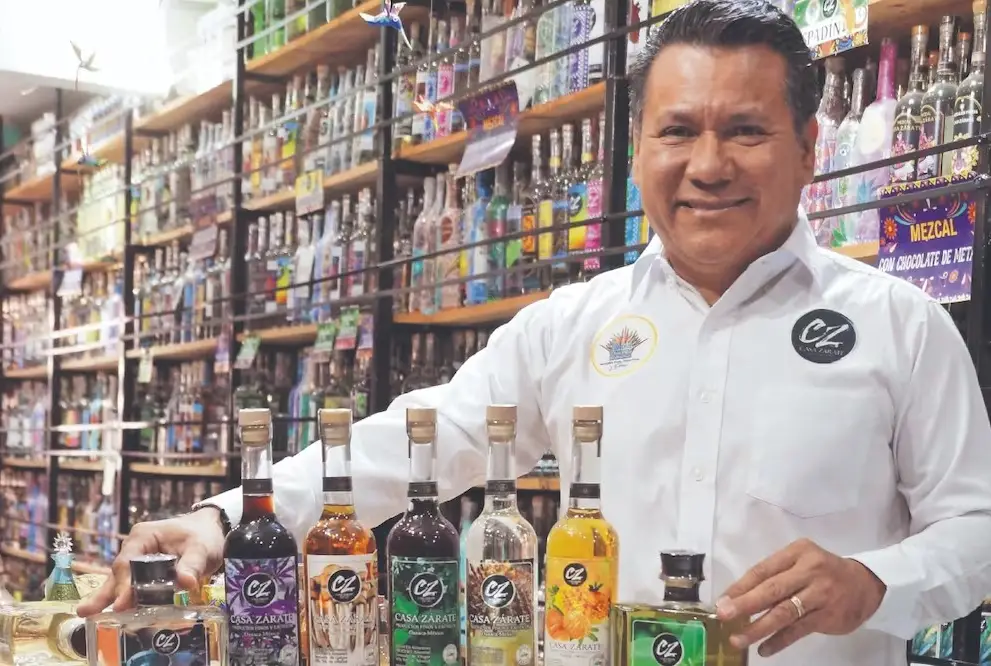

Luis Zárate Cuevas comes from a family that has dedicated itself to mezcal production for generations in Villa Sola de Vega, a town in the southern mountains of Oaxaca.
As a teenager, he was already traveling to Salina Cruz, a municipality in the Isthmus of Tehuantepec, to sell this beverage produced by his grandfather and earn some money while continuing his studies.
Upon reaching adulthood, Luis decided to dedicate himself entirely to this craft, but he faced the fact that there were thousands of brands on the market in the state, not to mention those produced in other parts of the country that have a designation of origin. This situation led him down the path of innovation and the creation of exclusive mezcals, many of which incorporate traditional medicine through the use of herbs and plants.
Twenty-five years after the start of this initiative, the master mezcal maker boasts a catalog of 200 varieties of mezcal made from flowers, insects, herbs, seeds, fruits, and even traditional dishes like mole. His mezcals infused with coca leaves, cannabis, and hallucinogenic mushrooms are also particularly noteworthy.
Each bottle is displayed in an exhibition room created especially for his family business, Casa Zárate Mezcales Finos, and in his Mezcal Museum, where he offers tastings.
This room houses 10,000 bottles and mezcals made with 100 different agave varieties, including Tobalá, Tepextate, Arroqueño, Cuishe, Madre Cuishe, Tripón, Barril, Jabalí, Coyote, Cucharilla, Tobasiche, Mexicano, and Sierra Negra.
“We specialize in making rare, exotic, and fine mezcals from wild agave, as well as using ancestral production methods: distilled in clay pots and reed pipes; the agave is still crushed with a mallet, and it’s fermented in wooden vats and cowhides,” he says.
The difference in Luis Zárate’s products is that he goes beyond simply adding seeds, herbs, or flowers to the liquid; it lies in the application of other processes such as the addition, maceration, and injection of oils or oil extracts into the spirit.
One example is the way he makes his cannabis mezcal, of which he has 51 varieties.
The first process is distillation, which is done with the cannabis included; then, the distillate is placed in a wooden barrel, and the freshly cut plant material is added to “reduce the color.” It remains there for three years and is finally aged for two years in a glass bottle, at which point the cannabis oil is added.
“Oil and mezcal are two liquids of different densities, so obviously they don’t mix. We have a process that we’ve perfected to allow the mezcal and oil to blend,” he explains.
A similar procedure is used to make mezcal from hallucinogenic mushrooms. “It’s not just a matter of adding a mushroom and that’s it,” he points out. In this case, he explains, in addition to distilling the mezcal, a laboratory molecularly modifies the psilocybin, the active ingredient in hallucinogenic mushrooms, so that it can “coexist” with the mezcal.
“The truth is, it’s already an extremely exotic and complex mezcal. As far as our research has shown, it’s the only one with an active substance, with a real effect, here in Mexico and in the world. There’s no other beverage registered or found with psilocybin. Someone might add a mushroom, that’s possible, but it doesn’t have a real effect.
“And in the case of cannabis mezcals, we’re making some very complex ones with indica cannabis, the green ones; and sativa cannabis, the ones that are other colors. Right now, we have a mezcal made with six different types of purple cannabis, which are from the sativa family,” he explains.
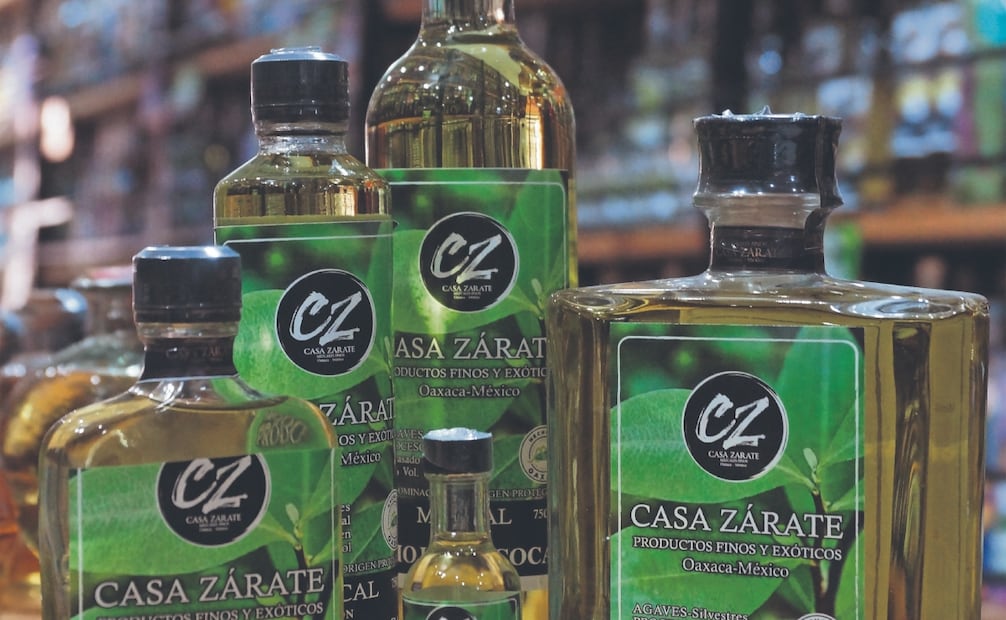
There’s also the distillate and maceration with coca leaves imported from Bolivia. The master mezcal maker points out that in South American countries like Bolivia, Colombia, Ecuador, and Peru, people use this plant daily to avoid altitude sickness: they have cities and towns at very high altitudes, above 4,000 or 5,000 meters.
Source: eluniversal