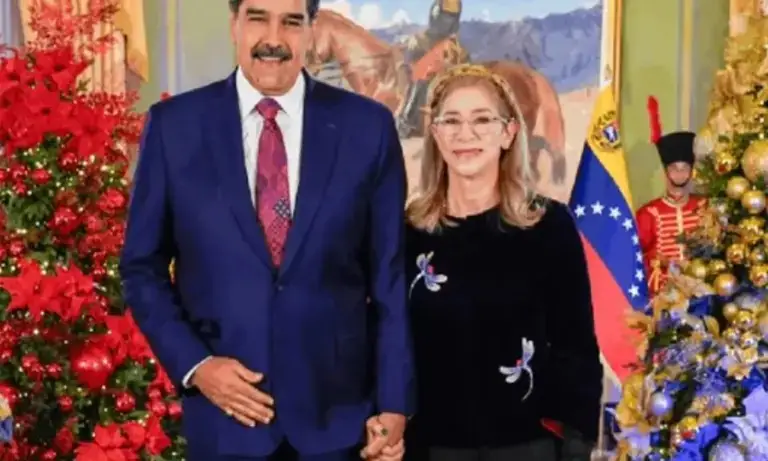

For years, Cilia Flores wielded influence behind the scenes, yet always close to the center of power in Venezuela. Known within Chavismo as the “First Combatant,” her figure has been key to the political structure that accompanied and sustained Nicolás Maduro since before his rise to the presidency.
Today, her name is back in the headlines after it was confirmed that she was captured alongside the Venezuelan president during the operation announced by the United States on January 3, 2026.
Cilia Flores was born on October 15, 1956, in Tinaquillo, Cojedes state. A lawyer by training, specializing in criminal and labor law, she grew up in working-class neighborhoods of Caracas and became involved early on with leftist movements. Long before becoming Maduro’s wife, she was already an active figure within Hugo Chávez’s political project.
In the 1990s, Flores participated in the legal defense of military personnel implicated in the 1992 coup attempt led by Hugo Chávez. It was in this environment that she met Nicolás Maduro, then a union activist and part of the Bolivarian leader’s inner circle. She herself recalled that first encounter years later:
“During that journey to free Chávez, we were involved in street activities. I always remember a meeting in Catia, and when a young man asked to speak, he spoke, and I just stared. I thought, ‘How intelligent.’”
From that moment on, they shared activism and political strategy, although Flores focused on building her own political capital within Chavismo.
Cilia Flores’s political career took off in 2000, when she was elected to the National Assembly. Re-elected in 2005, in 2006 she became the first woman to preside over the Venezuelan Parliament. She later held positions such as vice president of the United Socialist Party of Venezuela and attorney general of the Republic during the final stretch of Hugo Chávez’s government.
Her time in the legislature was not without controversy. She was accused of hiring family members within Congress, an accusation she partially rejected, stating:
“Yes, my family members were hired based on their own qualifications. I am proud of them and will defend their work as many times as necessary.”
When Maduro assumed the presidency, Flores rejected the traditional title of first lady and adopted that of “first combatant,” a concept aligned with Chavista rhetoric. Although she reduced her public appearances, analysts agree that her influence remained intact.
Political scientist Carmen Arteaga described her role as follows:
“She has a whole political operation. When she becomes first lady, she takes a back seat. But for many, she is the power behind the throne or a top-level advisor.”
Other experts point out that her power was never formal, but rather exercised through personal connections and internal decision-making, which hindered accountability within the regime.
From 2015 onward, Flores’s inner circle came under international scrutiny. Two of her nephews were convicted in the United States for drug trafficking, and she herself was sanctioned by Canada and later by the U.S. Treasury Department. In defense of his wife, Maduro declared:
“If you want to attack me, attack me, don’t mess with Cilia, don’t mess with the family, don’t be cowards. Her only crime is being my wife.”
On January 3, 2016, Donald Trump confirmed that both had been captured and transferred out of Venezuela. Attorney General Pam Bondi reported that:
“Nicolás Maduro and his wife, Cilia Flores, have been formally indicted in the Southern District of New York.”
The woman who operated from the shadows for decades now faces her most critical moment, with an uncertain legal future and a historical role that, for many, was decisive in the consolidation of Chavismo.

Source: msn