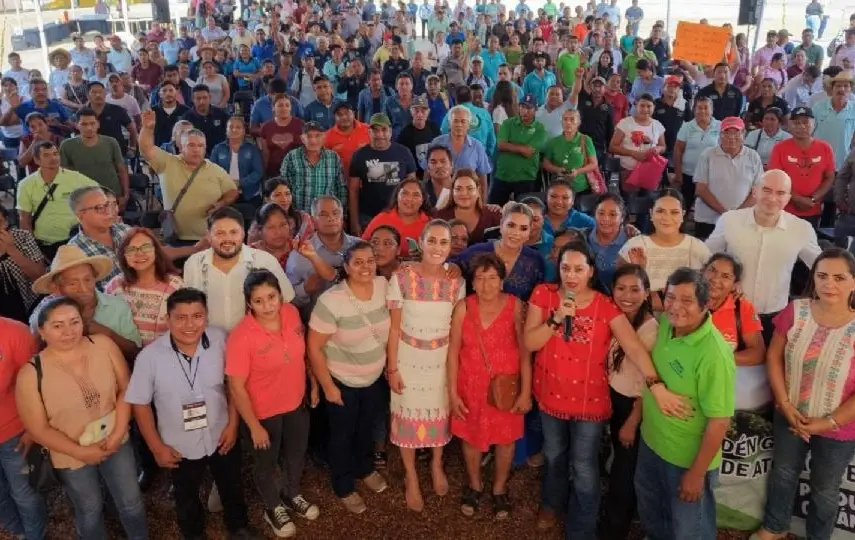

In Atoyac de Álvarez, Guerrero, Mayor Claudia Sheinbaum Pardo announced that the Food for Well-being program will expand its reach in the state by promoting hibiscus production, with the goal of strengthening the economy of local producers and guaranteeing fair prices without intermediaries.
During her visit to the municipality, the mayor explained that the intention is for hibiscus, along with other strategic crops, to be purchased directly from producers at a fair price, processed, and marketed with added value.
She detailed that this product could even be sold bagged or transformed into tea, which would generate higher incomes that go directly to the producing communities.
Sheinbaum also oversaw the production of Coffee for Well-being, one of the pillars of the Food for Well-being program, whose purpose is to ensure that more than two million producers throughout the country obtain sufficient income through a direct and equitable market.
She pointed out that the abandonment of rural areas in past decades was linked to falling prices and a lack of fair marketing channels, a situation they are now seeking to reverse.
The president emphasized that this model does not replace the traditional market, but rather complements it, allowing small producers to have a decent income base.
She also highlighted that the program is part of a broader strategy to advance food sovereignty, promoting crops such as cacao in Tabasco, beans in Nayarit, Zacatecas, and Durango, and honey in Campeche, which are sold in more than 26,000 Welfare Stores across the country.
For her part, the Director General of Food for Well-being, María Luisa Albores González, emphasized that in Guerrero, the price of natural coffee is currently up to 65 pesos per kilogram, a significant improvement compared to the 18 to 35 pesos it previously fetched.
Governor Evelyn Salgado Pineda highlighted that Guerrero is a national leader in the production of coconut, hibiscus, melon, and natural coffee, and holds prominent positions in mango, corn, and avocado.
Representing the producers, Maribel Benítez acknowledged that the new model has dignified agricultural work and ensured fair prices for those who sustain it.

Source: mvsnoticias