
This Tuesday, January 20th, marks Martin Luther King Jr. Day, a date that honors the legacy of the iconic American civil rights leader. In this context, Mexico has experienced significant moments related to his legacy and his historic struggle for justice and equality.
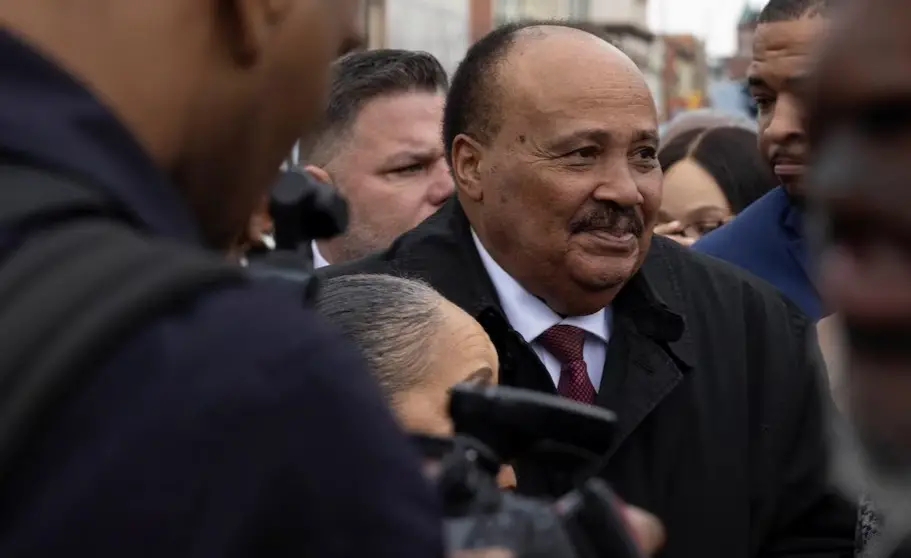
One such event occurred when Martin Luther King III, the eldest son of Martin Luther King Jr. and also a human rights advocate, visited Mexico at the invitation of President Andrés Manuel López Obrador’s government.
This visit took place in February 2021 to participate in the ceremony commemorating the 190th anniversary of the death of Vicente Guerrero, a hero of the Mexican War of Independence and Mexico’s first Afro-Mexican president. At this historic event, held in Cuilápam de Guerrero, Oaxaca, King III was invited to join President López Obrador as part of the commemorations organized by the Mexican government and emphasized the importance of remembering not only the struggle for racial equality in the United States, but also those in Mexico and Latin America.
During his stay in Mexico, King III and his family received an official welcome and participated in various cultural activities, including visits to iconic landmarks such as his father’s statue in Lincoln Park in Mexico City and tours of museums and historical sites.
Martin Luther King III’s presence in Mexico strengthened the ties between the legacy of the civil rights movement in the United States and the struggles for social justice in Mexico, highlighting values such as equality, nonviolence, and human dignity—principles that his father championed and that he continues to promote in different parts of the world.
This visit serves as a reminder of how the ideals of freedom and equality transcend borders and continue to inspire dialogues on human rights and justice in our country.
Who is Martin Luther King III?
Martin Luther King III was born on October 23, 1957, in Montgomery, Alabama, and is the eldest son of the historic civil rights leader Martin Luther King Jr. and Coretta Scott King. From a young age, he grew up in an environment marked by the fight against racial segregation and the defense of equality, which shaped his public vocation. After his father’s assassination in 1968, he and his family assumed the responsibility of preserving and projecting his legacy in the social and political spheres.
Unlike his father, King III has developed his activism in a contemporary context, focusing on human rights, social justice, combating poverty, and promoting nonviolence. He was president of the Southern Christian Leadership Conference (SCLC), the organization founded by Martin Luther King Jr., from where he spearheaded campaigns in favor of voting rights, access to education, and the inclusion of historically marginalized communities in the United States.
In addition to his institutional work, he has been a constant voice against racial discrimination and structural violence. He has participated in 21st-century civil rights movements, supporting causes such as justice system reform, economic equality, and the protection of minority rights. His activism has also extended internationally, promoting dialogue on human rights beyond U.S. borders.
Martin Luther King III is currently considered one of the principal moral heirs to his father’s thought. His work seeks to adapt the principles of equality, dignity, and peaceful resistance to current challenges, keeping alive the message that made Martin Luther King Jr. one of the most influential figures of the 20th century.
Source: infobae