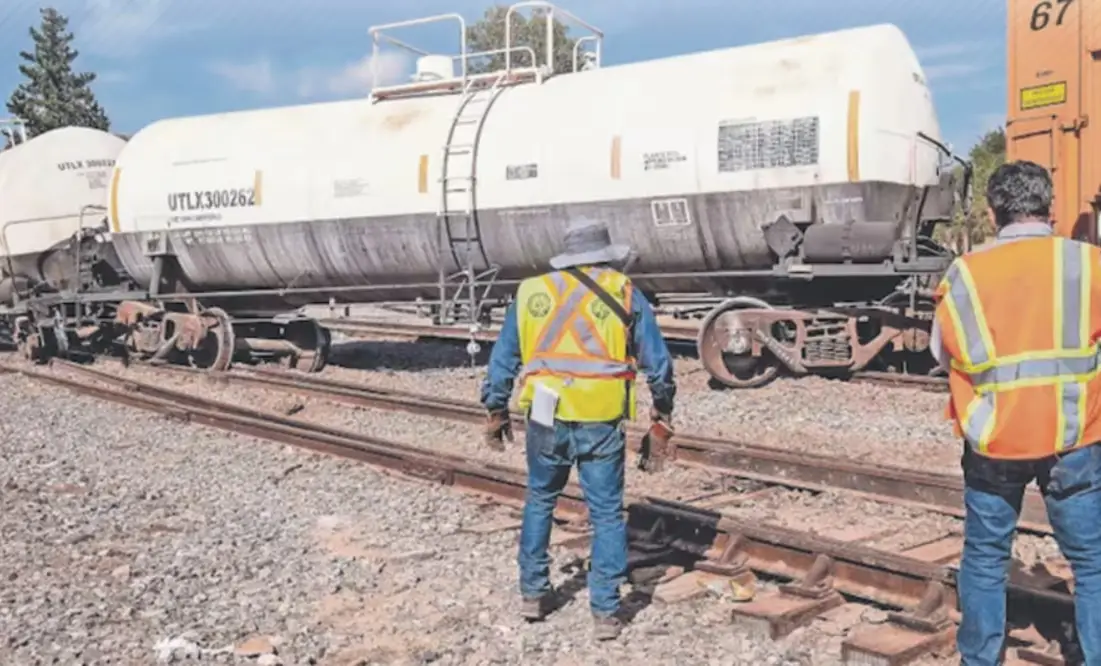

The country’s rail system, including new federal government passenger trains like the Maya Train and the Interoceanic Railway, reports a derailment every two days, according to figures from the Railway Transport Regulatory Agency (ARTF).
Open data from this agency, consulted by EL UNIVERSAL, indicates that while there has been a decrease in the number of these incidents—considering that in 2021 there was one derailment per day—the system continues to show vulnerability in its freight and passenger operations.
Between January and October 2025, 145 derailments were reported, compared to 163 during the same period the previous year.
These figures do not yet reflect the Interoceanic Railway derailment at the end of last year, which resulted in 14 deaths and approximately 100 injuries, and which has kept this flagship project of the previous administration, led by Andrés Manuel López Obrador, out of service.
ARTF figures show a 3% increase in vandalism cases during the same comparison period.
Experts explain that the number of derailments and vandalism on trains remains very high, reflecting the lack of rule of law and highlighting the poor safety conditions for operating this mode of transport, even though the figures have decreased in recent years.
This situation should be of even greater concern to the government, considering that in the coming years it will be launching passenger trains on the tracks and/or routes currently used for freight.
It should also address international concerns that these incidents occur even in developed countries, on systems more advanced than those used in Mexico, as was the case recently in Spain, where there are high-speed trains, not medium-speed ones like those used here.
“It’s good that the number of derailments is decreasing, because this is the most catastrophic event for the sector, which points to technical issues. These incidents do occur, and in Mexico, the figures indicate that there are still many, considering that the system is primarily for freight, that it’s not the main mode of transportation, and that these aren’t high-speed trains, as they are in Europe, where trains move a significant number of people every day,” said Edmundo Gamas, Director General of the Mexican Institute of Infrastructure (Imexdi).
“On the other hand, we have to wait for an investigation in Mexico that is free from political influence and adheres to technical principles. We’ll see how the two authorities handle these accidents and how they resolve them. Our point of reference is that when a similar accident happened on the Mexico City Metro, the government didn’t conduct an investigation, and better information and photographs emerged from the press.”
Humberto Treviño, an independent specialist, said that, in comparison to the accident in Spain, where 39 people have died so far, derailment incidents in Mexico must be understood in the context that only 2% to 3% of people travel by train, compared to 30% in the Spanish case. “This issue needs to be examined much more deeply, and whatever is necessary must be done to ensure that these incidents do not multiply with new projects as the percentage of train users increases,” he said.
Miguel González, a professor at UNAM (National Autonomous University of Mexico), indicated that, observing what is happening internationally, where infrastructure projects and their development are based on technical rather than political considerations, in Mexico projects must be evaluated from the outset, guaranteeing that they are profitable and technically viable.
“A railway system needs financing and profitability. Perhaps it will come from freight, but in Mexico, the trend is toward new state-owned enterprises, so infrastructure development, as happened with the Maya Train or the Interoceanic Railway, will be subsidized. And even so, what we’ve seen still happens,” he pointed out.
Read also: Interoceanic Railway: Sheinbaum says AMLO’s son should be investigated for derailment; engineers were responsible for the technical aspects
Official figures in Spain show that, unlike in Mexico, that railway system has experienced between 20 and 25 derailments per year, with only a few serious incidents like the one this past Sunday.
Juan Carlos Machorro, an infrastructure specialist and partner at Santamarina y Steta, said that the federal government needs to conduct a technical audit to assess the risks faced by the projects the current administration wants to put into operation.
Source: eluniversal