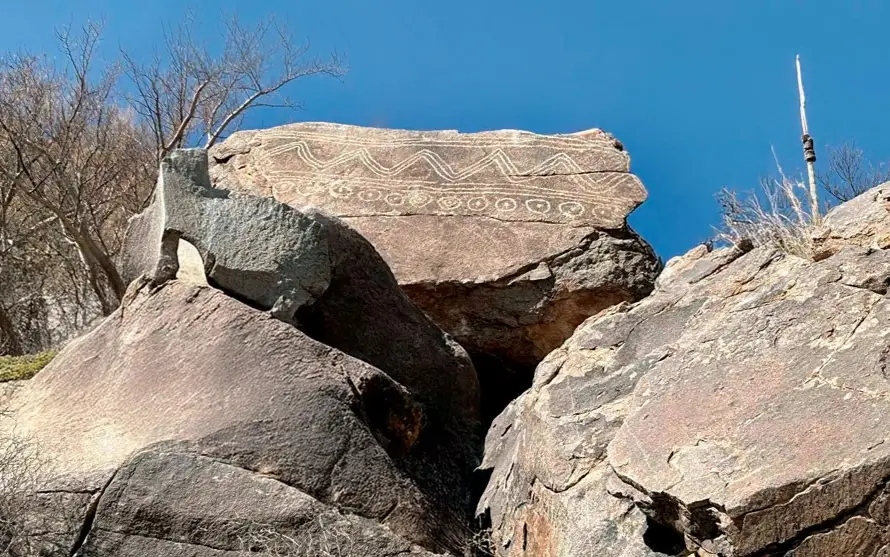

Based on its location, position, engraving, and geometric shape, an ancient stone containing “the movement of the Universe,” discovered in the Sonoran Desert by experts from the National Autonomous University of Mexico (UNAM), could be a horizon calendar that records the Sun’s path in its annual cycle.
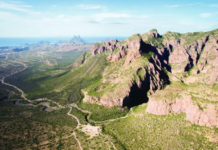
The area is one of the most enigmatic in the world due to the large number of rock art sites (both engravings and paintings) it contains, explained César Villalobos Acosta, director of the Institute of Anthropological Research (IIA) and head of the scientific team, in an interview.
The researcher maintained that desert cultures are just as important as those of other regions, such as those in central or southern Mexico. All societies adapted to their environments, “which are also cultural and symbolic,” and one of their most sophisticated expressions was that captured in stone through engravings.
In this case, the desert was inhabited by the so-called Trincheras culture, whose occupation spanned from 200 to 1450 CE. Besides petroglyphs, they left behind pottery decorated with purple dye. However, this heritage could be in danger due to uncontrolled visits that can cause damage, he warned.
Almost a decade ago, Villalobos Acosta began studying human societies settled in the Sonoran Desert. “My interest is in documenting long-term processes, where climate change or environmental fluctuations also determine how societies adapt and move within that space.”
Along the Sonoran coast, and along a 140-kilometer stretch, we have identified 74 previously unrecorded archaeological sites; that is, evidence of human occupation ranging from a collection of pottery fragments, some projectile points, and shell debris in areas of 10 square meters, to others spanning kilometers.
This desert, which covers approximately 300,000 square kilometers, extends beyond the state of Sonora into the United States and large portions of Baja California. It is characterized by its abundance of rock art sites. “It was a densely populated and culturally important area,” the university researcher emphasized.
These were established, sedentary, and agricultural societies that cultivated corn, beans, and squash, according to the evidence, and were highly mobile within these territories, the archaeologist explained.
The site has about 1,500 engraved stones; “we estimate that there are between 6,000 and 10,000 engravings, also related to ceramics and shells. We estimate that the earliest evidence at this site dates back to 2500 BCE and continues until the 15th century, with a series of continuities and discontinuities,” the researcher added.
The basalt calendar rock, located about 35 meters above the plain and measuring approximately 1.20 by 2 meters, has a series of circles engraved on its eastern side, and at the top a design that has been identified elsewhere as a way of dividing the world into seasons. Its geometric design is repeated at least eight times at the archaeological site; it is recurrent and, therefore, has a cultural structure.
Villalobos observed that if we stand on this rock and look eastward toward the horizon, we can see at dawn how the sun moves throughout the year between two extremes, the summer and winter solstices, and how it passes twice, in the central part, through the point marked for the equinoxes.
Ancient agricultural societies needed to measure time to carry out their activities, such as planting and harvesting, and to know, for example, the beginning of the rainy season.
The scientist announced that, in collaboration with the Institute of Geology, they will conduct an analysis of the rock’s microcomponents to help more accurately date the engravings. The first results are expected by mid-2026.

Source: gaceta.unam