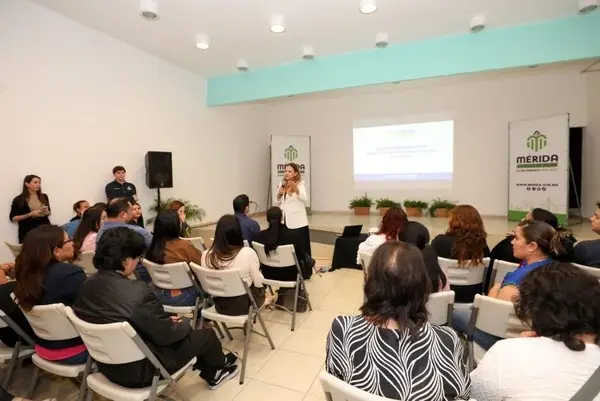

Mérida will take a major step forward with the opening of its first Municipal Autism Center, announced Mayor Cecilia Patrón Laviada, as she presented the preliminary plans for this space to representatives of the neurodivergent community. The center will provide accessible and professional services to many families in Mérida.
“This new municipal center, located in the eastern part of the city, will serve children, youth, and adults, recognizing the significant need. It will be the first model, and we will adapt and expand it, striving for sustainability to ensure its continued operation,” stated the mayor.
This initial meeting aimed to share the sustainable project being developed in collaboration with civil society and various organizations and stakeholders involved in the issue, listening to and addressing real needs to continue moving toward a more just and inclusive Mérida.
In a statement, the mayor emphasized that this project reflects the collaborative work with local legislators, who recently approved the Law for the Care and Inclusion of Autistic People. This law aims to guarantee basic rights such as health, education, and employment, as well as create spaces for the care of this population.
With the municipality of Mérida as an ally in this effort, the Municipal Autism Center has an authorized budget of 3.5 million pesos for the 2026 fiscal year and will be operated by staff from the Municipal DIF (System for Integral Family Development). Its inauguration is planned for April 2nd, coinciding with World Autism Awareness Day.
It will feature two new spaces: the Sensory Therapy Gym, designed to help people process and organize sensory information more effectively and promote adaptive responses in the brain, thus fostering learning and neuroplasticity to improve sensory processing, socialization, and cognitive stimulation, among other benefits.
In addition, it will have a Multi-Sensory Stimulation Room that will provide a variety of controlled sensory stimuli to promote sensory exploration and overall well-being. These stimuli are primarily used in therapies for autism and other neurodivergent conditions to facilitate goals such as interaction and communication, sensory stimulation, and psychomotor development and function, among other benefits.
The main objective is to provide care and prevent problems from early childhood, helping future generations of neurodivergent adolescents and adults achieve full integration into society.
It is expected to become a municipal benchmark in the care of neurodivergent children and will include care for various age groups, expanding its coverage to adults with autism.

Source: ahoratabasco