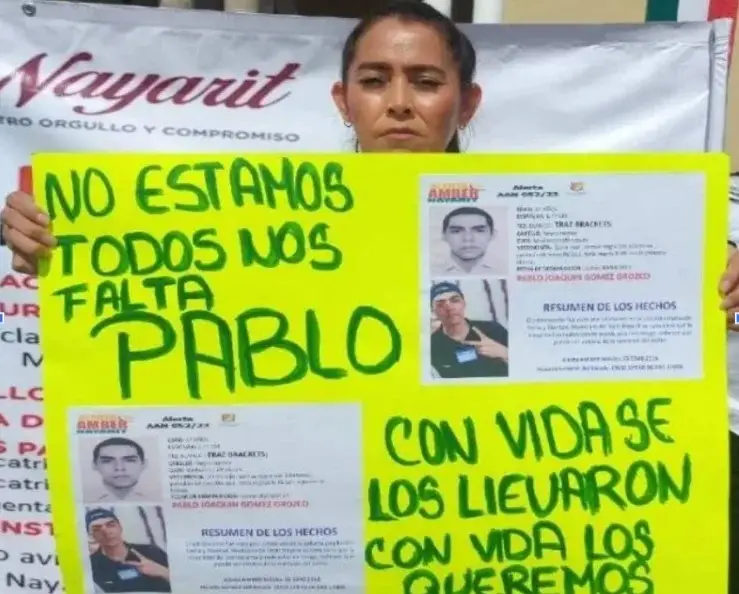

More than two years after the disappearance of Pablo Joaquín Gómez Orozco, his mother, Alejandrina Fabiola, denounces a series of omissions, negligence, and alleged irregularities committed by the prosecutors’ offices of Nayarit, Jalisco, and Zacatecas, as well as by the Jalisco Institute of Forensic Sciences. She asserts that these actions not only prevented her son from being searched for in a timely manner but also resulted in the mishandling of human remains and a revictimizing process.
Pablo Joaquín disappeared on March 30, 2023, in Tepic, Nayarit. He had a high school education, was studying programming, and attended leadership and personal development workshops on weekends.
That day, he left around 10:00 a.m. to look for temporary work for Holy Week and never returned.
Alejandrina immediately went to the Nayarit Prosecutor’s Office, where she was told she had to wait 72 hours to file a report. When she returned, she says they tried to dissuade her by arguing that “her son was probably on vacation.”

“I demanded that a report be filed, but they didn’t launch any search,” she recounts.
To find him, she posted missing person flyers in downtown Tepic, but it had no effect. On April 7, she received a call: it was Pablo Joaquín.
“He told me they had taken him to Zacatecas, that he was very scared, that a cartel had him, and that I should please go get him,” she says.
The mother took this information to the state prosecutor’s office, but they told her they couldn’t act based solely on a phone call. Alejandra then requested the call log, which was denied.
Faced with this refusal, she traveled to Mexico City and protested in front of the Supreme Court. Only then did she manage to obtain the phone records, which showed locations in Jalisco, Zacatecas, and Aguascalientes. She requested cooperation between states. She says none responded.
“In Jalisco, they told me they had more than 15,000 missing persons, so why bother looking for a cell phone?” she recalls.
The same area where the phone was found was later where a body, presumed to be that of her son, was located in Encarnación de Díaz, Jalisco, in the community of San José del Bajío. According to the mother, Pablo was first taken to Tala, near Rancho Izaguirre.
She wasn’t notified until September 21, 2025, more than two years later.
“The new search commissioner took me to Lagos de Moreno, and at first they told me they didn’t have any bodies. Then they made calls, and it turned out he was indeed in Jalisco.”

However, upon arriving at the Forensic Medical Service (SEMEFO), she was again met with refusals. Later, officials asked her in a “rude and arrogant” manner whether or not she wanted the remains.
The director of the forensic institute assured her that the body was fully identified and tried to convince her to accept it. She requested that it be transferred to the Attorney General’s Office (FGR) for further genetic testing. There, she discovered something even more serious.
“The jawbone didn’t belong to my son; it was from someone around 40 years old, and there was a duplicate bone: one was his, and the other wasn’t.”
Alejandrina requested that the other two bodies found alongside her son’s also be analyzed. Later, she reviewed a document dated September 26, in which Jalisco authorities acknowledged that they weren’t 100% certain of the body’s identity. “But they had told me it was fully identified and that they were going to release it to me. If I had accepted it, they would have given me someone who wasn’t my son.”
Since then, she reports that the Jalisco Institute of Forensic Sciences has refused to provide complete information about the processing, despite formal requests from the Jalisco Attorney General’s Office and the National Human Rights Commission (CNDH).
“The body was in SEMEFO since April 2023 and I was notified two and a half years later,” he says.

Source: emeequis