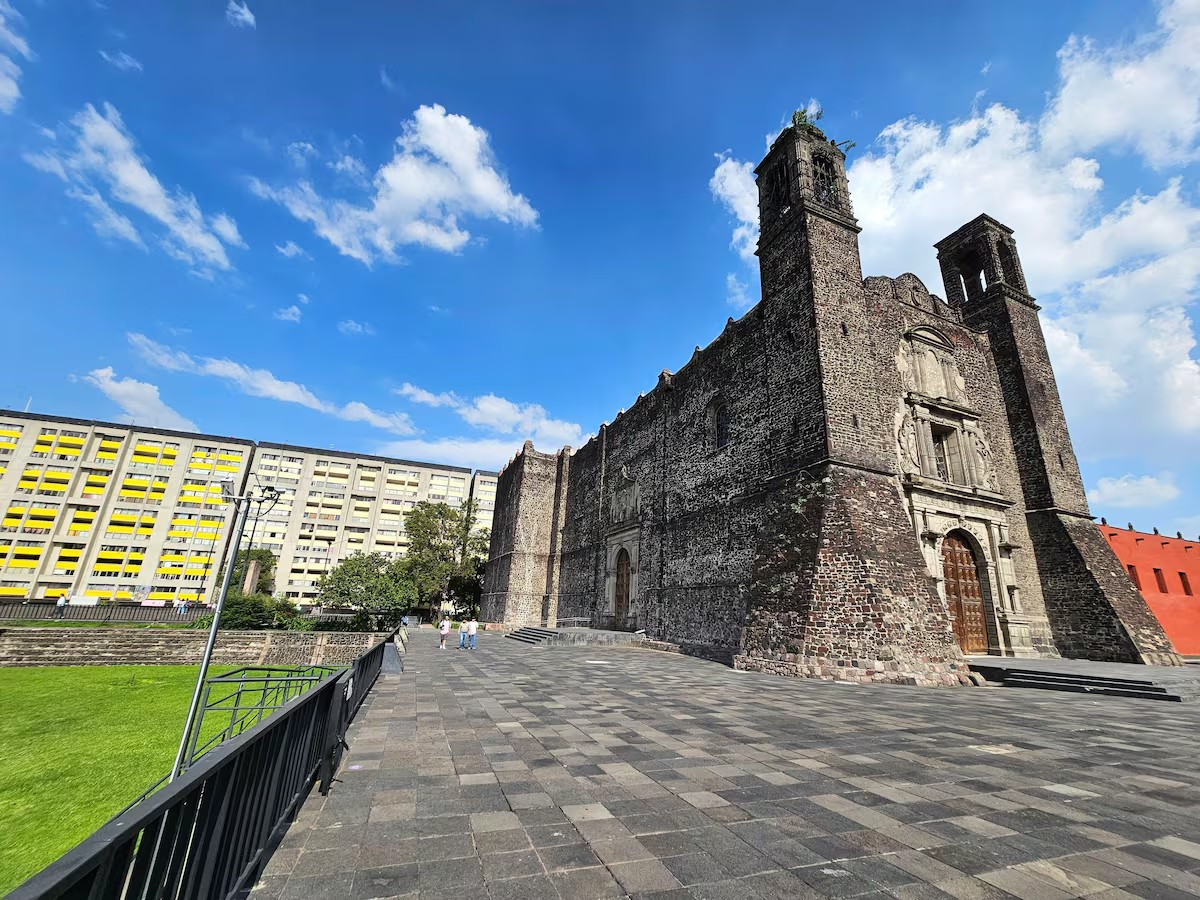

History, with a capital H, will surely captivate any unsuspecting visitor who ventures to the Plaza de las Tres Culturas in Tlatelolco, right in the heart of Mexico City. This very spot once housed one of the largest and most organized commercial centers of the indigenous world. Today, reconstructing its vibrant atmosphere requires a leap of imagination. Just take a few steps and peer into the nearby moat…
where a succession of mysterious structures still stand: there, perhaps, are the ceremonial temples, over there the altars and Mexica palaces that are believed to have dominated this landscape. Today, only silence remains. And the walls of tezontle, that reddish or blackish volcanic stone characteristic of the pre-Hispanic era.
The architect Rodrigo Torres lives in Tlatelolco and directs the Mirador creative center. He explains that the great market functioned like a slaughterhouse, with a structure made of ephemeral materials: “In the Templo Mayor Museum, next to the Zócalo, food remains have been found, such as crustaceans and shellfish, whose arrival in Tenochtitlan remains unexplained. The answer seems to indicate that there was trade between the two local groups.” Torres’s keen eye also discerns the outline of what appears to have been a ceremonial space.
“The pyramidal base is visible, as in other Mesoamerican archaeological structures,” he details. But what is evident to the architect is barely discernible to the tourist, barely conjuring up the outline of a possible sketch. Basic information indicates that the church of Santiago Tlatelolco, adjacent to the ruins and the plaza that serves as the central point of the visit, was inaugurated in 1610 by the Franciscan order. In fact, stone blocks from the temples buried in the archaeological zone were used in its construction. Inside, the German-Polish artist Mathias Goeritz installed a series of stained-glass windows that are well worth a visit.
In this way, layers upon layers of history from three distinct Mexicos begin to intertwine. It all depends on how much time you have to explore. Because right there, a massive, architecturally significant housing complex, designed in the mid-20th century, comes into view: the Nonoalco-Tlatelolco Housing Unit. “The idea of inserting these housing blocks into a historical area has been a difficult process to understand. In fact, for the rest of the city, living in Tlatelolco is still perceived as something negative,” explains the architect. He is referring to the massacre, at the hands of the Mexican police and army, of an undetermined number of students who were demonstrating against government oppression and for a more democratic country in the Plaza de las Tres Culturas on October 2, 1968, just days before the opening of the Olympic Games in the capital. Official figures report around 30 deaths. An independent university report raises the number to 350.
“Four years after its inauguration, in 1964, the massacre occurred, and many residents left the neighborhood. Then, with the 1985 earthquake, it was almost deserted. And in recent decades, the deterioration of security has shaped the public’s perception of this area,” Torres concedes. The mastermind behind the design, the renowned architect and urban planner Mario Pani, never spoke about the project once it was completed. “It’s curious, because here he synthesized all his previous ideas about architecture as a tool for coexistence and progress. His concern was precisely how to occupy public spaces, and for this he conceived a series of units whose core lies in community organization,” Torres explains.
It was a revolutionary idea, marked by the industrial aesthetic of modern rationalism: three enormous sections of residential towers to house thousands of families, spaced by green areas, and services such as daycare centers and sports and social centers. Something of that popular spirit is still palpable as you walk along the covered walkways that connect the complex. The community gardens and the lushness of the grounds bear witness to the pillars of an architecture open to the city and imbued with a profound sense of community.
East of the Plaza de las Tres Culturas, on Paseo de la Reforma, lies a small, hidden room with the feel of a chapel. David Alfaro Siqueiros (Mexico, 1896–1974) moved a mural titled Cuauhtémoc Against the Myth (1944) to this space in the mid-20th century. It is a free-access area where the artist politically represents the resistance of the last Aztec emperor against the Spanish conquest. “This is an example of a technique he called sculpture-painting, in which he incorporates wooden volumes and reliefs into the composition. Beyond his communist ideals, what is fascinating is his commitment to bringing art, to incorporating it, into public life,” argues Torres.
Source: elpais