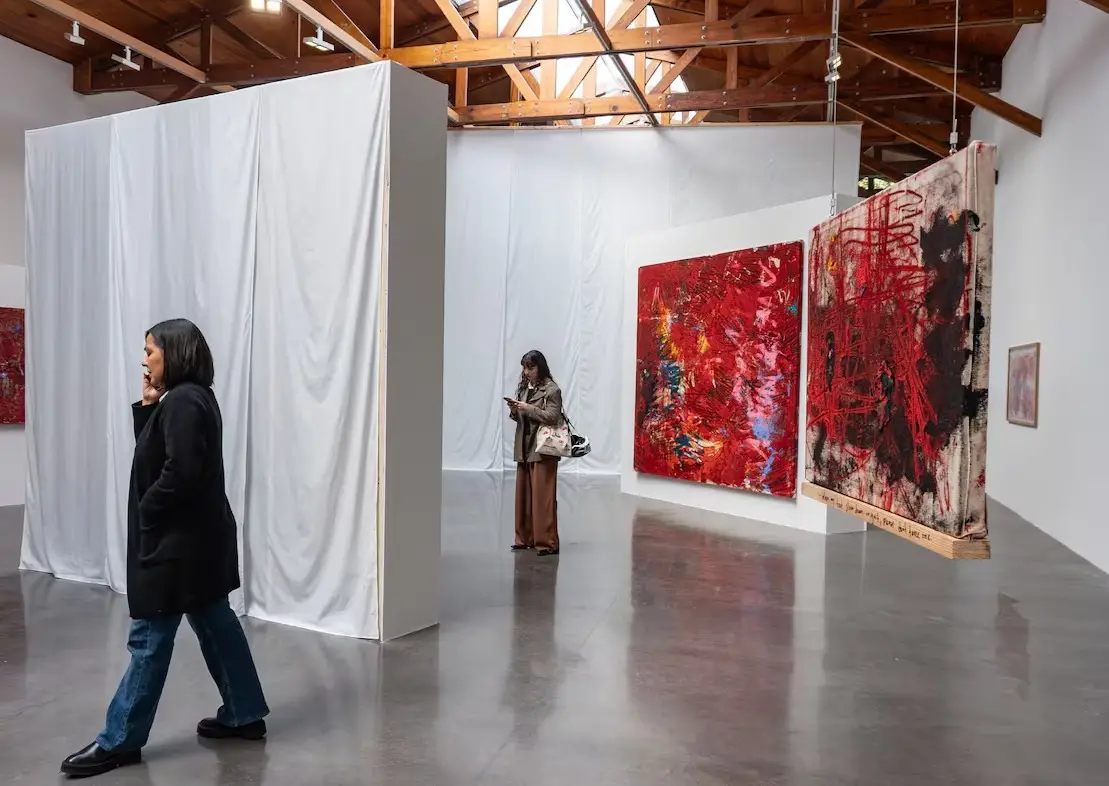

Mexico City is in vogue, and anyone who has strolled its streets since the pandemic has witnessed it firsthand. The Mexican capital is experiencing a moment of splendor that places it at the forefront of the continent and, increasingly, the international scene. It’s not just the pre-Hispanic heritage or the gastronomy; the future of contemporary art is being forged in this metropolis that is buzzing like never before. Art Week, which begins this Tuesday and which every year brings together hundreds of artists, galleries, and collectors in the first days of February, once again unfolds a powerful artistic program spearheaded by the spaces of Zona Maco, Material, and Salón Acme. “This year we have placed a strong emphasis on the curatorial aspect, in the Sur and Ejes sections, which are spaces for reflection and encounters, in the case of Ejes, with more emerging art,” notes Direlia Lazo, artistic director of Zona Maco.
With more than 25 exhibitions and some 70 parallel activities, this is the leading fair that sets the pace in the Latin American art conversation. Among its highlights are the choreographic performance COLOSOS by Diego Vega at the Palace of Fine Arts, and the Gunther Gerzso exhibition tour, as well as a thematic exhibition by Gabriel de la Mora at the Tamayo Museum. This year marks the fair’s 22nd edition, confirming its exponential growth. “In recent years we’ve had around 80,000 visitors, and we expect similar numbers,” says Lazo, illustrating the event’s growing popularity: “Hotels have told us that during art week they fill up to the same capacity as Formula 1.”
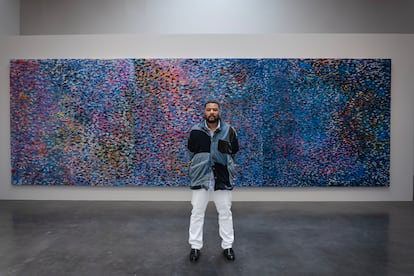
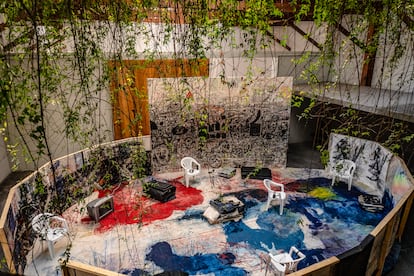
Mexico City sits at the table with the great metropolises of the art world, such as New York, São Paulo, and Bogotá, but its essence is unique. “It’s a cultural powerhouse. Beyond the Latin American context, it’s more of a cultural force than New York.” “Perhaps it doesn’t have that commercial force, which is even destructive, but it’s that axis where culture converges and is directly transferred to the Pacific, to Asia, Japan, China, Korea,” explains Colombian artist Óscar Murillo, the Kurimanzzutto gallery’s big bet for art week with his exhibition, The Water Well.
The artist is interested in the idea of porosity, the interaction between the public and the private, the personal and the political or social. For this reason, his work is imbued with tools that allude, for example, to work in maquiladoras (assembly plants). He is not interested, however, in turning it into a didactic instrument. “Art is not a didactic device but a space of freedom,” he points out. This same notion of porosity is what makes him value these kinds of encounters, which become like “a contaminant” that “nourishes things.” The exhibition he is most looking forward to is The Womb Space, at the MUAC (University Museum of Contemporary Art). starring her fellow countrywoman Delcy Morelos.
Salon Acme, which has selected 82 artists from among 1,800 applications, joins the already extensive scene with a proposal that has placed “special care” on “museography.” “We changed the design of the sections a bit and are concentrating the exhibition in the first room, which we used as a storage space last year.” “It’s a slightly more mature experience,” says Ana Castella, its director, who notes that the previous edition drew around 18,000 visitors and this year they expect to reach 21,000. After hosting Veracruz last year, the space will now feature the state of Puebla, curated by Nina Fiocco, with activities including culinary demonstrations such as that of chef Ángel Vázquez. Among the 18 artists are Sofía Abraham, Blanca Alonso, and Antonio Barrientos.
Following the Colombian artist’s observation, Castella believes Mexico City “has established itself as a capital that still plays a role somewhat outside the rules of the global market.” “There’s a bit more flexibility and freedom, which makes it even more interesting.” “You can see and enjoy art in a very diverse way, not just around the market,” he explains, a sentiment present wherever he asks. Galleries become, above all, “ambassadors” of the city, in the words of José Kuri, co-director of Kurimanzutto, who believes that art has been expanding throughout the city, even reaching more “remote” areas: “That gives me a lot of hope, a real desire to be here. Why would we want to be the new Berlin?”
Source: elpais