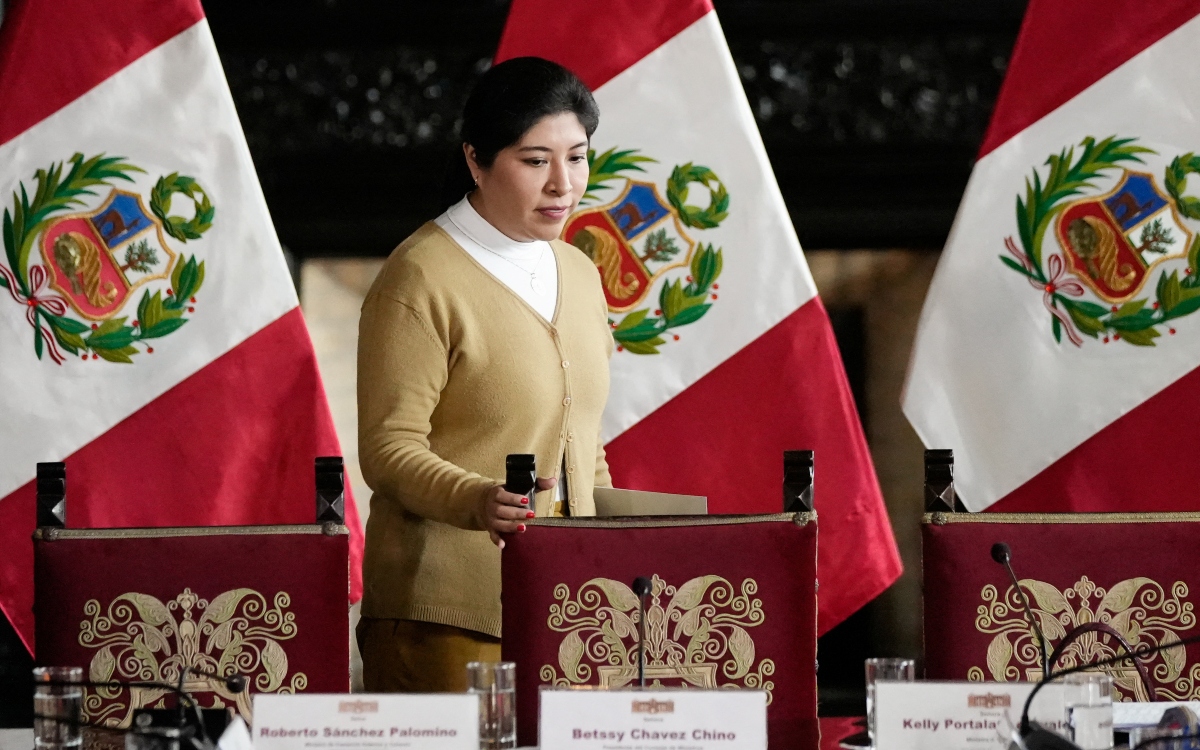
Peruvian Foreign Minister Hugo De Zela reiterated on Monday that the Peruvian government has no intention of forcibly entering the Mexican Embassy residence in Lima to arrest former Prime Minister Betssy Chávez, who has been granted asylum there. Chávez was sentenced to 11 years and 5 months in prison along with former leftist President Pedro Castillo (2021-2022) for the failed 2022 coup attempt.
“I want to reiterate with absolute firmness that Peru will not forcibly enter the Mexican Embassy; it is not even being considered,” De Zela emphasized in statements to reporters, reaffirming the position the Peruvian government has maintained since learning that the Mexican government granted asylum to Chávez.
From the outset, the Peruvian government has opposed replicating the experience of Ecuador in 2014, when that country’s president, the right-wing Daniel Noboa, ordered the storming of the Mexican Embassy in Quito to capture former Vice President Jorge Glas, a member of the Correa administration, who had also been granted asylum by the Mexican government.
Two weeks ago, Peru agreed to allow Brazil to take over Mexico’s diplomatic missions, having severed relations with Mexico at all levels after learning of the asylum granted to Chávez.
De Zela also noted that, during a visit to Washington last week, he spoke with representatives of several countries in the region to the Organization of American States (OAS) about the Peruvian government’s consultations regarding the Caracas Convention (1954), which regulates political and diplomatic asylum.
The Peruvian government has submitted the asylum procedure to the OAS for consultation, arguing that Mexico has undermined it by granting this benefit to Chávez, against whom the government denies any political persecution.
While the Convention stipulates that asylum cannot be granted to those prosecuted or convicted of common crimes, it remains the prerogative of the receiving state to determine whether the request constitutes political persecution.
Thus, the Peruvian government has made the granting of safe passage to Chávez, which it is obligated to provide so she can travel to Mexico to seek asylum without being detained by Peruvian authorities, contingent upon this consultation process.
Chávez was sentenced to 11 years and 5 months in prison for conspiracy to commit rebellion, after a court of the Peruvian Supreme Court found her complicit in the address to the nation given by President Castillo on December 5, 2022, in which he ordered the closure of Congress and the intervention of the judiciary.
The message, delivered by Castillo from the Government Palace with the aim of avoiding a possible impeachment by Congress, after evidence of corruption was revealed that directly implicated him, had no effect and the president was arrested when he was apparently heading to the Mexican Embassy, where his family was granted asylum that same day.
Source: aristeguinoticias