Trump wants to cut China out of North American supply chains and secure privileged access to strategic resources. For Mexico and the German automotive industry, this means making decisions.
With a weak economy and under intense pressure from Donald Trump, Mexico begins renegotiating its free trade agreement (USMCA) with the United States next week. While Foreign Minister Marcelo Ebrard is traveling to Washington backed by a powerful delegation of expert negotiators and prominent business leaders, analysts consulted by DW foresee challenging negotiations.
“Mexico is entering the negotiations with a weak economy where neither consumption nor investment is growing,” warns Ignacio Martínez Cortés, coordinator of the Laboratory for Analysis in Trade, Economics, and Business (LACEN), in an interview with DW. Meanwhile, Mexico, the US’s largest trading partner, exported $534.8 billion worth of goods last year, a record high.
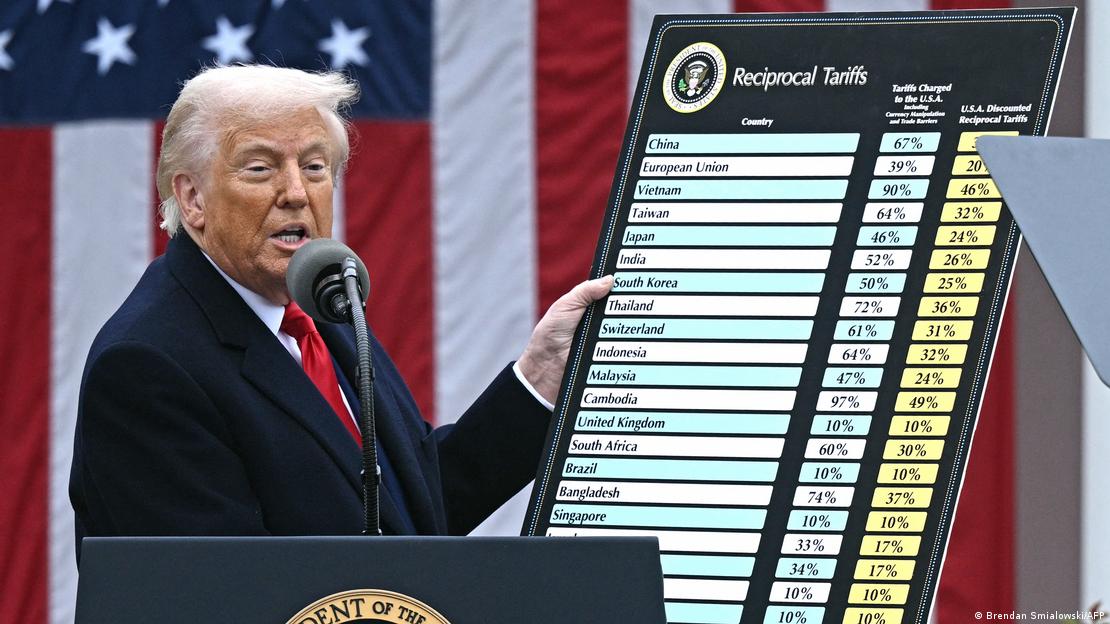
But the sword of Damocles hanging over the Mexican economy has a name: Donald Trump, with his penchant for tariff wars. Mexico, despite being the largest trading partner of the United States, has also suffered from his arbitrary tariffs, for example, on aluminum, steel, copper, semiconductors, and automobiles, including those of German brands.
“Tariffs are the elephant in the room,” says Gabriela Siller, director of economic analysis at Grupo Financiero BASE. “In a free trade agreement, they simply shouldn’t exist,” she tells DW.
According to Martínez Cortés, the United States’ attention is focused on three key points: keeping China out of sensitive supply chains such as telecommunications and cybersecurity, reducing the possibility of Beijing using Mexico as a springboard to gain preferential access to the U.S. market, and guaranteeing privileged access to Mexico’s energy and mineral resources.
“If Mexico wants to maintain its privileged access to the U.S. market, it will have to make concessions on these three points,” predicts the PhD in International Economics from the Complutense University of Madrid.
One of the issues that will cause the most friction, according to both analysts, will be the discussion on the rules of origin, which establish the minimum percentage of products manufactured in North America.
This point is especially relevant for German automakers that have plants in Mexico, such as Volkswagen, Audi, and BMW. Originally, a car could enter the U.S. if 62.5 percent of its components came from the three countries of the USMCA (Mexico, the United States, and Canada). This was gradually reduced from 2020 to 75 percent. Now, there is talk of up to 85 percent.
With this, Washington wants to force the automotive industry to decouple its supply chains from China (where many components originate due to low costs) and to reshoring, the return of its plants to the U.S.
Siller warns that the rules of origin could be extended to other sectors such as technology and cybersecurity. “If it’s also applied to computer equipment, it would greatly affect Mexico,” says Siller, an economics professor at the Monterrey Institute of Technology. “Last year, computer equipment exports from Mexico saved export growth; without them, it would have fallen,” she points out.
For Martínez Cortés, another danger lies in the U.S.’s intention to impose quotas on certain agricultural exports. “If that quota is exceeded, tariffs will have to be paid,” he explains. This, according to the economist, harms Mexico’s booming agribusiness.
Another critical issue could be energy. Although both countries are more or less strategically aligned, prioritizing fossil fuels over renewables, Mexico included a clause in the last trade agreement that allows for regulations favoring its state-owned oil company, Pemex, over private companies. Now, Trump is pushing to abolish that clause and allow foreign investment in oil and gas extraction, beyond strategic minerals.
Source: dw