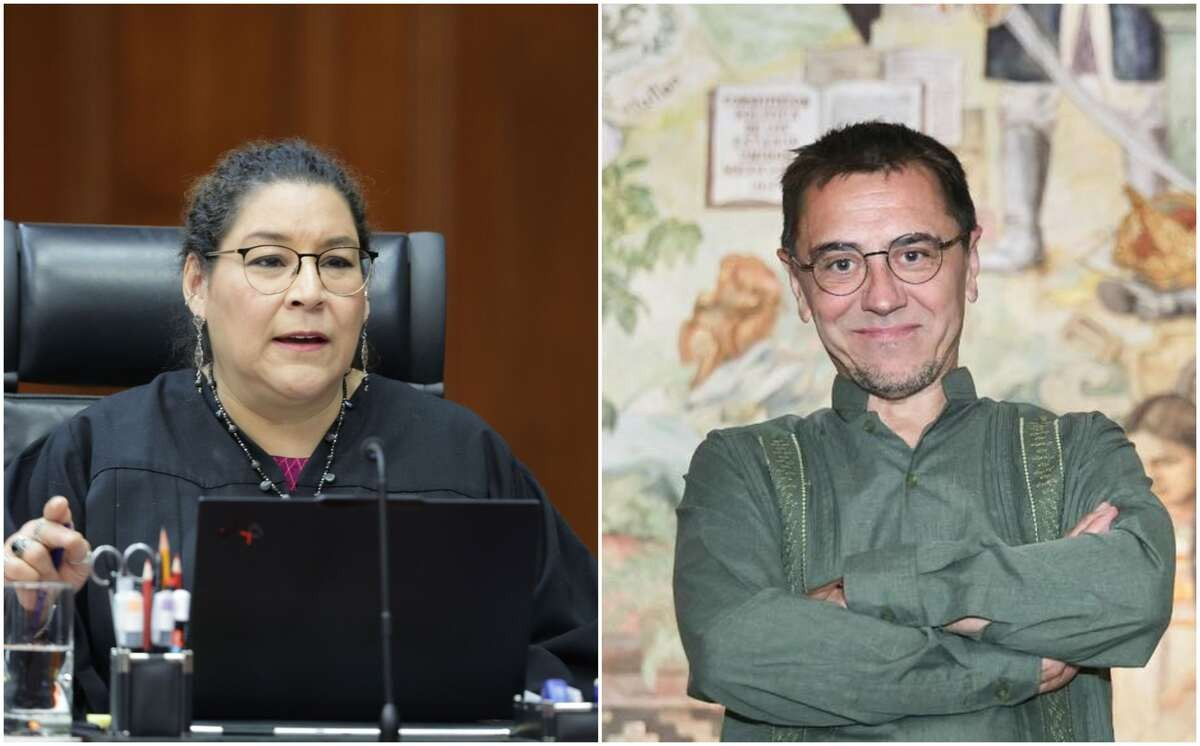

Supreme Court Justice Lenia Batres Guadarrama received Juan Carlos Monedero, a Spanish left-wing politician, founder of the Podemos party, and former advisor to Hugo Chávez’s Venezuelan government, at the court’s headquarters.
The invitation extended by the Justice allowed the foreign analyst to use the institutional space to express favorable opinions about the regime of the so-called Fourth Transformation and criticize the positions of the Mexican opposition. This situation generated questions due to recent accusations of “interference” made by legislators and spokespeople of the Morena party regarding visits by figures from the European center-right.
While various sectors of the ruling party maintained a campaign of discrediting opposition parties for inviting international political actors, the Spanish ideologue was given the floor at the Constitutional Court to comment on the country’s electoral context.
“You complained about Díaz Ayuso’s visit. We sent her for 10 days, and you couldn’t even tolerate her for 10 days. It was a small act of revenge for sending Felipe Calderón, Salinas de Gortari, and Peña Nieto to Madrid. It was a way of compensating, but you didn’t even honor the agreement for 10 days. No, no, no. It’s true that you have a touch of savagery about you,” the Spanish politician declared.
The Podemos co-founder used the Supreme Court building to point out that under the current administration, the country is experiencing a positive political landscape that serves as an example for the rest of Latin America, an intervention in the national public debate that was supported by the event organizers.
The reception given to the leftist ideologue stood in stark contrast to the conditions faced by the president of the Community of Madrid, Isabel Díaz Ayuso, who arrived in Mexico to carry out commercial and cultural activities and hold working meetings with PAN governors, including Teresa Jiménez of Aguascalientes, Mauricio Kuri of Querétaro, Libia Dennise García of Guanajuato, and Maru Campos of Chihuahua.
Although the Madrid official’s activities were part of an institutional exchange, the Spanish delegation’s organizers suspended the trip and announced their return to Europe, citing operational obstacles attributed to the federal government.
“In an unprecedented move, the Mexican government has threatened the organizers of the Platino Awards for Ibero-American Cinema with closing the complex where the awards are being held if the president of the Community of Madrid attends the event or enters the venue at any time,” stated the press release issued by the Community of Madrid delegation.
Although the Interior Ministry issued a statement clarifying that the Madrid official had full guarantees of transit and freedom of expression, the event held by the court minister reignited criticism of the double standards of the ruling party when evaluating the participation of foreign intellectuals and politicians in the country’s public spaces.

Source: politico