If you’re on the Atlantic coast and want to reach the Pacific (or vice versa), the only viable option in terms of time and distance is to pay the toll and cross the 80 kilometers of the Panama Canal. Options to circumnavigate the northern or southern parts of the continent are simply not feasible, whether due to distance, weather, geopolitics, or danger.
In fact, a few years ago, Nicaragua attempted to propose its own canal, but without success. Now, however, Mexico has put forward an ambitious project: the Interoceanic Corridor of the Isthmus of Tehuantepec. Interestingly, it’s not an artificial waterway connecting the two oceans, but rather a combination of ports and railways to connect both coasts of Mexico.
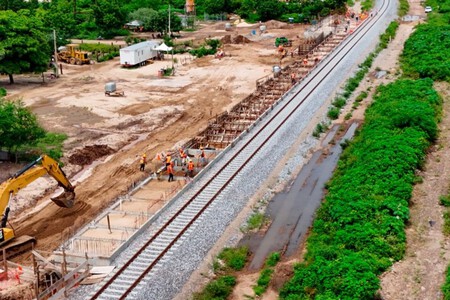
The Interoceanic Corridor of the Isthmus of Tehuantepec is a multimodal infrastructure project that combines three railway lines, totaling over 1,200 kilometers of track, including branches to two ports: Coatzacoalcos (Veracruz) and Salina Cruz (Oaxaca).
The idea is that containers will be unloaded at one port, transported by train across the country, and then re-shipped on the other side, all in less than seven hours. Its objective is to transport 1.4 million containers per year.
The federal government refers to this project as crucial for the country’s economic development for three reasons: the improvement of its railway and port infrastructure, the promotion of freight transport, and its potential to compete with the Panama Canal.
The corridor is also of paramount importance for nearshoring at a time when the U.S. market is encouraging companies to leave China in favor of closer locations like Mexico. Finally, this infrastructure will contribute to the region’s development, as it crosses 79 municipalities: 46 in Oaxaca and 33 in Veracruz.
The project includes the construction of 14 industrial parks along the corridor, forming different clusters. The government is providing logistical infrastructure and access to supplies, as well as tax incentives to encourage companies to establish themselves there.
Regarding the ports, the project envisions the modernization of all of them to strengthen their capacity and increase their depth, essential for allowing larger and more numerous vessels to dock. The Mexican government’s goal is for the Corridor to be fully operational by mid-2026. In short, in theory, it’s just around the corner.
The Corridor’s true success depends on the railway, ports, highways, and industrial parks functioning as a single, perfectly integrated and optimized system. Currently, the ports, railways, and industrial parks are progressing at different paces.
Source: motorpasion