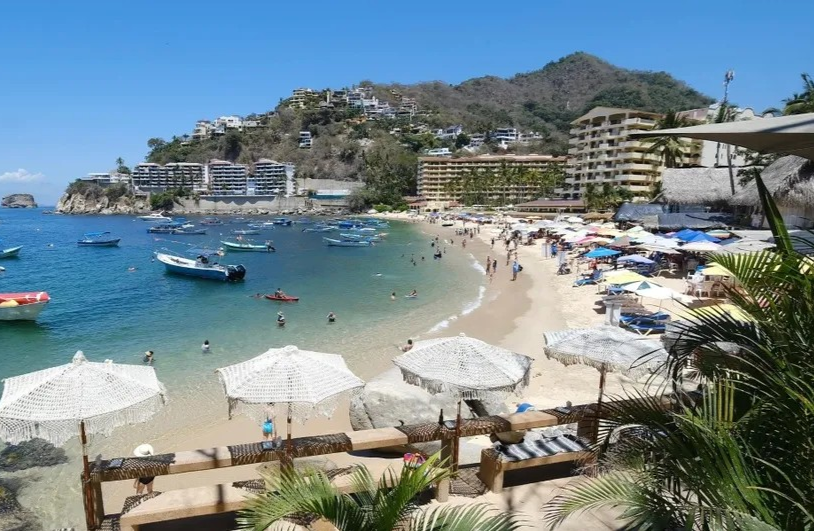

Before you see the sea, you hear the birds. The road that descends toward Mismaloya, south of Puerto Vallarta, Jalisco, narrows between trees and dampness. The sound is loud and repetitive: the chachalacas announce the dawn with a bouncing cry, as if warning that this land is still alive. The air changes, and a strip of sand opens up across the landscape, with the sea stretching out unhurriedly, in total calm.
This paradisiacal corner not only attracts tourists from all over the world, but also private interests that find in a legal loophole in its environmental protection an opportunity to take control of the territory.
For those who live here, the threat is not hypothetical. MILENIO toured this coastal town, which fears for its preservation in the face of corporate threats and the lack of legislation to guarantee its protection.
Biologists, merchants, environmental activists, tourism service providers, women who depend on beach commerce, tourists, and municipal government authorities all share a central concern: preserving free access and the ecological balance of a space they consider collective heritage.
Its name comes from Nahuatl and means “place where fish are caught with the hands,” a direct reference to the natural abundance that for generations sustained those who lived between the city and the sea.
The history of the place changed in 1964 when Mismaloya gained international fame as the setting for the film The Night of the Iguana, directed by John Huston.
The filming put the small town on the world map and marked the beginning of tourism in Puerto Vallarta. Even today, ruins of the set survive, coexisting with restaurants, boats, palapas, and trails, all overlooking one of the region’s most recognizable landmarks: the Arches of Mismaloya.
Off the coast rise these rock formations that seem to float on the sea.
Three of the Mismaloya Arches bear the following names: Rock of the Arches, Turtle Rock, and Devil’s Rock, but the arches weren’t always islands.
Those in the know say they are fragments of the Sierra Madre Occidental mountain range that, over thousands of years, were separated by marine erosion. Today, they are distinguished by the underwater tunnels and caves within them.
On the five islets located between Las Gemelas Beach and Mismaloya, pelicans, boobies, and other birds rest in their natural habitat, while underwater, fish, coral, manta rays, humpback whales, turtles, and dolphins reproduce; this attracts local and international tourism with activities ranging from diving and snorkeling to kayaking at sunrise.
“It’s an important area for diving, due to all the marine life that exists there, from manta rays and turtles to fish; it’s the beginning of a great underwater canyon,” explains biologist Astrid Frisch Jordan, president of Whale Ecology and Conservation, who emphasizes that the rock formations serve as a nesting area for birds.
This natural wealth did not go unnoticed by the State. On July 28, 1975, the federal government declared Los Arcos a Refuge Zone for the Protection of Marine Flora and Fauna, prohibiting activities that would alter the ecosystem.
The decree remains in effect and expressly prohibits the exploitation, alteration, or impact on the marine ecosystem, as well as activities that jeopardize its natural balance, but it was never officially recognized as a Protected Natural Area.
This legal loophole is now the most vulnerable point that puts the area at risk and is being exploited by private interests.
In recent years, residents have noticed a pattern: the purchase of strategic properties, the closing of access points, and the placement of fences and private property signs in areas that have historically been open to the public.
The goal, they allege, is to control the entire corridor: the beach, the viewpoint, the maritime routes, and the tourist experience.
In the background, names are emerging. One of them is Fernando González Corona, a businessman from Jalisco with experience in the real estate and tourism sectors and a stint in politics; he was a federal deputy and a pre-candidate for governor of Jalisco. In the Chamber of Deputies, he served as president of the Tourism Commission.

He arrived in Puerto Vallarta in the 1980s and initially worked as a timeshare agent, rising through the ranks to become a tourism developer, according to an online biography.
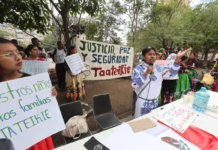
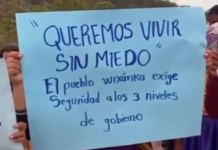
In the protest that erupted in mid-January, they partially blocked the highway and demanded the intervention of authorities. It wasn’t a spontaneous event. It was the breaking point after the placement of private property signs.
Among those who spoke was Lili Guzmán, an environmental activist and native of Mismaloya, who says she was raised between the river and the sea. Her connection to Mismaloya is both daily and inherited. She comes from a local family dedicated to community-based tourism.
“What we’re saying is that we need guarantees that the area won’t be privatized… We know the beaches belong to the nation, but we also know that they’re granted in concessions and then the concessionaires acquire power they shouldn’t have, like closing off access.”
Biologist Astrid Frisch Jordan points out that this situation directly affects protected species such as whales, manta rays, and turtles. “More than one whale is run over each season, mostly calves and mothers, reproductive females.”
Banderas Bay is a humpback whale breeding ground, where mothers seek coastal areas to protect their young. She maintains that the problem is greater than official records reflect: “We only see the tip of the iceberg. The problem is much more extensive than it seems.”
Before descending to Mismaloya Beach, the viewpoint is the first point of encounter between tourists and the landscape. From there, you can see the Arches, the open sea, and, occasionally, manta rays, dolphins, and whales.
Trucks and vans arrive constantly so visitors can take photographs while browsing the craft stalls that have sustained several families in southern Puerto Vallarta for more than two decades.
The motor of the motorboat breaks the morning silence in Mismaloya. The sea is calm, and the sun begins to reflect on the Arches, a landscape that Fermín Guzmán Zúñiga cares for every day as if it were part of his own history.
Everyone knows Fermín as “Chipol,” and he’s no guide by chance: he grew up surrounded by the water, flora, and fauna of this beach, back when there were no hotels or roads. “I was born and raised here in 1958, before all this, when it was untouched,” he says as the boat moves forward.
This paradisiacal corner attracts tourists from all over the world and private interests seeking the opportunity to take control of the territory.
Biologist Astrid Frisch Jordan points out that this situation also directly affects protected species (Photo: Courtesy). From childhood, his life has been linked to tourism. He remembers that his family started selling soft drinks to foreigners who came to the area during the filming of “The Night of the Iguana.” “We used to sell Coca-Cola to the Americans… a can for a dollar, and that’s how my family’s economy started,” he says proudly.
“Chipol” doesn’t just navigate; he watches over and protects the sea. Suddenly, he raises his voice: “There’s a whale!” Without hesitation, he points out the exact direction to his partner. The boat accelerates for just a few minutes, and right where he indicated, the dark back emerges from the water. The blowhole opens and exhales. The whale appears.
The moment confirms that “Chipol” knows the sea because he has lived it his whole life. “Underwater noise intensifies up to 1,200 times,” he explains, while keeping a watchful eye out for any other vessel getting too close.

Source: milenio