
Quintana Roo is emerging as a new breeding ground for the monarch butterfly, with up to 700 individuals in the state. This not only redefines its traditional distribution in Mexico but could also help strengthen its populations and combat its risk of extinction by opening new routes and safe areas for its development.
Previously, it was believed that oyamel fir forests were the only habitats capable of supporting this endangered species; however, the Cozumel Parks and Museums Foundation, in conjunction with the Alas Mayas organization, documented the presence of different biological stages of the monarch butterfly (Danaus plexippus) in areas such as Cozumel and Isla Mujeres.
This implies that the Mexican Caribbean, beyond being just a migratory stopover area, contains the appropriate environmental conditions for the species’ reproduction.
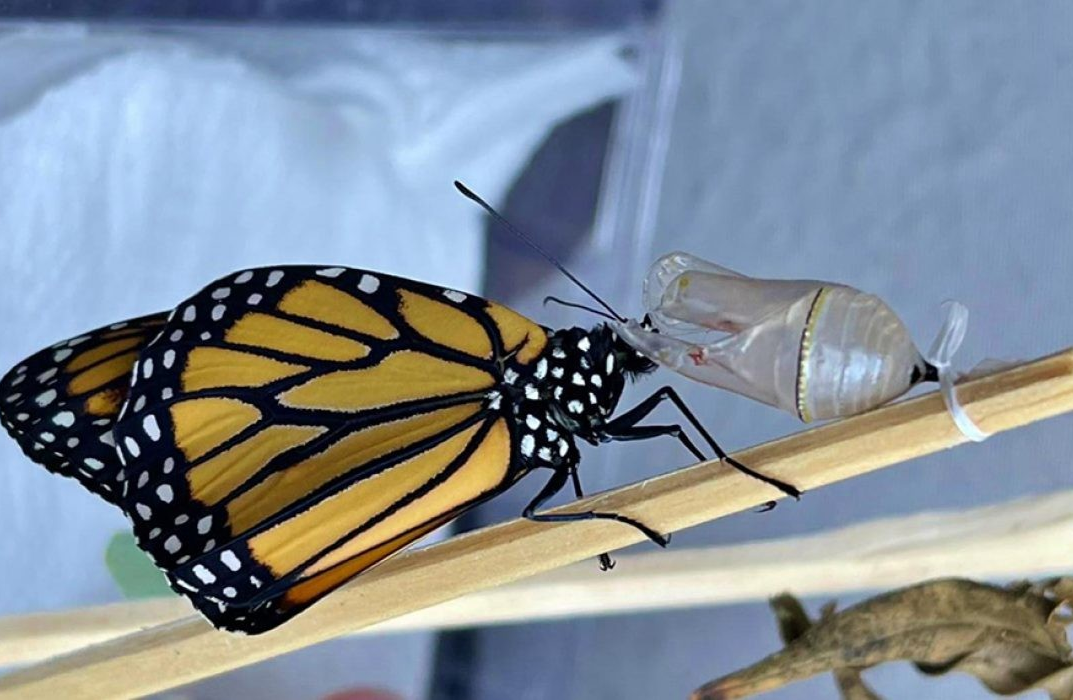
The most documented case is that of the Cozumel Flower Child Botanical Garden, where the emergence of the 30th butterfly from its chrysalis was witnessed. Therefore, in order to promote the environmental conservation of the species, the mayor of Cozumel, José Luis Chacón, announced the planting of 80 shrubs to create biological refuges within the urban area.

The space, located on Félix González Avenue, consists of an ecological corridor with plants such as Curassavica—used as food and habitat by butterflies, bees, and hummingbirds—and milkweed—which is essential for feeding caterpillars.
However, Isla Mujeres is also emerging as a new sanctuary for the butterfly; according to Yamira Yanet Ruiz Noh, Director of Environment and Ecology for the Isla Mujeres City Council, the area is prone to developing the healthy ecosystems necessary for the presence of this species.
In this regard, authorities and environmental organizations are monitoring the monarch butterfly’s movement across the peninsula. The community is encouraged to report any sightings of eggs, caterpillars, chrysalides, or adult butterflies in their gardens to strengthen the monitoring and conservation of the species in the region and thus prevent its extinction.
As part of the ongoing monitoring of the monarch butterfly’s movement across the peninsula, the community is encouraged to report any sightings of eggs, caterpillars, chrysalides, or adult butterflies in their gardens.

Source: quintanaroo.quadratin