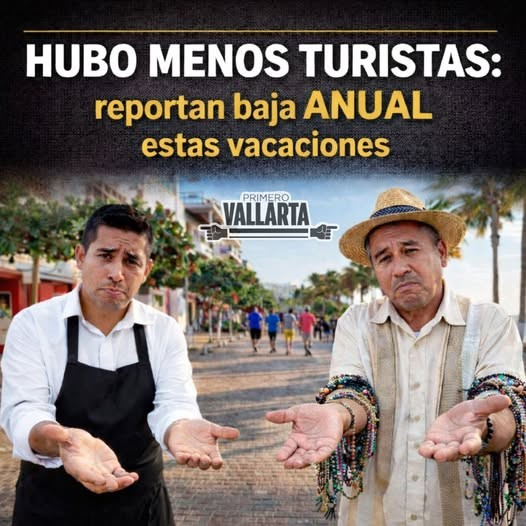

The first measurements gathered from restaurant owners, vendors, tourism service providers, and residents whose livelihoods depend directly or indirectly on tourism have sounded a new alarm in Puerto Vallarta: this year’s Easter holiday season, spanning Holy Week and Easter Week, has seen a significantly lower influx of visitors compared to last year, when a historic low for the destination was already being discussed. According to these initial reports from the sector, the general perception points to a drop of between 30 and 40 percent compared to the same period in 2025. The sentiment echoed today in commercial areas, restaurants, jewelry stores, beaches, boardwalks, and tourist service centers is not simply one of a slowdown, but rather one of a decidedly weak season for a city that relies heavily on tourism. “It was dead; we’ve had more sales on regular weekends,” said a jewelry store owner in the city center who asked to remain anonymous. The phrase starkly summarizes the atmosphere reported by various economic stakeholders: less foot traffic, lower consumption, slower sales, and commercial occupancy that failed to reach the dynamism typically expected during the most profitable days of the holiday season.
The delicate aspect of the situation is that this perception doesn’t arise after a strong season, but rather following a worrying precedent. Last year, business owners and merchants were already warning of weak numbers and atypical performance during Holy Week and Easter. The fact that the sector itself is now perceiving a new, even more severe, decline places Puerto Vallarta before a problem that can no longer be masked with optimistic pronouncements or complacent reports. When a tourist city begins to normalize bad seasons on top of worse ones, what’s at stake is not just the closure of a few businesses, but the stability of an entire economic chain encompassing employment, suppliers, transportation, informal commerce, lodging, and services.
In this context, criticism has also begun to focus on the lack of a serious public strategy to sustain and recover the destination’s tourism competitiveness. Among voices within the sector, the accusation persists that the municipal Tourism Office has become a costly and inconsequential agency, incapable of translating its existence into real campaigns for promotion, positioning, or attracting visitors. This is compounded by dissatisfaction with the state’s handling of tourism policy, perceived by some stakeholders as a series of experiments without clear foundation, while Puerto Vallarta loses momentum compared to neighboring destinations that do seem to have a market narrative, more effective institutional coordination, and a more visible promotional presence, as is the case with the Riviera Nayarit.
The underlying criticism is significant: for some in the sector, the municipal government of Luis Ernesto Munguía has shown no interest whatsoever in promoting tourism in Puerto Vallarta, while at the state level, the most visible political message has been to call for “speaking well” of the destination and ignoring the structural problems. But asking for silence or spreading optimism is not the same as promoting tourism. Promotion requires planning, campaigns, market intelligence, coordination with businesses, rebuilding trust, urban planning, security, public image, and a clear strategy to reposition the destination. Without these, Puerto Vallarta risks continuing to lose ground in the very sector that sustains a significant portion of its economy.

Source: primerovallarta