
The Director General of the National Institute of Indigenous Peoples coordinated a tour to monitor the Justice Plan in the Sierra Madre Occidental.
In San Francisco de Ocotán, Mezquital, Durango, the Director General of the National Institute of Indigenous Peoples (INPI), Adelfo Regino Montes, led a multi-day tour of the traditional territory of the O’dam and Mexikan peoples to assist displaced Indigenous families. This initiative, part of the Mexican government’s humanitarian efforts, is guided by the principle that “for the good of all, the poor come first, and especially Indigenous peoples.”
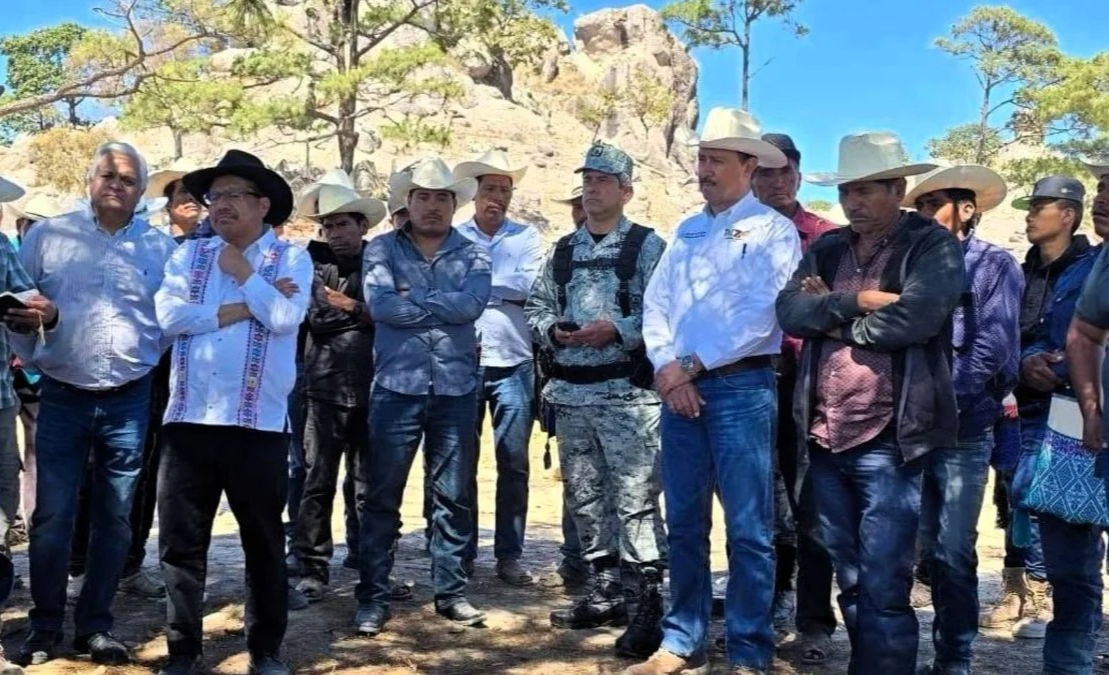
The tour was conducted with the support of members of the National Guard, INPI officials, representatives of the Durango state government, and traditional and agrarian authorities. For four days, they traveled through the Sierra Madre Occidental to listen to the communities affected by insecurity and to monitor the implementation of the Justice Plan for the O’dam, A’udam, Mexikan, and Wixárika Indigenous peoples.
During a meeting in the town of Las Botijas, part of the O’dam community of San Francisco de Ocotán, Adelfo Regino Montes explained that the purpose of the visit was to conduct an urgent assessment of the situation of displaced families, particularly in San Buenaventura and its surrounding communities located on the border between Durango and Nayarit.
The head of the National Institute of Indigenous Peoples (INPI) emphasized the need to deliver humanitarian aid, including food supplies, to isolated communities. He also reported that the state government’s health sector is addressing a measles outbreak that has resulted in the deaths of two children in the community of Los Amoles and has left three people hospitalized at the La Guajolota Hospital.
Authorities in San Francisco de Ocotán requested the construction of a clinic, as the community includes 14 outlying communities, making it essential to guarantee access to healthcare services for the entire indigenous population.
The Durango government pledged to send vaccination teams and address the request for a medical unit in the municipality as part of its healthcare efforts in the area.
The displaced traditional authorities raised the need to establish an access road to San Buenaventura through the state of Durango, given the impossibility of using the access route through Huajicori, Nayarit, due to insecurity in the area.
It was agreed that the route to be explored as a new road would be through Las Botijas, Angostura de los Aguacates, Mesa de los Gallos, and Alacranes, ending in San Buenaventura. A two-day walking tour was also planned, with the participation of community authorities, the National Institute of Indigenous Peoples (INPI), and state and municipal governments.
In response to demands for electrification, it was agreed to request that the Federal Electricity Commission (CFE) address the situation in the area, while the INPI will analyze the possibility of creating new school cafeterias to serve Indigenous children.
Federal and state authorities agreed to review the request to establish permanent bases of the Ministry of National Defense and the National Guard in San Buenaventura and its annexes to strengthen security in the territorial demarcation.

Source: reporteindigo