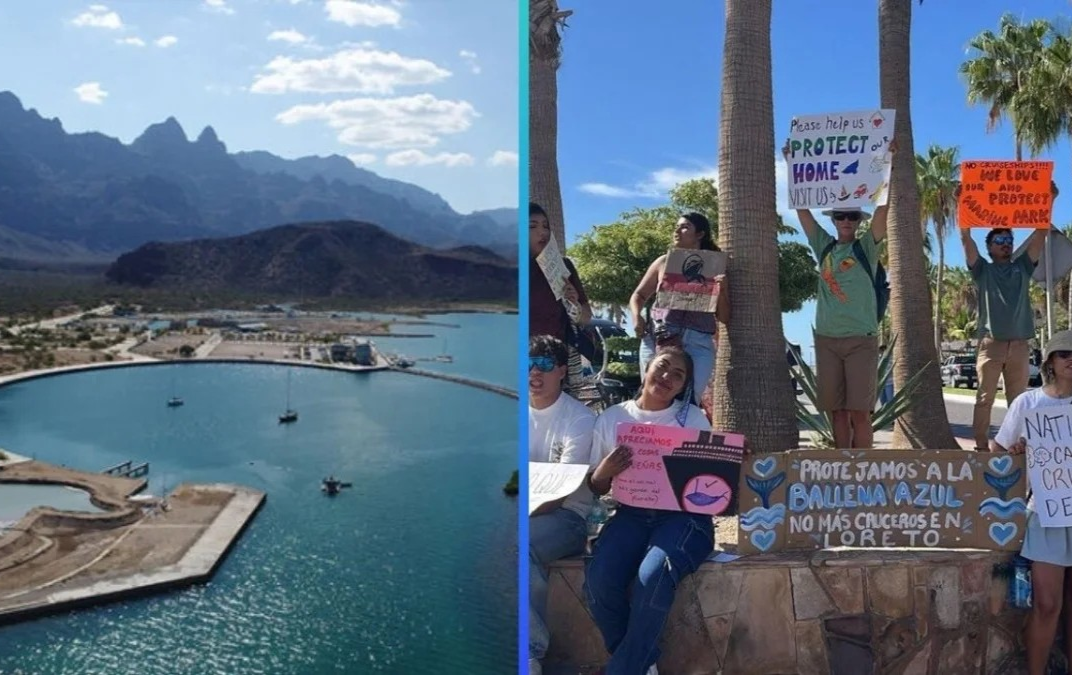

Recently, a decree was published in the Official Gazette of the Federation updating and expanding the status of the Port of Loreto in Baja California Sur. The measure responds to the growth of its maritime activity and seeks to modernize its legal framework to allow both national and international operations. However, the opening to international maritime traffic has generated uncertainty among the population.
Ebrard explains the key issues that Mexico will defend in the USMCA.
Until now, the port was classified as a cabotage port, meaning it was limited to domestic transit. With the new decree, it acquires the category of a cabotage and deep-water port, which could allow the arrival of vessels from abroad, such as large cruise ships, yachts, and cargo ships.
The federal government has justified this decision based on the increase in maritime traffic in the region and the potential to strengthen connectivity in the Pacific. The aim is to boost tourism, attract investment, and consolidate the port system as an engine of regional economic development.
With this modification, the Port of Loreto is now enabled to grow and expand its connection with international routes.
However, the measure has generated concern among residents of Loreto, who warn of potential environmental repercussions. The change could lead to an increase in maritime activities within a region of high ecological value, near the Loreto Bay National Park, a nationally important Protected Natural Area.
Among the main risks cited are the increase in polluting emissions, underwater noise, the risk of spills, and damage to marine ecosystems.
There is also concern about the pressure that mass tourism could exert on resources such as water, waste management, and local biodiversity, as well as the potential alterations to coastlines and habitats resulting from future infrastructure projects to accommodate larger vessels.
Various social sectors have publicly protested the decree, demanding its repeal, considering it unfeasible and contrary to environmental balance, as well as disregarding the will of the community.
Peaceful march held in Loreto, Baja California Sur / Photo: Social Media.
“Loreto is not just a port; it lies within the Loreto Bay National Park, a unique ecosystem home to blue whales, dolphins, and endemic species of high ecological value. The decree addresses competitiveness, investment, infrastructure, and connectivity. It opens the door to international operators, strengthens shipping interests, and redefines maritime operations. What’s at stake is not just a port change, but the economic, environmental, and social future of an entire community,” they stated.
As part of their actions, activists and civil society held a peaceful march this Wednesday at 7:00 a.m. under the slogan: “Loreto is not for sale, it must be defended.”
For her part, the mayor of Loreto, Paz del Alma Ochoa Amador, affirmed that the reclassification must strictly adhere to the guidelines of the Loreto Bay National Park Advisory Council, a body comprised of representatives from various social and productive sectors.
The councilwoman emphasized that any decision regarding the port’s operation must guarantee the protection of species, including whales, and the natural wealth that distinguishes this destination. She also pointed out that the port currently lacks the necessary infrastructure to receive large vessels.
“Large vessels will not be received because we don’t have the infrastructure, and because Loreto’s management plan does not allow actions that affect our protected natural area,” she stated.
She insisted that any decision must be reviewed by the Advisory Council, which will evaluate aspects such as carrying capacity, delimitation of tourist zones, fishing routes, wildlife protection, anchorage sites, waste management, landing times, regulation of service providers, and scientific monitoring.

Source: radioformula