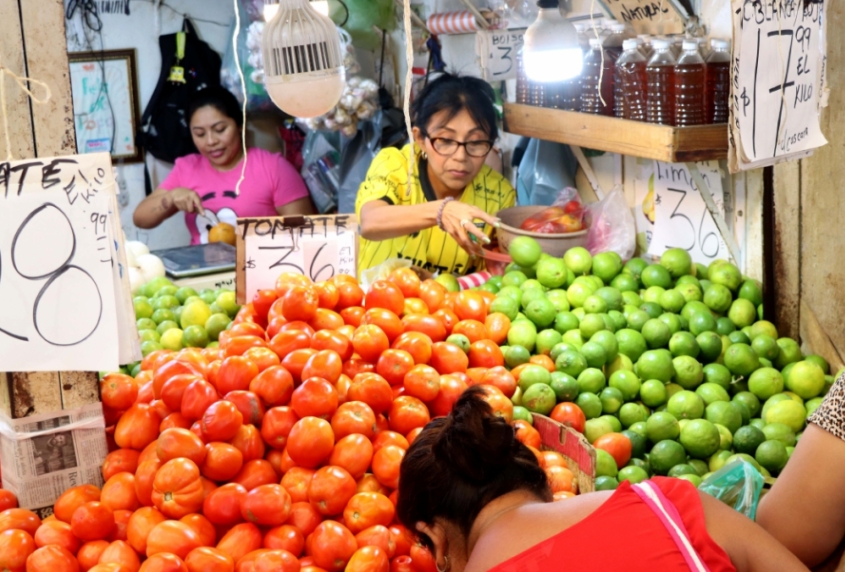

Yucatán’s economic structure means that external inflationary effects have a significant impact on its residents’ finances, to the point of steadily increasing the cost of living, particularly for basic goods, economist Gabriel Rodríguez Cedillo, PhD in Government and Public Administration, told the newspaper.
“The economic system in Yucatán depends on what comes from outside, via the central part of the country, via Mexico City. Much of what we consume comes from there. Or in some cases, it comes via Puerto Progreso, but those are very small percentages. And what Yucatán produces is minimal, it’s very little,” explains the professor at the Faculty of Economics of the Autonomous University of Yucatán (UADY).
This dependence, he says, creates a structural vulnerability to price increases originating outside the state.
“When we, as a Yucatecan economic system, depend on our resources, our goods, and what we eat from elsewhere, we are obviously very vulnerable to the direct impact of external inflationary effects.”
In this context, the specialist affirms that Yucatán has become an expensive state for its own inhabitants.
“That’s why Yucatán is a very expensive state. Very expensive for us. There’s always a constant, albeit minimal, price adjustment for goods, almost imperceptible from one day to the next, but when you count 30 days, you see the difference,” he indicates.
The phenomenon, he adds, becomes more evident in the daily experience of consumers.
“Imagine this multiplied by the thousands of products that exist in the world; we have an expensive economy, and I think we already feel it. I think you feel it when you go to the supermarket,” he says. “You no longer buy the same things you did three months ago, and you say, ‘Wow. I’m buying less than I did three months ago.’ So, we import inflation.”
Dr. Rodríguez Cedillo emphasizes that this pressure is intensified by energy factors.
“Imagine if we already have the energy problem that Mexico imports, inflation because it still has an international link to energy prices, well, imagine how that affects us,” he explained.
And this generates a cumulative effect.
“The prices of goods coming from abroad, via the central part of the country, are inflated by this international energy increase, so they arrive here with double inflation.”
Added to this scenario is what is called a “gentrification of the basic food basket,” a phenomenon that directly affects the purchasing power of the local population.
“What this phenomenon is doing is further increasing the prices of goods. And income loses purchasing power much faster and faster,” he points out.
According to the specialist, this process is not spontaneous, but rather driven by specific economic dynamics.
“This gentrification is also driven by local factors; that is, who is attracting residents? That’s the important question. What, or who, is bringing new residents? A single economic sector. The infamous real estate underdevelopment,” he asserts.
Rodríguez Cedillo questions the growth model based on the real estate sector, arguing that it generates concentrated benefits and widespread costs.
“I call it real estate underdevelopment because it generates private development for the owners, but it generates underdevelopment for the rest of the Yucatecan economy and for the inhabitants of Yucatán.”
He even emphasizes contradictions in the housing market.
“El Diario published a very interesting article stating that there is a housing deficit. But for the last 10 years, they’ve been saying we have a real estate boom. How can a housing deficit coexist with a boom in real estate development?”
For the economist, this reflects an unequal economy.
“We have an economy with completely disparate behaviors that prioritizes certain things, privatizes benefits, and socializes costs.”
At the same time, the consumer market seems to be adjusting to the new residents with greater purchasing power, to the detriment of the local population.
“In the last six months, how many good-quality supermarkets have opened? (…) with prices that really aren’t adequate, they aren’t in line with the average Yucatecan income, which ranges between 8,000 and 12,000 pesos gross per month,” he shares.
This gap between prices and income is changing consumption habits.
“What this means is that, for example, many people go to Costco and use their credit cards, but Costco has prices typical of higher-income cities.”
The doctor warns that the margin for non-essential spending is practically nonexistent for most of the population.
“The average Yucatecan doesn’t really spend much on leisure, unless they save and stop spending, or go into debt, or simply don’t spend any at all, which is the case for most of the population. The average Yucatecan who does spend on leisure does so with a credit card,” he concludes.

Source: yucatan