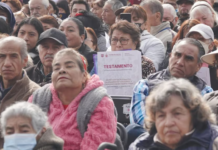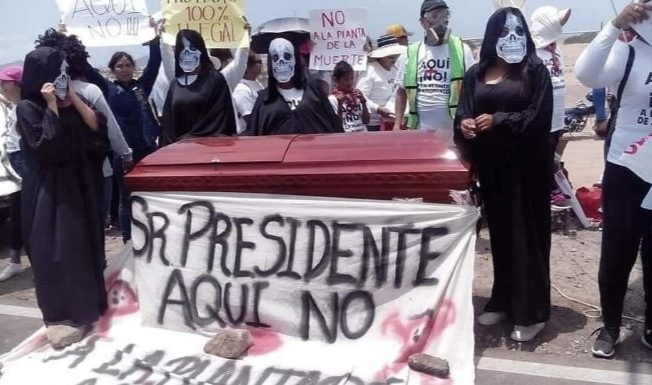

Claudia Quintero and Melina Sandoval, leaders of the ¡Aquí No! (Not Here!) movement, comprised of Mayo-Yoreme indigenous people, fishermen, service providers, and environmentalists from Sinaloa, have no doubt in their assessment of the images circulated on social media on April 23rd, showing dozens of people disrupting the inaugural event of the transnational consortium Pacífico Mexinol and toppling the pedestal where the “cornerstone” of the menthol plant stood. They assert that these images reveal the weariness of a population that has fought legally and peacefully for over 11 years for respect for their territory and way of life, against the imposition of projects that impact the bays of Santa María, Ohuira, and Topolobampo in northern Sinaloa.
The protests against the authorities’ failure to hold a public consultation with the indigenous and fishing communities that will be impacted by the methanol plant forced foreign investors and even the U.S. Ambassador, Ron Johnson, to take refuge in the private ballroom of the Fiesta Inn hotel in Los Mochis to hold the official ceremony.
After the indigenous people and fishermen disrupted the groundbreaking ceremony for Pacífico Mexinol with their impassioned protest, Johnson, in his speech, demanded of the Mexican government:
“For this investment to prosper, the private sector needs certainty, security, and an environment free of corruption. Without these conditions, investments will not move forward.”
Meanwhile, the governor of Sinaloa, Rubén Rocha Moya, invited to the groundbreaking ceremony on land unrelated to the planned construction site, was forced to travel to the port of Topolobampo to address the protesters. There, he had to commit to dialogue with Mayor Claudia Sheinbaum, given that the Ministry of the Environment and Natural Resources (Semarnat) was responsible for authorizing the construction without holding the required public consultation, as mandated by Convention 169 of the International Labour Organization and national regulations.

“There will be no groundbreaking ceremony without the proper consultation. I will tell the federal government that the plant will not proceed without this requirement,” said Rocha Moya.
With Transition Industries, owned by Rommel Gallo, as the main developer, Pacifico Mexinol has announced an estimated investment of $3.3 billion and a daily production of approximately 6,130 tons of methanol extracted from natural gas obtained through fracking in Texas.
Furthermore, it shares a partnership in design and financing structure with the International Finance Corporation and KfW IPEX-Bank, a German development bank that also finances Gas y Petroquímica de Occidente (GPO), the builder of an ammonia plant against which the Mayo-Yoreme indigenous people are litigating.
Among the company’s partners is also Macquarie Group, a global marketer of methanol, and it has indirect partners such as Mitsubishi Gas Chemical Company, Samsung E&A, and the multinational Techint Engineering and Construction, as the most visible companies.
At the local level, it is reported that among the Sinaloa investors are the Murrieta family, with businesses in agribusiness; the Valderrama family, partners in the Chepe train project; and the Elizondo family, also dedicated to agribusiness, all of whom wield significant economic and political power in the state.
Melina Sandoval, a Mayo-Yoreme leader displaced from her homeland due to threats stemming from her defense of the territory, warns that what happened on Thursday, April 23, was the result of a series of abuses against Indigenous communities, despite their having resorted to the courts for over 11 years to demand respect for their territory and fishing as a way of life.
“People are very upset, very angry. Today (Thursday the 23rd) they told me, ‘Let’s go inside and disrupt the event; that’s the only way we’ll achieve anything. What’s the point of us being there peacefully while they’re celebrating and achieving their goals?’ And the barriers were opened, and people were let in. So, it’s something we can no longer stop,” says Melina, who was present at the demonstration as a leader of the ¡Aquí No! (Not Here!) movement.

In an interview, she recalls that the struggle of the indigenous people of northern Sinaloa has always been waged “with the weapons of the law,” against the industrial projects Gas y Petroquímica de Occidente (GPO), an ammonia plant financed by Germany and Switzerland, and Pacífico Mexinol, a conglomerate financed by the United States, Germany, South Korea, and Italy.
“All we ever sought was for this to be peaceful, but seeing that even the laws are no longer protecting us, seeing that the words written down guaranteeing our rights are just words on paper because they have been violated, seeing that the law is merely fiction, well, we understand the weariness and frustration of the people; it’s now clear to them that the Yoreme people will be there, preventing them from working,” Melina points out.
The great frustration of the residents and fishermen of this region also stems from the fact that the event, which was planned to take place several kilometers from the site where Pacífico Mexinol is scheduled to be built, occurred practically after the Fifth District Judge, Enrique Parada Ser, refused to grant a definitive suspension of injunction 255/2026, filed by the indigenous fishermen’s cooperative of Paredones on March 18, precisely because of the lack of consultation.
Founded in 1942, the Eustaquio Urías Fishing Cooperative, which also has an injunction pending against GPO, holds a concession until 2041 for the extraction of seafood from Ohuira Bay, an economic activity on which 942 families depend, as acknowledged by Pacífico Mexinol in its Environmental Impact Statement (EIS) submitted to Semarnat (the Mexican Ministry of Environment and Natural Resources).
The fishermen had obtained an initial ruling on April 7, granting a provisional suspension in their legal action against the General Directorate of Environmental Impact and Risk (DGIRA) of the Ministry of Environment and Natural Resources (Semarnat). The DGIRA had authorized the construction of the methanol plant without conducting the required Indigenous consultation, despite the company’s documentation demonstrating the impact on the fishing region.
On April 21, two days before the thwarted event, Judge Parada Ser, who, while in office, submitted himself to the electoral process of June 1, 2025, denied the permanent suspension, arguing that “there is no proof of the harm” that Pacífico Mexinol could cause to the Indigenous fishermen. The fishermen had submitted “three written arguments (…) in which the damage to fishing and Indigenous territory is scientifically proven,” evidence which the judge disregarded, the fishermen emphasized in a statement the day after the ruling.
Claudia Quintero, an Indigenous leader and member of the ¡Aquí No! movement, elaborated in an interview that the court ruling contains procedural irregularities and is even discriminatory.
“He (the judge) wants us to prove the harm. How can we prove harm if the company isn’t even up and running yet? That’s illogical and discriminatory, and it violates our right to a precautionary measure. How is it possible that I have to pay for an environmental impact study to prove to a judge that it will harm me?”
“He even discriminated against us, saying we’re just fishermen, that there’s no archaeological evidence to prove we’re an Indigenous community. He’s violating my right to self-identification. We’re going to file an appeal with the Collegiate Court of Mazatlán. We’re going to keep fighting,” Quintero asserted.

Source: proceso