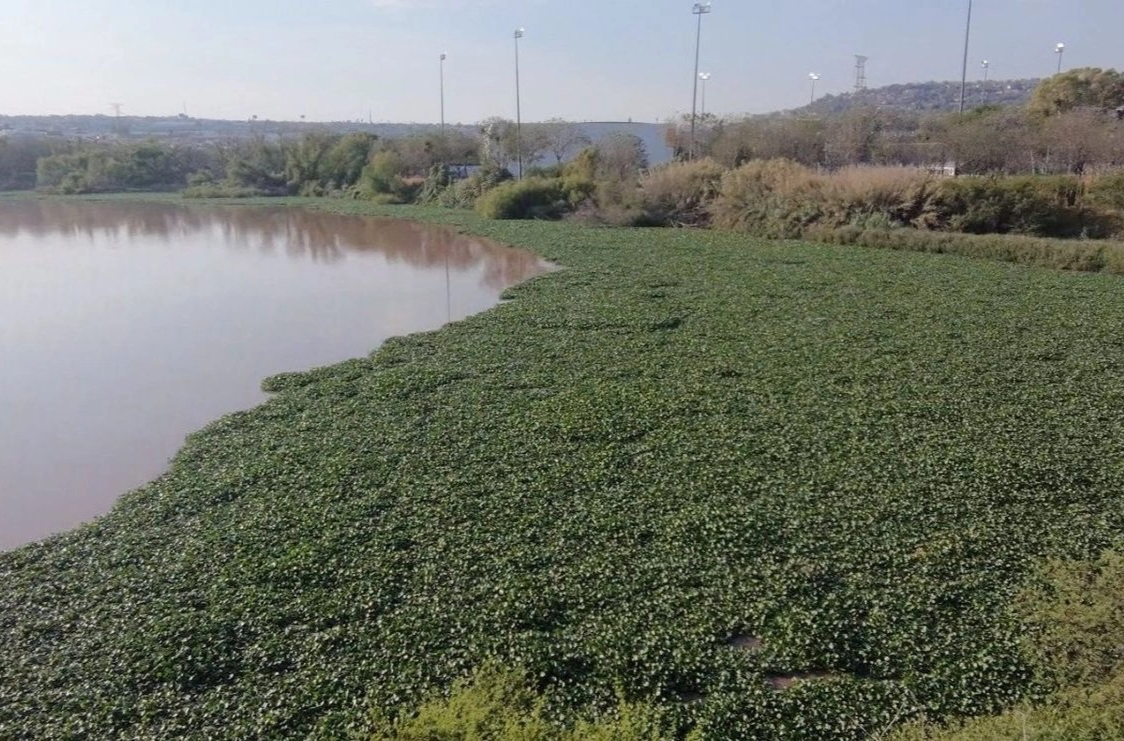

A mosquito infestation detected since November of last year continues to affect more than 30 neighborhoods in the northern part of the state capital due to the mismanagement of water hyacinth in the Benito Juárez embankment, located in Querétaro 2000 Park, residents reported. They accuse municipal authorities of neglecting the problem, and with the heat, the insect population has increased, along with the resulting health problems.
Eduardo López, a resident of the Constituyentes neighborhood, told La Jornada that it is a mosquito infestation “that we detected last November and that got out of control due to the lack of attention from the authorities.”
The presence of the insects, he explained, is due to stagnant water where water hyacinth is growing along the Benito Juárez embankment in Querétaro 2000 Park.
“There are also a large number of mosquitoes and flies because it’s no longer just rainwater; it also includes—although we don’t know the quantity or if it’s being discharged clandestinely—sewage from homes or government drainage systems, including schools at all levels,” he stated.
He recalled that they reported the problem in December 2025, but “they only told us to send letters to the State Health Department and the city council so they could fumigate the area; on April 28th, I returned to file another report and they told me the same thing, but no one came.”
Desperate and curious to know how many neighborhoods are suffering from the infestation, Eduardo López created a WhatsApp group, which now has nearly 950 members, “and don’t doubt that we’ll end up with a thousand.”
Due to the city council’s inaction, those affected decided to direct their demands to the state governor, Mauricio Kuri González, a member of the National Action Party (PAN), along with signatures from health specialists. “A marine biologist gave us his professional opinion regarding the problem,” stated Eduardo López.
Meanwhile, “the authorities told us that they had already analyzed the mosquito and that this species does not spread diseases; however, specialists and affected residents have said that they do transmit illnesses,” he expressed.
He emphasized that the residents decided to fumigate their homes, but this can cause poisoning, according to experts. “Perhaps they haven’t gotten dengue, Zika, or chikungunya, but people in the group have sent me photographs of children and elderly people with welts caused by mosquito bites,” he asserted.
The resident insisted that they have requested the local government address the root of the problem and not just implement a 60-day fumigation solution.
“We want a comprehensive solution, including cleaning the water hyacinth from the riverbank and an agreement to keep the storm drains clean so that wastewater can be properly disposed of. There needs to be environmental monitoring and control in the area, but most importantly, a thorough cleaning is needed,” he stated.
“The water hyacinth they removed was simply tossed aside to dry, but the moisture only created breeding grounds for more mosquitoes,” lamented Eduardo López.
Meanwhile, the Querétaro State Institute of Sports and Recreation announced in a statement the closure of the jogging track at Querétaro 2000 Park from May 1st to 4th, due to mosquito control measures and the removal of water hyacinth from the park’s water feature.

Source: jornada