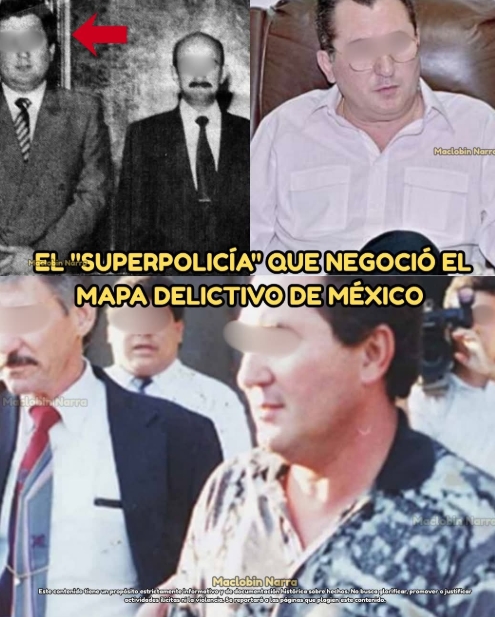

In the 1980s and 90s, the line between law enforcement and illicit activity became almost invisible. At the heart of this phenomenon was Guillermo González Calderoni, a figure who not only wore a badge from the Federal Judicial Police but also operated with a logistical sophistication that made him a key player in the system. Educated and with outstanding operational skills, he represented an era in which law enforcement was, on many occasions, a management tool for criminal organizations.
His role within the state apparatus was that of a strategic mediator. González Calderoni did not limit himself to making arrests; he managed who could operate and who had to be eliminated. A clear example was the neutralization of Miguel Ángel Félix Gallardo in 1989. Although the world saw it as a victory for justice, the operational reality suggested a shift in protection strategy: one leader was eliminated to facilitate the rise of other emerging organizations. His job was to use state resources to regulate the illicit drug market, eliminating the competition from his current allies.
This duality allowed him to accumulate economic power that defied any institutional logic. However, wielding power outside the ethical framework comes at a very high personal security cost. After becoming an obstacle to the system he himself helped build, he fled to the United States seeking refuge. His life in exile ended abruptly in February 2003 in McAllen, Texas. While in his vehicle, he was the target of a professional takedown that closed one of the darkest chapters in the relationship between the police and criminal organizations.
The institutional consequence of his actions was a profound crisis of credibility within law enforcement agencies. His story demonstrated the fragility of public trust when those in charge of maintaining order use their credentials as a ticket to the criminal underworld. The fragmentation of the judicial police following these scandals taught us a lesson about the importance of internal controls and transparency in preventing the law from being hijacked by private interests.
The González Calderoni case invites us to reflect on the inevitability of consequences when one plays both sides of the law. In the end, no institutional protection lasts forever, and the past often catches up with those who try to arbitrate a game where the rules don’t exist. His story is a reminder that true security doesn’t depend on individuals with absolute power, but on solid institutions that don’t allow the uniform to become a mask for illegality.
Do you think the current professionalization of the police has completely eradicated these figures who operate from within the system? 👇
This content is for informational and historical documentation purposes only. It does not seek to glorify, promote, or justify any illicit activity.
Source: mexicodailypost