
Yucatán Week in Mexico City 2026 kicked off today at the Palacio de los Deportes (Sports Palace) in Mexico City, where artisans, musicians, chefs, and others showcased the rich cultural heritage of the state of Yucatán.
The event was inaugurated with the presence of Governor Joaquín Díaz Mena and other state and federal government officials. The governor emphasized that the Mayan Renaissance promotes culture with the more than 270 exhibitors from 20 municipalities participating in this event, which runs from May 8 to 17. Gastronomy, textiles, and other products will be on display and available for visitors.
Governor Díaz Mena stated that Yucatán Week in Mexico City 2026 is a vibrant experience that brings together micro, small, and medium-sized businesses, as well as producers and artisans. “It’s about understanding that being Mayan is not a memory of the past, but a living culture of the present, with its sights set on the future and pride in its roots.”
During the meeting, the Secretary of Tourism, Josefina Rodríguez Zamora, the Secretary of Tourism for Mexico City, Alejandra Fraustro Guerrero, and the Undersecretary of Tourism for the Government of Mexico, Nathalie Desplas Puel, were present. Desplas Puel emphasized that this celebration represents more than a cultural fair; “it is a bridge of identity that brings the historical, tourist, and cultural richness of Yucatán closer to thousands of people.”
Desplas Puel stated that “today, the Sports Palace becomes an embassy of the flavor, warmth, and history of Yucatán. The state is not only a world-class tourist destination but also a pillar of culture and an essential engine of our country’s tourism industry. I would like to share some compelling figures.”
He also pointed out that Yucatán is one of the country’s most important tourist destinations and serves as a fundamental engine for the national tourism industry. “During the first quarter of 2026, the state received nearly one million tourists, supported by an infrastructure of more than 700 tourist establishments that generate thousands of direct and indirect jobs.”
Also present were the director of the National Commission for Physical Culture and Sports of Mexico, Rommel Pacheco; the general director of the National Lottery, Olivia Salomón Vibaldo; the Secretary of Tourism Development of Yucatán, Darío Flota Ocampo; the National President of the Mexican Chamber of the Construction Industry, Luis Rafael Méndez Jaled; the executive director of the Mexican Institute of Industrial Property, Santiago Nieto Castillo; the president of the Business Coordinating Council and of the National Chamber of Commerce, Services and Tourism of Mérida, José Enrique Molina Casares; the general director of CONALEP, Rodrigo Alejandro Rocas Navarrete; among others.
The program featured Yucatecan painter Víctor Argáez and a musical performance by the Yukalpetén Traditional Orchestra before and after the opening ceremony.

Guayaberas and Ternos
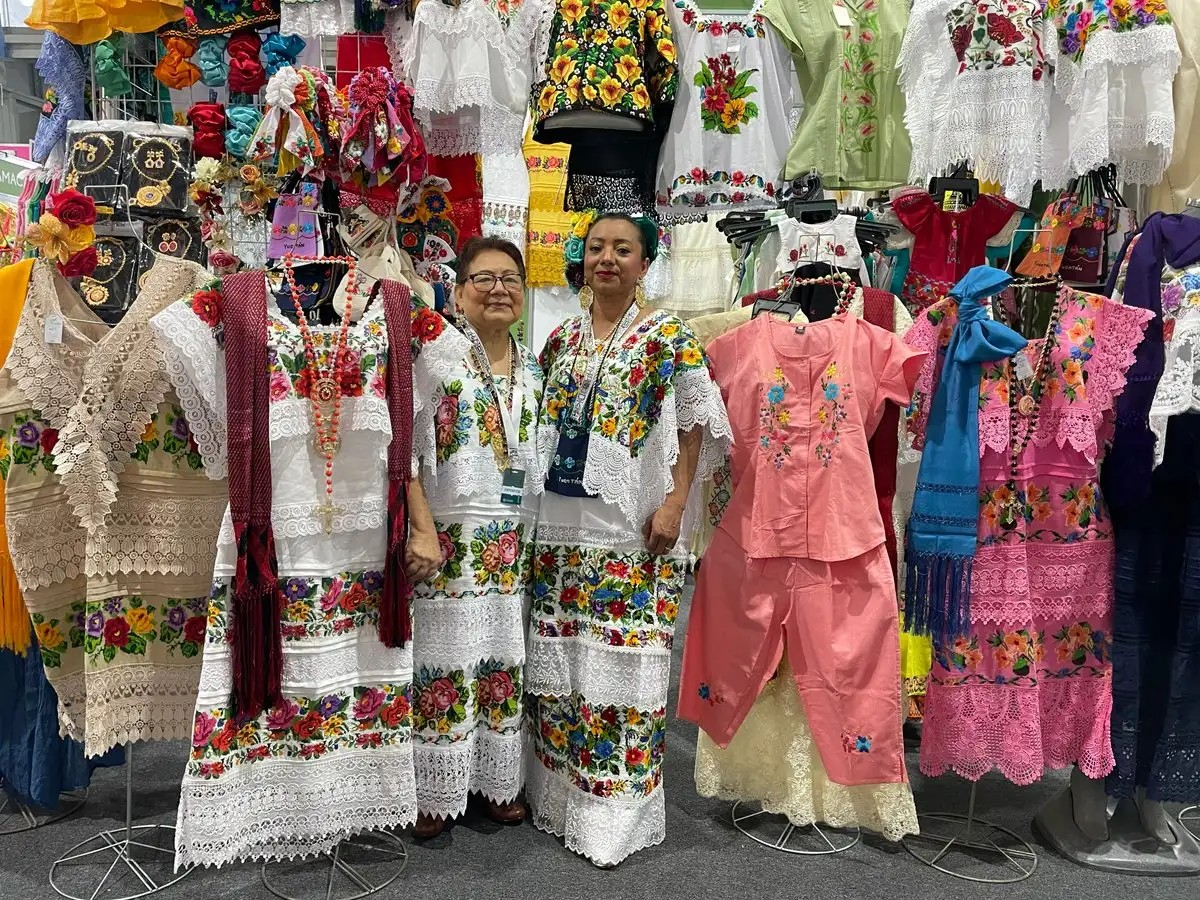
In an interview with La Jornada, María Anastasia Couoh, who runs her kiosk called Anita, explained that most Yucatecan garments are more special because they are handmade from linen fabric. “We make ternos, dresses, huipiles, rebozos, among other things, but each one takes at least three months to make, whether it’s a size 34 or 46. There are special garments for events; women’s garments are multicolored, incorporating almost every color, but we can also make them in a single color. The huipil is also widely worn for celebrations, often adorned with flowers. Many people add a headdress, a ribbon, and earrings; it’s a way of honoring the occasion.”
While the manager of the Guayaberas D’ake stand pointed out that this garment comes from Cuba and that the thin fabric is cool due to the high temperatures, “we in Yucatán wear it for cultural and traditional reasons, for special events like this one, which, by the way, is Guayabera Day, celebrated on March 21st.”
Gastronomy
Lilián Correa of the Colonos restaurants mentioned that the state of Yucatán has a wide variety of dishes prepared in different ways, “we are very rich in gastronomy and culture. The most emblematic dishes are cochinita pibil, poc chuc (sliced pork), panuchos, and lechón (roast suckling pig). We have many pig farms in Yucatán; it is the main protein source. We also have options for those who don’t eat meat, such as chaya empanadas, notable for their corn dough mixed with chopped chaya leaves and filled with Edam cheese, as well as lime soup.”
Correa explained that papaya candy is also a delicious but lesser-known dessert. “In Yucatán, we have an incredible variety of dishes; it’s not a standardized cuisine. There are many ways to prepare it: charcoal-grilled, wood-fired, buried and smoked, and so on. It’s often wrapped in a banana leaf, which intensifies the flavors.”
Honey
At the Grupo Apícola shop, Carlos Koyoc indicated that honey is one of the main products with the highest production in the state of Yucatán and at the national level. “In Yucatán, there are about 8,000 beekeepers, and among them are generations like mine, who have been involved in this tradition for 50 years. We are a cooperative in the community of Texán de Palomeque, and this honey is different because of the flora and fauna; that gives it its unique flavor and value.”

Source: jornada