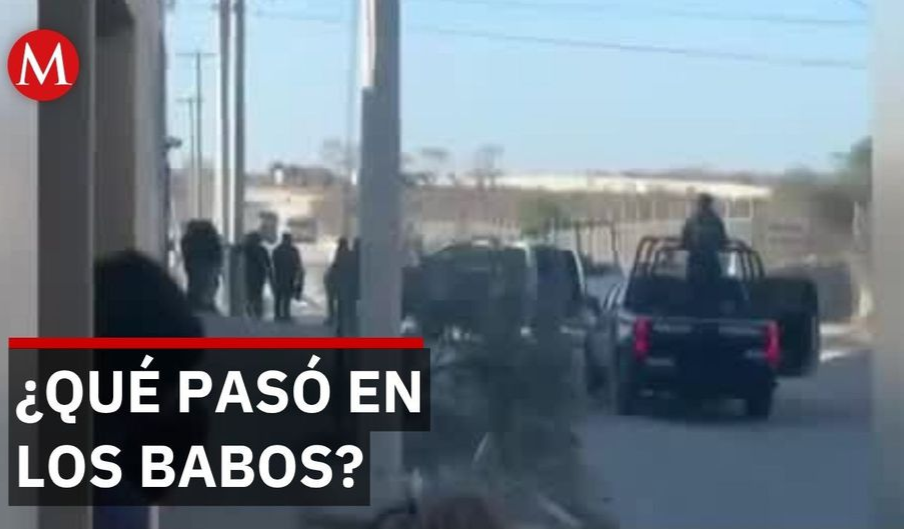

On the night of May 30, residents of the municipality of Los Cabos, in Baja California Sur, shared multiple videos on social media capturing a series of attacks in the locality of Santa Anita.
According to reports from the State Security Board, the outbreak of violence resulted in the death of a US citizen and left seven people injured, including two members of the Secretariat of National Defense (Defensa). What is known about the case? Here are the details.
What was the toll of the shootout in Los Cabos?
Around 11:00 p.m. on May 30, military personnel from Defensa patrolling the San José del Cabo area became aware of firearm detonations on the Benito Juárez Transpeninsular Federal Highway, in the vicinity of the locality of Santa Anita.
Upon reaching the site, the uniformed personnel were attacked by armed individuals traveling in various vehicles, triggering a confrontation. Among the units used by the armed civilians, according to the State Attorney General’s Office (PGJE), was a recent-model gray Dodge Ram showing multiple bullet impacts.
During the exchange of gunfire, two soldiers aged 20 and 25 were injured, as well as five civilians who were in the area, including two women (aged 65 and 43), a 36-year-old man, and a 14-year-old minor.
“Additionally, a man originally from California, United States, was injured in the events and unfortunately lost his life during the early hours of this Sunday [May 31],” established an initial report from the State Security Board.
In the hours following the shootout, the PGJE confirmed the opening of an investigation file for the crimes of qualified homicide and attempted qualified homicide.
Two suspected participants in the shootout arrested
Following the attack recorded in Santa Anita, state and federal personnel deployed preventive and reconnaissance operations that led to the seizure of firearms, tactical equipment, and the arrest of two suspected participants at different locations in the entity.
In a property within the Oasis neighborhood of San José del Cabo, a man originally from Mexicali, Baja California, was arrested while in possession of two long firearms, tactical equipment, and a Suburban-type vehicle.
Subsequently, at another residence in San José del Cabo, authorities confiscated 47 plate-carrier vests, 62 ballistic plates, a rifle, 19 cartridges, two banknote counters, and 14 communication radios.
A third operation took place in the Montereal neighborhood, where a long firearm, two magazines, and suspected explosives were seized. A second person, considered a generator of violence in the region, was arrested at the same site.
Baja California Sur: A region disputed by Sinaloa Cartel cells
In July 2025, the National Urban Public Security Survey (ENSU) revealed that the perception of insecurity in La Paz and Los Cabos, two of the main tourist destinations in Baja California Sur, grew noticeably.
In the case of La Paz, 36.7 percent of the surveyed population reported feeling unsafe, compared to the 27.8 percent recorded in the previous quarter. In Los Cabos, the percentage jumped from 24.7 to 36 percent, according to data disclosed at that time by the National Institute of Statistics and Geography (Inegi).
A couple of months before the survey results were revealed, the United States Embassy and Consulates in Mexico issued a travel advisory for their citizens in Los Cabos and La Paz to take precautionary measures, as multiple murders, shootouts, and threats broadcasted by criminal groups were recorded within a span of a few weeks.
It is presumed that one of the episodes driving the escalation of violence occurred on April 16, 2025, when an armed attack was carried out targeting a stepson of René Bastidas Mercado, alias El 00, identified as an operator for Los Chapitos of the Sinaloa Cartel.
Later, on April 22, Ulises Omar Cota Montaño, a commander of the Ministerial Criminal Investigation Agency (AMIC), was murdered. In subsequent days, local authorities found various drug banners (narcomantas) attributing the crime to Abraham Cervantes Escárrega, alias El Babay, an alleged lieutenant of Los Mayos—a rival faction of Los Chapitos.
El Babay was arrested in 2017 and identified as a supposed member of the Jalisco New Generation Cartel (CJNG). However, in April 2025, it was revealed that this man had regained his freedom and was operating as an ally of Los Mayos.
The apparent connection between this criminal cell and the crime against the AMIC commander was confirmed on April 25, 2025, by Omar García Harfuch, head of the Secretariat of Security and Civilian Protection (SSPC).
On that date, the official announced the capture of Marcos Iván ‘N’, alias Marquitos, and six of his alleged accomplices. Presumably, Marquitos acted as the leader of a group linked to Los Mayos with a presence in Los Cabos and La Paz, responsible for the murder of Cota Montaño.
In statements highlighted by journalist Diego Soto, Governor Víctor Manuel Castro Cosío acknowledged that the public security strategy in Baja California Sur had experienced failures and that it was necessary to redouble efforts in the matter.
In addition to the acts of violence framed within the dispute between Los Mayos and Los Chapitos, various search collectives have reported in recent months the discovery of clandestine graves and human remains in municipalities such as La Paz, Los Cabos, and Comondú.
Source: milenio