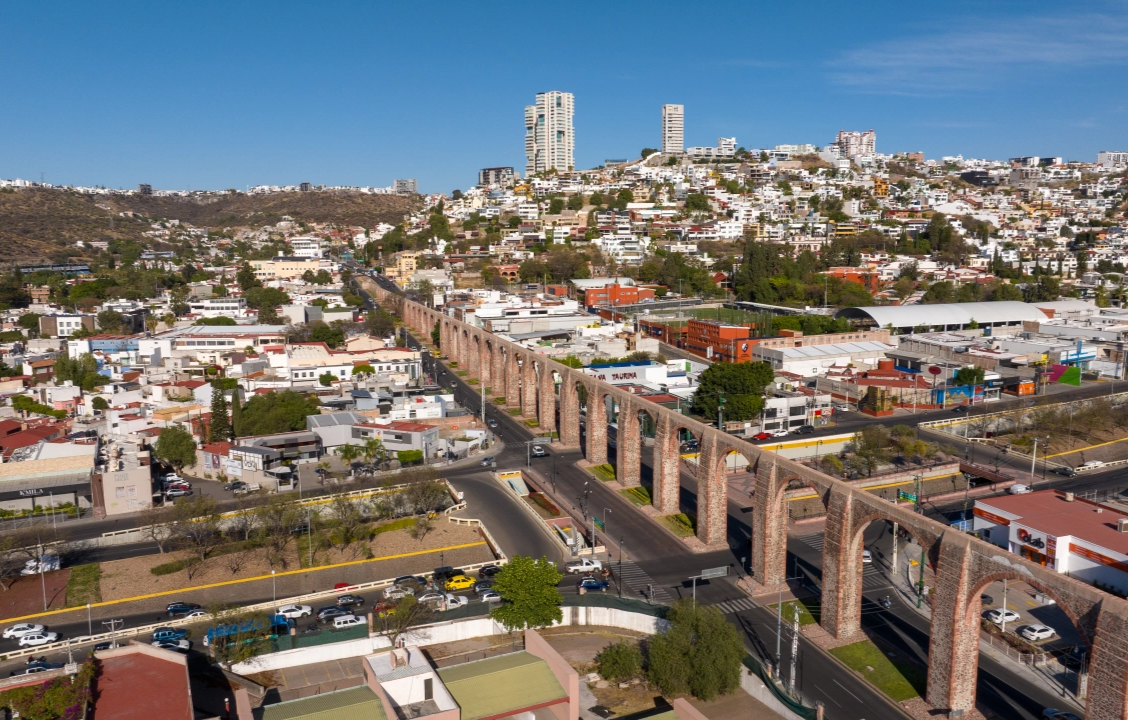

The Querétaro metropolitan area—comprising the municipalities of Corregidora, Huimilpan, El Marqués, and Querétaro—has solidified its position as the most competitive large urban area in Mexico, according to the 2026 Urban Competitiveness Index (ICU), which assesses cities’ capacity to generate, attract, and retain talent and investment.
For this study, the Mexican Institute for Competitiveness (IMCO) evaluated 72 relevant metropolitan areas across the country on a competitiveness scale of Very High, High, Upper-Medium, Lower-Medium, Low, and Very Low. This scale was determined by their performance on six sub-indices that measure challenges in the urban environment.
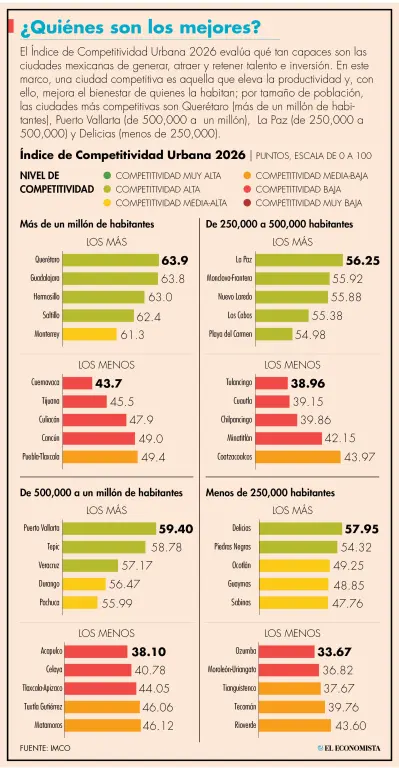
Querétaro was rated as High competitiveness and moved up two positions in the ranking, which includes 21 cities within the category of cities with more than one million inhabitants. This segmentation “allows for the presentation of results in comparable urban contexts.”
The greatest improvement was seen in the Society and Environment indicator, where it moved from 13th to 5th place due to its average schooling of 11.77 years, as well as its medium-high performance in solid waste management, water consumption, and 73.25% educational coverage.
It received the highest score in the Political System and Government sub-index because 61.9% of its total income is self-generated and 69.9% of adults consider corruption to be frequent; it also scored highly in the Innovation and Economy sub-index.
Guadalajara, despite having the same score, dropped to second place in the ranking compared to the previous year; it obtained second position in the Innovation and Economy sub-index for contributing the highest number of patent applications with 7.8 per 100,000 inhabitants, and an economic diversification of 884 sectors.
Hermosillo and Saltillo completed the podium of large cities with high competitiveness. The Sonoran metropolitan area ranked highly in the Labor Market sub-index, with an average wage of 556 pesos per hour worked, the fifth highest.
Saltillo achieved the best indicators in Law, with a homicide rate of 3.2 per 100,000 inhabitants and 0.4 stolen vehicles per 1,000 registered.
Meanwhile, the Mexico City metropolitan area dropped four places in the Competitiveness Index (ICU) as its rating fell to Medium-High, placing it 10th in its category, behind Monterrey, Mérida, Chihuahua, Aguascalientes, and San Luis Potosí, and ahead of La Laguna.
Mexico City “does not deteriorate in absolute terms” thanks to its leading position in economic diversification and use of financial services, registering 4.5 bank cards per adult, the highest in the Infrastructure sub-indicator.
Juárez, Mexicali, León, Morelia, Toluca, and Puebla-Tlaxcala were ranked as having medium-low competitiveness. Cancún, Culiacán—which “dropped four places in the ranking due to the rise in insecurity since the end of 2024”—Tijuana, and Cuernavaca were rated as having low competitiveness.
Puerto Vallarta, Tepic, and Veracruz were ranked as the metropolitan areas with populations between 500,000 and one million with high competitiveness, out of a group of 17. Among the 23 cities with populations between 250,000 and 500,000, La Paz, Monclova-Frontera, Nuevo Laredo, Los Cabos, and Playa del Carmen were rated as having high competitiveness. Of the 11 cities with fewer than 250,000 inhabitants, only Delicias and Piedras Negras were rated as having high competitiveness.
The Infrastructure and Political System and Government sub-indices showed improvements in digital connectivity, provision of basic services and fiscal autonomy; in contrast, the average economic growth of metropolitan areas fell from 4.1 to 2.4% compared to the previous edition, violence intensified and the perception of corruption remains at high levels.
Source: eleconomista