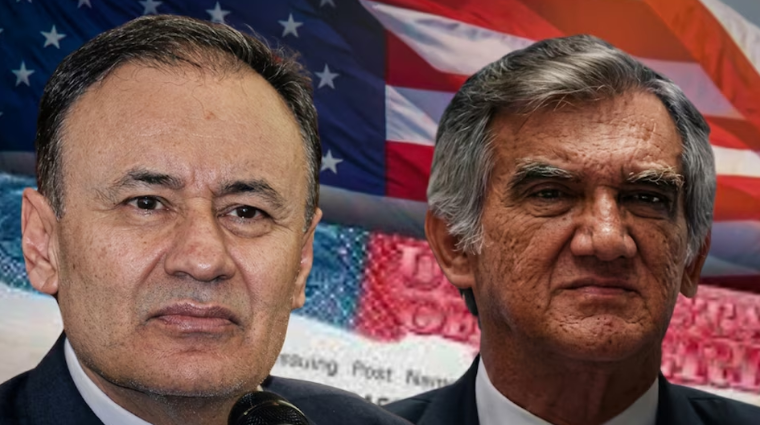

The U.S. Department of Homeland Security (DHS) officially denied that the governors of Sonora, Alfonso Durazo, and Tamaulipas, Américo Villarreal, have been granted special entry permits known as “parole,” thus refuting previous reports that both officials had received this immigration benefit after their visas were canceled.
The confirmation came in response to a formal information request from La Opinión. The agency responded via email with the full last names of both governors—a detail that clarifies any ambiguity about who the inquiry referred to.
“Francisco Alfonso Durazo Montaño and Américo Villarreal Anaya have not been [granted such permission],” the DHS stated.
Significant Public Benefit Parole is a discretionary immigration authorization that allows foreigners to enter or remain temporarily in the U.S. without a visa, provided their presence represents a recognized benefit to the government, the public interest, or national security. Only three agencies can grant it: USCIS, CBP, and ICE, and all three were consulted for this response.
The controversy erupted after a Los Angeles Times report claimed that Washington had revoked the visas of both governors and, simultaneously, granted them this special entry permit. Journalist Steve Fisher, author of the investigation, stated that Villarreal entered U.S. territory through an official port of entry and was escorted by officials, although he clarified that he could not confirm whether the Tamaulipas governor was cooperating with any investigation.
Regarding visas, both the DHS and the State Department referred each other, although the latter clarified that visa review is an ongoing process: if new and potentially unfavorable information about a visa holder emerges, a consular officer can determine revocation.
This Monday, during her morning press conference, Mayor Claudia Sheinbaum was questioned about the case and responded with a rhetorical question: “That’s a good one, isn’t it?”
In her Monday morning press conference, the mayor maintains that a U.S. government institution denies the existence of this authorization linked to 2023 data and asserts that the version is false.
In response to another related question, Sheinbaum attributed the spread of these narratives to “far-right sectors” in both countries, whom she accused of seeking to damage the bilateral relationship. He indicated that the objective would be to influence both the November elections in the United States and the 2027 Mexican elections. He dismissed the notion that this represents a unified stance by the Donald Trump administration and pointed out that media outlets such as The New York Times and the Los Angeles Times have systematically constructed a negative narrative toward Mexico.
This episode unfolds against a backdrop of escalating bilateral tensions. The Trump administration has intensified its pressure against organized crime in Mexico and filed charges against 10 Mexican politicians, including the former governor of Sinaloa, Rubén Rocha Moya. The Mexican Attorney General’s Office rejected his preventive detention, deeming the evidence presented insufficient.
Meanwhile, the former Secretary of Public Security of Sinaloa, retired General Gerardo Mérida Sánchez, voluntarily surrendered to U.S. authorities and is facing trial in the Southern District Court of New York, where he pleaded not guilty.
Source: infobae