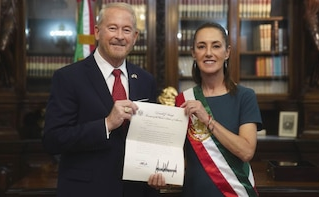

The United States Ambassador to Mexico, Ronald Johnson, reported on Monday that since Donald Trump began his second term in January 2025, his administration has transferred 313 individuals wanted by Mexican authorities so they could face legal proceedings in Mexico.
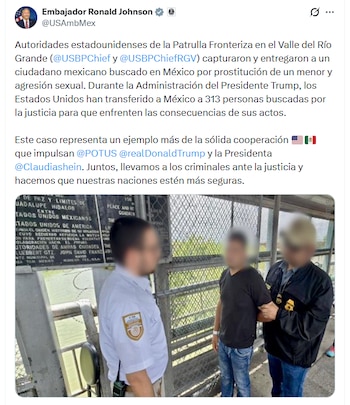
The announcement was made through his X (formerly Twitter) account following the arrest and transfer of a Mexican citizen wanted for child prostitution and sexual assault. U.S. Border Patrol agents in the Rio Grande Valley detained the man and handed him over to Mexican authorities.
Johnson described the case as an example of the cooperation promoted by Trump and President Claudia Sheinbaum. “Together, we are bringing criminals to justice and making our nations safer,” the diplomat wrote.
The announcement comes just days after representatives from dozens of Mexican and U.S. security agencies met at the U.S. Embassy as part of the Bilateral Implementation Group to review progress in combating organized crime, fuel theft, border security, irregular migration, and arms trafficking.
Mexico Has Submitted 269 Extradition Requests Without a Single One Being Completed
Despite Johnson’s announcement, President Claudia Sheinbaum has repeatedly asked Washington to address Mexico’s formal extradition requests.
Deputy Foreign Minister Roberto Velasco Álvarez stated during a press conference on May 19 that the Mexican government submitted at least 269 extradition requests to the United States between January 1, 2018, and May 13, 2026. Of those, 36 were rejected and 233 remain pending. A total of 183 of the pending cases are formal extradition requests.
Among the individuals Mexico seeks is former Tamaulipas governor Francisco Javier García Cabeza de Vaca, who faces allegations of organized crime and money laundering. Another case involves Víctor Manuel Álvarez Puga, accused of operating tax fraud schemes; his extradition request was denied because U.S. authorities determined the charges did not involve a violent crime.
Sheinbaum has also requested the extradition of individuals connected to the Ayotzinapa case, among others.
Transfer vs. Extradition: What Is the Difference?
The 313 transfers cited by Johnson and the 269 extraditions requested by Sheinbaum refer to different legal mechanisms.
Extradition is a legal and diplomatic process governed by international treaties. It requires evidence, court orders, and allows the individual to challenge the request through appeals and judicial reviews. The process can take months or even years.
Transfers, in most cases, are coordinated deportations. A person is detained in the United States for violating immigration laws, not necessarily because Mexico is seeking them. During the immigration process, authorities discover an active arrest warrant in Mexico and expedite the deportation. Once the individual crosses the border, Mexican authorities execute the warrant.
This mechanism speeds up the process for both governments: the United States removes individuals with criminal records from its territory, while Mexico captures fugitives without waiting for a lengthy international legal process.
Sara Carter Warns That the United States Continues Targeting Mexican Politicians
Sara Carter, Director of the U.S. Office of National Drug Control Policy, recently stated that the Trump administration continues to focus on Mexican officials allegedly linked to organized crime.
In an interview with the program American Thought Leaders, Carter said the administration’s actions are intended to dismantle the financial and political protection networks that have allowed cartels to operate. “We have to be just as tough on them, and that means taking and seizing their funds,” she said.
Carter cited as an example of cooperation the operation that resulted in the death of Nemesio Oseguera Cervantes, known as “El Mencho,” leader of the Jalisco New Generation Cartel (CJNG), on February 22 in Tapalpa, Jalisco. She stated that U.S. intelligence located the cartel leader, while Mexican authorities carried out the operation with support from the National Guard and the Armed Forces.
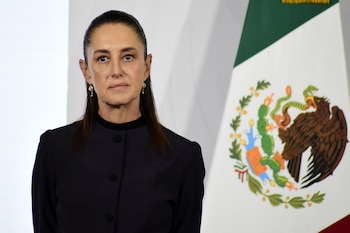
Sheinbaum chose not to respond directly to Carter’s remarks. “It is very difficult to respond to every statement made by the U.S. government. There are things we do not agree with. It is their opinion, and we have our own position,” she said during a press conference on Monday.
The president reiterated her policy of “cooperation without subordination” and urged Washington to strengthen efforts to seize weapons being smuggled into Mexico.
Ricardo Monreal, the Morena party leader in the Chamber of Deputies, supported Sheinbaum’s position and stated that any public official found to have ties to organized crime “must pay for them and must be prosecuted by Mexican authorities,” according to remarks he made to the media on Monday.

Source: infobae