
Although there are more women in newsrooms today, journalism in Sinaloa continues to grapple with structural shortcomings: a lack of professional growth, the centralization of news coverage, and limited confidence in female leadership.
This is the assessment of Martha Alicia Araujo Trapero, a journalist whose career began in 1964, making her one of the first women to join local media outlets as a reporter.
“I started in the social news section, but it was a long road to being accepted into the local news desk,” she recalls. Her time working in various areas—culture, the general newsroom, and later local news—was not merely a path to advancement but a process of intensive training: “I learned a great deal there because I had to read all the national and international news and decide what would be published.”
She truly came into her own through fieldwork. Araujo specialized in investigative and advocacy journalism, addressing social issues in rural communities and administrative districts such as Navolato, Quilá, El Dorado, and Costa Rica.
“It was about going out to see, verify, ask questions, and get to know people. Everyone had problems, and everyone had information,” she notes.
However, that type of journalism—grounded in the territory and close to the people—is becoming increasingly rare today.
“The work has become highly centralized. There is no longer that travel to the communities, yet there are many problems out there that aren’t being reported,” she warns.
As an example, she cites the impact of violence on education—a topic that, in her view, has not received sufficient attention.
Regarding the role of women, she acknowledges progress in terms of representation but not in decision-making power.
“The talent is there, but there hasn’t been the confidence to place certain roles in women’s hands,” she asserts. For her, an invisible barrier persists, limiting access to leadership positions. “Young women’s work is restricted. They have the capability, but they aren’t allowed to develop it.”
This stagnation is also reflected in the lack of professional growth within media organizations, leading many female journalists to move elsewhere or leave the profession entirely.
“There is no growth. There is stagnation, and that isn’t right,” she says. Araujo insists that journalism must reclaim its social mission, broaden its perspective beyond the cities, and open up genuine opportunities for new generations—especially women.
“There are many social issues that are not being addressed. There are sectors that need a voice,” she concludes.
Against a backdrop of violence and shifts in the media landscape, her assessment points to an urgent need: returning to the local communities, trusting in young talent, and breaking the patterns of inertia that still hold back journalism in Sinaloa.
Receives recognition
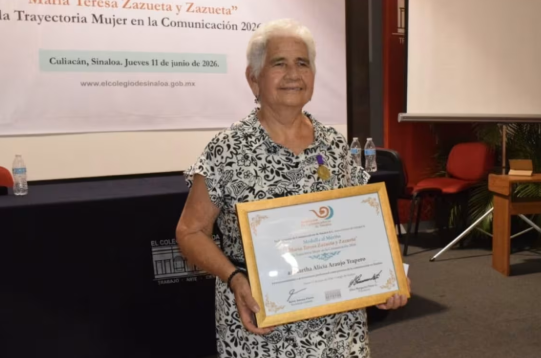
On June 12, Martha Alicia Araujo was awarded the ‘María Teresa Zazueta y Zazueta’ Medal of Merit. The award was presented by the Association of Women Communicators of Sinaloa in recognition of a woman who made journalism her way of life—a vocation pursued with passion, discipline, and a profound sense of social responsibility.
The ceremony, held at El Colegio de Sinaloa to mark Freedom of Expression Day, was attended by members of the association, fellow journalists, and the honoree’s family and friends. Araujo expressed both emotion and surprise at this recognition of her career.
Source: revistaespejo