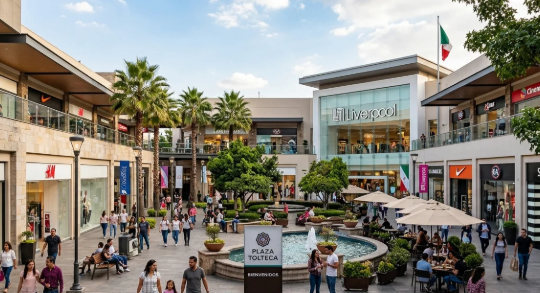

Amid a context where security in shopping centers has become a priority, authorities in the municipality of San Pedro Garza García, in the state of Nuevo León, are preparing to implement a program that is already generating controversy: “Cascoff,” a strategy that will allow establishments to remove individuals who do not make purchases or who disrupt order.
The measure, promoted by the municipal government, aims primarily to prevent crime and improve coexistence within shopping malls and commercial areas by enforcing existing regulations, without the need to create new laws.
What does the Cascoff program for shopping centers consist of?
According to local authorities, the “Cascoff” program will provide business owners with tools to discreetly request the removal of individuals who engage in behavior considered inappropriate within their establishments. Among the main points is the possibility of limiting the stay of individuals who do not make purchases, colloquially known as “refriteadores.”
The Municipal Secretary of Public Security, José Luis David Kuri, explained that the intention is not to violate rights or eliminate people’s anonymity, but rather to offer mechanisms that help maintain order without the need for direct confrontation.
Additionally, the program includes institutional support so businesses can act with greater legal certainty, as well as clear guidelines for identifying situations that affect coexistence, ranging from aggressive behavior to prolonged occupation of spaces without making purchases.
In the coming days, municipal personnel will visit commercial areas to inform business owners about the operation of the program, which will be presented before the City Council for possible incorporation into municipal regulations.
Security vs. Rights: The Debate Generated by the Measure
Although the initiative has been presented as a solution to strengthen security, it has also sparked debate about its potential social implications. Specialists and social media users have warned that this type of measure could lead to discrimination if it is not applied using clear criteria.
The risk lies in the fact that the definition of “inappropriate behavior” or simply remaining in a place without making a purchase may be subject to subjective interpretations, potentially affecting certain groups such as young people, older adults, or informal workers who use these spaces as places to rest.
If replicated in other cities across the country, the impact could be significant: on one hand, it could improve the perception of order and security in shopping centers; on the other, it could limit access to spaces that, although privately owned, function as places for public social interaction.
Recent Case Rekindles the Discussion
The debate regarding the use of force in commercial spaces gained attention following an incident in the municipality of Monterrey, where a security guard was recorded striking a woman accused of alleged theft.
According to reports shared on social media, the woman had not committed any crime and was falsely accused, resulting in a physical assault that was captured on video. The case generated public outrage and highlighted the need to regulate the actions of security personnel in commercial establishments.
This type of incident reinforces the importance of ensuring that programs such as “Cascoff” have clear guidelines, adequate training, and constant supervision to prevent abuse and guarantee that security measures do not become acts of violence or exclusion.
A Model That Could Expand
While the City Council analyzes the proposal, business owners and citizens remain attentive to the development of this initiative, which could set a national precedent.
The key will be finding a balance between security and respect for individual rights. Otherwise, a measure intended to improve coexistence could end up generating more conflicts than it seeks to resolve.
Source: marca20