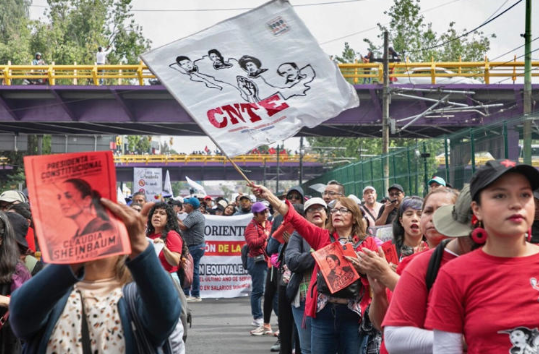

The expression “negotiation, mobilization, negotiation” sums up the way the National Coordinator of Education Workers (CNTE) operates: alternating between dialogue with authorities and mobilization as a pressure mechanism to achieve its objectives and keep its demands alive. Protests, blockades, and encampments have been present since the teachers’ organization was founded 46 years ago. This capacity for mass mobilization is what gives the CNTE political power and makes it one of the groups that exerts the most pressure on governments, according to education specialists.
What is the CNTE?
This has been the case administration after administration, from the government of José López Portillo to that of Claudia Sheinbaum, who inherited the current conflict with the CNTE over the same demands it has been making for several years. The president included some of the teachers’ demands as government commitments or campaign promises, and the union is now demanding that she fulfill those promises through a strike that has lasted 17 days and complicated mobility in the city in the middle of the 2026 FIFA World Cup.
The CNTE was founded in December 1979 in Tuxtla Gutiérrez, Chiapas. It was created by teachers, mainly from southern Mexico, who were dissatisfied with the National Union of Education Workers (SNTE), the official union that had historically been close to the governments in power and allied with ruling political parties.
Dissident teachers from Chiapas, Tabasco, and Guerrero formed an alternative political-union organization to the SNTE that would fight to improve teachers’ working conditions. In fact, one of the CNTE’s first demands was a 30% salary increase for teachers. It also demanded union democracy within the SNTE.
For this reason, the CNTE never became an independent union separate from the SNTE. Instead, it functioned as an organization within the union that challenged its leadership.
The CNTE’s organizational model, in contrast to the SNTE, helped attract thousands of teachers because one of its defining characteristics is consulting its grassroots members before making decisions and presenting demands. In addition, the CNTE was not created by any political group or party but by rank-and-file teachers, allowing it to expand beyond southern Mexico and reflect the problems affecting educators across the country.
Protest as a Pressure Mechanism
It is a movement, a well-organized interest group, that has learned that its strength comes from mobilization.
With a large number of people willing to take to the streets, the CNTE gained the power it needed for authorities to pay attention to dissident teachers. Through pressure generated by demonstrations, marches, and blockades over the years, the organization has achieved significant victories: the fall of SNTE leader Carlos Jonguitud Barrios in 1989; salary increases for teachers; representation within the SNTE; and the repeal of the 2013 education reform.
It also achieved the cancellation of teacher evaluations for promotions and job assignments in 2019. In 2025, it succeeded in getting Sheinbaum to withdraw a new reform initiative to the ISSSTE Law and approve a gradual reduction in the retirement age for state workers.
All of this makes the CNTE a complex movement: it is a group with a social base and legitimate labor demands, a counterbalance to power, but at the same time it is accused of using the teachers’ struggle for political purposes.
“Governments have always sought to buy a fragile peace. They become frightened by mobilizations because they have many negative effects on society, social pressure begins to build, and they end up giving in,” says Marco Fernández, researcher at Tecnológico de Monterrey and México Evalúa.
Two weeks before the opening of the 2026 FIFA World Cup, the CNTE set up camp in the streets of Mexico City’s Historic Center and began blockades, demonstrations, and dialogue sessions with federal authorities.
To deactivate the protests, which threatened to disrupt the World Cup opening ceremony and operations at Mexico City International Airport, the federal government presented several proposals, including eliminating the current teacher career system, implementing a new education reform, and guaranteeing teachers the lowest commissions on retirement savings accounts (Afores).
The Relationship Between the CNTE and the SNTE
The Teachers’ Movement
The CNTE estimates that it has around 500,000 members, according to its own calculations, since it does not maintain an official membership registry.
It is present in 33 union sections but is especially strong in Mexico City, Oaxaca, Zacatecas, Chiapas, Guerrero, and Michoacán.
Érik Avilés, director of Mexicanos Primero in Michoacán, argues that CNTE members remain affiliated with the SNTE, making it problematic that the CNTE has never completely separated from the union.
According to the researcher, despite the public criticism between both organizations, the SNTE has never expelled CNTE members, even during periods of major disagreements. As a result, he considers the CNTE to be an “armed wing” of the SNTE that enables a “double negotiation.”
In other words, it pressures authorities to meet certain demands through demonstrations while negotiations continue without direct confrontation.
“The refined negotiation, the one conducted at the table with velvet gloves, is obviously carried out by the SNTE. But the mobilization, the street struggle that allows for the double negotiation, belongs to the CNTE,” he explains.
On May 15, during the Teacher’s Day ceremony, SNTE leader Alfonso Cepeda echoed the CNTE’s demands. In front of President Sheinbaum, and in an unusual move, he requested changes to the pension system. He also called for reforms to the teacher job assignment system and the repeal of the 2007 ISSSTE Law.
In other words, he made the same requests the CNTE has been protesting for years, although without explicitly mentioning the organization.
According to specialists, both organizations have maintained political ties: the SNTE with the PRI, the PAN, and now Morena, while the CNTE had members in the PRD’s National Democratic Front and later within Morena as well.
The CNTE did wage a genuine struggle against the union leadership in its early years and, ten years after its founding, achieved its first major victory using the strategy it still employs today.
In 1989, it mobilized thousands of teachers in massive protests in Mexico City against Carlos Jonguitud Barrios, then leader of the SNTE. This historic teachers’ movement became known as the “Teachers’ Spring.”
The CNTE demonstrations contributed to Jonguitud’s downfall. However, Elba Esther Gordillo replaced him and remained in power for 23 years. As a result, the CNTE did not achieve union democracy within the SNTE.
Nevertheless, it consistently opposed Gordillo for reaching agreements with the PRI and PAN. The CNTE accused her of corruption and attempting to weaken the dissident movement until she was imprisoned in 2013 during the administration of Enrique Peña Nieto, while the country approved a new education reform.
What Does the CNTE Want in 2026?
Since then, teachers have protested for the repeal of that reform, which established teacher evaluations to determine promotions and job assignments.
During the administration of Andrés Manuel López Obrador, the CNTE demanded the reversal of the education reform approved under Peña Nieto. López Obrador implemented his own reform and eliminated the Professional Teaching Service.
In its place, he created the Unit for the Career System of Female and Male Teachers (Usicamm), which the CNTE also opposed because it believes the system lacks transparency in assigning teaching positions.
For that reason, the CNTE is now mobilizing against Usicamm, demanding the repeal of the 2007 ISSSTE Law and the return to a pension system without Afores.
However, specialists from Mexicanos Primero consider these demands impossible to fulfill under current conditions: the government faces high public debt, and public finances are insufficient to fund solidarity-based pensions.
“These are three extremely difficult demands to achieve. But there must be a confidential political agenda behind them,” says Marco Fernández.
The México Evalúa researcher also points out that the CNTE’s demands do not include an educational vision focused on improving student learning. On the contrary, some actions by both unions hinder efforts to improve the education system.
“As a result, we have a very serious problem of extremely low educational quality, where one of the key issues needed to change that—and which we have not been able to address—is improving the teachers who are in front of students.”
Links With Other Organizations
Another factor that strengthens the CNTE is that it is not limited to the teachers’ struggle but also builds alliances with other organizations and social movements.
In 2006, for example, it led the Popular Assembly of the Peoples of Oaxaca (APPO), made up of around 300 organizations that protested against PRI Governor Ulises Ruiz, who had previously attempted to remove a teachers’ encampment.
The organizations occupied Oaxaca’s capital for months, carried out blockades, and entered government offices until the federal government intervened with a violent eviction that left people dead and injured.
According to the CNTE, more than 200 teachers have died defending their rights since the organization was founded.
Today, the CNTE also joins the families of the 43 Ayotzinapa teacher-training students who disappeared in Iguala, Guerrero, in 2014, as well as the mothers of missing persons who demand a stronger government response to the disappearance crisis.
Source: msn