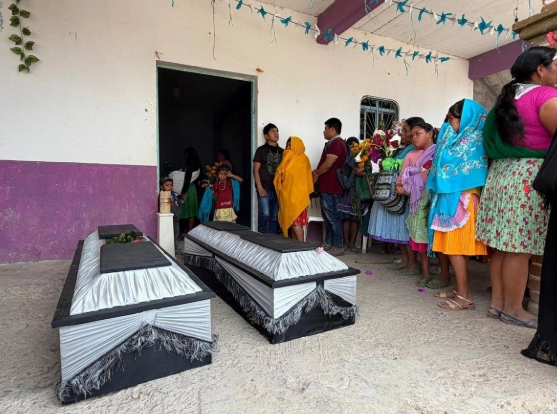

Public accusations made by Jesús Plácido Galindo against the criminal group Los Ardillos exposed the omissions, complicity, and collusion of the state government. From May 6 to May 11, the group, which controls the Montaña Baja region of Guerrero, launched a large-scale attack against Nahua communities in the municipality of Chilapa, affiliated with the Regional Coordinator of Community Authorities of the Founding Peoples (CRAC-PF).
Those were tragic days marked by shootings and armed incursions that destroyed homes, attacked residents of Tula and Xicotlán, killed six people, and forced more than 800 residents to flee their communities. Mothers left everything behind and struggled to carry their children to safety. The surrounding hills became both their refuge and their source of survival.
Calls for help from mothers, children, and community authorities reached the National Palace. President Claudia Sheinbaum instructed Interior Secretary Rosa Icela Rodríguez to assist the affected communities. Meanwhile, Public Security Secretary Omar García Harfuch stated that the conflict was merely an armed confrontation between Los Ardillos and Los Tlacos. This serious situation has become normalized in Guerrero. His characterization minimized the broader context of violence directed against Indigenous communities that have remained independent of these criminal groups and continue to govern themselves under their own traditional legal systems.
It is concerning that the secretary effectively criminalized communities that have organized to prevent criminal organizations from entering their territories. These groups have expanded their presence throughout the state to the point of controlling several regions and municipalities. The state’s security strategy has been undermined by inefficiency and alleged complicity. Security plans have failed to respond to the population’s most urgent needs. The Coordination Board for Peacebuilding has been reduced to closed-door meetings with little impact on improving public safety. Security forces consistently arrive too late, highlighting their ineffectiveness.
The greater threat is taking shape within municipal governments, where criminal organizations have allegedly taken control of key departments and offices, operating them as private businesses. This form of co-governance has imposed a gangster-style system designed to instill fear among the population. Social problems and community demands are no longer addressed by public authorities but by representatives of organized crime. Police officers allegedly act as lookouts and torturers.
Jesús Plácido dared to expose this criminal network that, according to him, operates under the protection of the state government. He has described the close relationships between politicians and criminal leaders. He has consistently denounced the 84 murders and 25 disappearances recorded over the past two decades. His close relationship with the affected communities has given him a broad understanding of how organized crime has infiltrated municipal governments and Indigenous communities. Criminal groups allegedly exercise control through municipal structures and traditional community leadership, maintaining loyal client networks. They have built a social base that enables them to pressure both state and federal authorities.
Unable to stop the escalating violence, mothers and fathers from Ayahualtempa organized a demonstration in which their children marched wearing the uniforms of the community police as a protest against what they described as government indifference. Jesús invited the media to cover the march and document the testimonies of mothers searching for their missing children.
His willingness to accuse municipal presidents of collusion with organized crime provoked a strong reaction from state authorities. Instead of investigating the allegations and supporting the affected communities, authorities allegedly turned against Jesús. The state prosecutor’s office charged him with aggravated homicide, while Deputy Secretary for Political Affairs Francisco Cisneros allegedly orchestrated a trap. Together with the state’s communications office, officials reportedly launched a campaign against the community defender, accusing him of organized crime, kidnapping, and being affiliated with Los Tlacos. He was transferred to the Almoloya prison by Air Force helicopter, a move described as an effort to silence him and isolate him from his family and legal defense.
According to the article, Jesús’ imprisonment benefited Los Ardillos, making it easier for the group to enter communities that had resisted their presence. Arrest warrants issued against several of Jesús’ associates are described as an attempt to weaken and dismantle the autonomous movement. Community assemblies would cease to be the driving force of local governance, while local authorities and commissioners would become subordinate to armed groups, leaving residents under the control of those responsible for violence.
Indigenous communities in the Montaña region are described as being forced to negotiate with criminal organizations and even recruit their children into criminal groups. Armed organizations have reportedly taken control of checkpoints, monitoring everyone entering and leaving the communities. They inspect vehicles, question travelers, request identification, search cell phones, and review contacts and stored information. According to the article, control is nearly absolute, with masked municipal police officers intimidating residents while carrying high-powered weapons. Criminal leaders allegedly monopolize commercial activities, control public works projects, and build their own armed forces using members of the same communities to suppress resistance or rebellion.
The influence of organized crime has, according to the article, surpassed that of municipal governments. During the most recent electoral process, criminal organizations allegedly demonstrated their ability to influence election outcomes in favor of preferred candidates. This criminal structure ultimately brought Jesús Plácido Galindo into the national spotlight. According to the article, he has paid a heavy price for challenging both organized crime and the political power structure in Guerrero.
Source: jornada