
On the northeastern outskirts of the Valley of Mexico, where urban sprawl loses its structure and becomes a vast expanse of asphalt and gray concrete, the limits of state authority are not defined by laws but by agreements. For years, the official narrative has portrayed municipalities such as Ecatepec de Morelos, Tecámac, Chalco, and Texcoco as the capital’s backyard: a commuter region plagued by common and uncontrollable crime. However, the reality beneath the surface is far more structural, profound, and, above all, institutional.
A file from Mexico’s Federal Secretariat of Security and Citizen Protection (SSPC), independently accessed for this special investigation, reveals the anatomy of a mutually beneficial symbiosis. The document, whose copies and operational implications have been shared among the highest levels of the Navy Secretariat (Semar) and the National Guard, details a network in which the boundary between local political power—consolidated under Morena—and at least ten criminal organizations in the region has effectively disappeared.
This is no longer the old dynamic of bribery to allow the free movement of illicit goods. Federal reports describe a model of co-governance.
A “society of impunity” in which organized crime provides votes, mass mobilization capacity, and logistical support during electoral campaigns, while municipal governments repay the favor by granting control over public services, public works, and the constitutional guarantee that local prosecutors will look the other way.
Chapter II
The “Monster of the Metropolis”
The federal investigation, which has accumulated surveillance, interceptions, and intelligence since 2020, focuses primarily on the eastern and northeastern regions of the State of Mexico. This territorial strip extends from Ecatepec to the foothills of Amecameca, passing through Ixtapaluca and Valle de Chalco.
Within this dense social ecosystem, groups with names ranging from identity-based to gang-related have emerged and expanded: La Chokiza, Los Uber’s, Los Vampis, Los Makiavelikos, Zona Norte, Los Michoacanos, Los Catalina, Los Rodolfos, Nueva Alianza, and Los Paletas.
According to the file, these criminal groups began their activities stealing auto parts and cell phones at bus terminals. They have since evolved into organizations responsible for “gota a gota” loan schemes, extortion rackets, illegal LP gas distribution using stolen fuel, and even winning municipal contracts in areas where they exert influence.
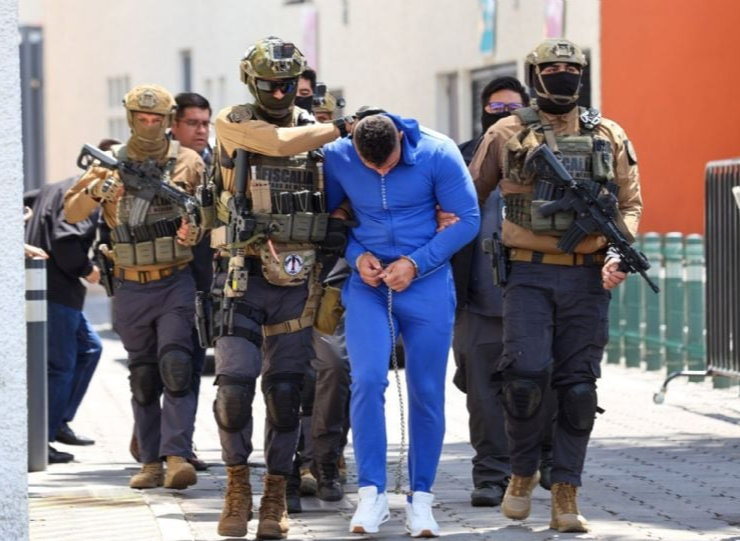
Arrest of David N., alias “El Deivid” or “El Chino”
The report includes photographs showing members of “La Chokiza” alongside Ecatepec Mayor Azucena Cisneros. It also states that they have allegedly “worked with and financed” various public and political activities since her time as a local legislator. The ongoing investigation further suggests that groups such as “La Chokiza” and Los Makiavelikos/Zona Norte/USON, which present themselves as labor unions, have provided financing.
According to the document, five local criminal groups currently stand out due to the violence they inflict on society and their willingness to defend territory through armed force. Although they have occasionally sought alliances with larger organizations from Jalisco or Sinaloa, local groups have largely chosen to maintain direct control over their neighborhoods.
Federal Intelligence Conclusion
“These groups stand out because of their violence, organization, and diversification of criminal activities, making them the principal generators of insecurity in Ecatepec.”
SSPC Files: The Five Key Cells
La Chokiza – High-Impact Structure
Threat Level: Critical (95%)
Leadership: “El Choko” (imprisoned) / “El Deivid”
Key Areas: Héroes de la Independencia, Ciudad Azteca
Areas of Influence: Extortion cells, “gota a gota” lending operations, and formal political financing connections.
The organization presents itself as a social support group and is closely linked to local political events in Ecatepec, including campaign financing.
Activities
- “Gota a gota” loans with high interest rates and violent collection methods.
- Contract killings and arms trafficking.
- Organized structure with collectors and enforcers operating mainly in Héroes de la Independencia and Ciudad Azteca.
“That area is the monster of the metropolis. There is no police force or authority capable of truly controlling, or even fully understanding, what happens in the State of Mexico,” explains Alberto Martínez Guzmán, criminologist at the National Institute of Criminal Sciences (INACIPE).
The specialist compares the institutional deterioration of the State of Mexico’s periphery to political crises seen in other states.
“All you have to do is shake the rug a little and all the dirt comes out. What we see here is identical to what happened in Morelos, where federal authorities are investigating at least a dozen mayors for organic ties to drug trafficking. In the State of Mexico, the scale is larger because of the enormous population density and resources at stake.”
The most documented case in the file is La Chokiza. According to federal intelligence data, Alejandro Gilmare Mendoza, alias “El Choko,” currently imprisoned in a maximum-security facility, actively financed the political ambitions of Ecatepec Mayor Azucena Cisneros during her years as a local legislator.
In exchange for cash contributions to political structures, the benefits reportedly extended beyond simple police tolerance.
“They have been granted explicit permission to commit crimes,” says Martínez Guzmán. “Even more troubling, as seen daily in Ecatepec, they receive municipal contracts. Members of these networks operate garbage collection services, control freight transportation, and obtain paving contracts. The arrangement is clear: public funds finance criminal organizations, and criminal organizations ensure the political group remains in power.”
The Cycle of Criminal Co-Governance
Criminal Contributions
- Campaign financing through informal cash injections.
- Mass mobilization and voter influence.
- Armed social pressure to protect electoral districts.
Municipal Compensation
- Local service concessions such as garbage collection and transportation routes.
- Direct assignment of public works contracts.
- Deliberate inaction by police and prosecutors.
“Municipal public budgets effectively finance criminal structures, while organized crime guarantees the survival of the ruling political group through force.”
Chapter III
The Economy of Siege: LP Gas and Extortion
For local business owners, the cost of this arrangement is a permanent war tax.
The preferred business of these criminal networks is no longer large-scale drug trafficking but the complete capture of local economies through extortion. The LP gas distribution sector has become one of their primary targets.
“As a civil organization, we have identified around fifteen legal LP gas distribution points in the region. Every month it is the same ordeal: representatives from one group arrive, then another, each claiming they are the legitimate ones who should receive the payment,” said a legal representative for several gas distribution companies operating in the Chalco–Ecatepec corridor, speaking anonymously.
“There are so many groups that we have lost track of who is who. The only certainty is the monthly fee required to keep operating. Those who refuse have had legally established gas stations burned down with total impunity.”
The criminal scheme also involves large-scale asset theft. According to the report, organizations steal tanker trucks, siphon off the fuel, and then sell it through networks of illegal gas stations operating on vacant lots in places such as Ixtapaluca and Valle de Chalco.
“Complaints are filed with municipal authorities regularly, but nothing ever happens,” the representative said. “They are protected. The collusion is obvious, and even the State of Mexico Attorney General’s Office rarely intervenes. The only relief comes when the National Guard or the military patrol the area and seize stolen vehicles.”
The SSPC file traces where this money ultimately goes. Federal authorities have identified at least five front companies linked to La Chokiza’s financial structure. These firms operate under formal contracts in Ecatepec, Chalco, and Ixtapaluca.
These shell companies handle urban maintenance projects, road repairs, and the organization of political rallies and public events. Because the criminal investigation remains active, the official names of the companies remain confidential.
Chapter IV
Cosmetic Arrests
Although state authorities often celebrate the arrests of high-profile leaders such as El Choko and his brother El Deivid, analysts and victims agree that these actions are largely symbolic.
The criminal structure remains embedded within municipal bureaucracies.
“It is useless to imprison historical leaders if the criminal network underneath continues collecting extortion payments every week.”
According to Martínez Guzmán, these arrests are largely designed for headlines.
“The leaders continue operating from prison. With the money they generate, they pay lawyers, bribe local prosecutors, and secure privileged conditions within state prisons.”
Experts who reviewed the federal intelligence file believe the only viable solution is to dismantle the financial and political networks that sustain these organizations.
“The blow against these groups must be decisive and accompanied by criminal prosecution of public officials who provide protection,” Martínez Guzmán concluded.
He argues that a federal intervention model similar to that used in Morelos is necessary, where local immunity has not prevented the arrest of sitting mayors when evidence showed links to criminal organizations.
Meanwhile, the mayors mentioned in the federal file continue publicly denying any criminal connections, attributing the allegations to political disputes.
However, according to federal security agencies, operational orders have already been signed. The document warns that government passivity is nearing its end, as federal authorities prepare a large-scale operation aimed at dismantling municipal networks of complicity in the coming weeks.
On the edge of chaos, the truce appears to be running out.
For this report, requests for comment were made to Ecatepec Mayor Azucena Cisneros and State of Mexico Governor Delfina Gómez. No response had been received by the time of publication.

Source: lasillarota