
Think about this:
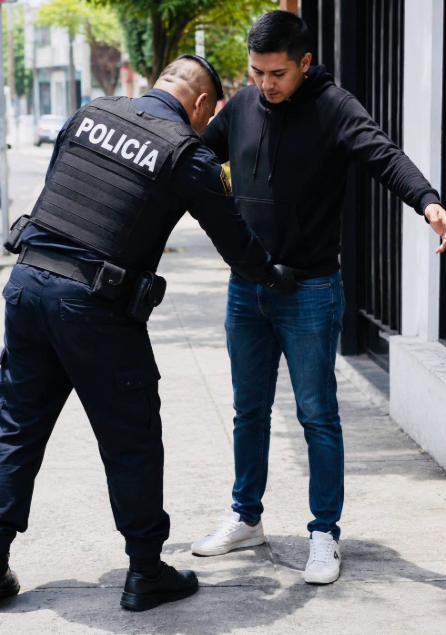
You are walking down the street, you are not committing any crime, and you are not carrying anything illegal. But a police patrol approaches, an officer stops you, and searches you.
When you ask why, the answer is: “You were acting suspiciously.”
Is it legal for them to search you just because you appear suspicious in the eyes of a police officer?
The answer is no. That suspicion must be objective from the perspective of any person (not just the officer) and must be based on facts that allow one to consider that a crime is being committed or that there is a probability that one will be committed.
The police must clearly justify and explain:
- What they observed.
- Where it occurred.
- What exactly you did.
- Why they reasoned that a crime might be involved.
If they cannot do so with verifiable facts, the detention, search, or intrusion is illegal.
In Mexico, no one should lose their freedom, privacy, or peace of mind solely because of a police officer’s personal impression.
The so-called “reasonable suspicion” cannot be based on hunches, prejudices, or subjective assessments.
LEGAL BASIS:
PREVENTIVE PROVISIONAL CONTROL. THE REASONABLE SUSPICION THAT JUSTIFIES ITS APPLICATION MUST BE SUPPORTED BY OBJECTIVE ELEMENTS AND NOT BY THE MERE SUBJECTIVE APPRECIATION OF THE POLICE OFFICER.
The First Chamber of the Supreme Court of Justice of the Nation has stated that, in order to establish the existence of reasonable suspicion justifying a preventive provisional control, the authority must specify what information (facts and circumstances) it possessed to assume that a person was committing unlawful conduct.
Likewise, it has held that such information must meet standards of reasonableness and objectivity; that is, it must be sufficient such that any person, from an objective point of view, would have reached the same determination as the authority if they had possessed the same information.
In this regard, although it is true that “unusual” or “evasive” behavior could, in certain cases, justify the existence of “reasonable suspicion” and consequently authorize a search or provisional control, for such justification to be taken into consideration it is necessary that it be properly supported by objective elements that allow the judicial authority to verify that the police officer acted reasonably.
Thus, the police authority must explain in detail, in each specific case, the circumstances of manner, time, and place that reasonably led it to conclude that the person acted “suspiciously” or “evasively” (that is, that the individual was probably committing a crime or was about to commit one, or how they attempted to flee).
Likewise, in those cases where the preventive control derives from the commission of an administrative infraction, the authority must present the facts that identify what the infraction consisted of, as well as those that subsequently justified a greater intrusion into the person or their property (for example, preventing the probable commission of a crime).
On the other hand, when reviewing the constitutionality of the restriction, if the authority claims that the accused acted “suspiciously” or “evasively,” the judge must analyze whether the authority’s subjective assessment was reasonably justified by objective elements, such as the context, the place and time in which the events occurred, as well as the description of the conduct observed by the authority, among other factors that may be relevant.
In every case, the judge must pay special attention to the reasons that led the authority to temporarily restrict a person’s rights, discarding those that may have been based solely on the individual’s appearance or on merely discriminatory reasons.
If the opposite were accepted—that it is enough for the authority to simply claim that the accused “adopted an evasive attitude in the officer’s presence” without providing further elements to justify a preventive provisional control—it would lead to the extreme of validating any intervention in a person’s personal liberty or privacy without requirements beyond the vague and subjective assessment of the police authority.
Digital Registry: 2014689.
Source: mexicodailypost