
The Caribbean sun no longer shines the same way on the pavement of Tulum. Where there was once an endless parade of tourists searching for the mystique of paradise, there are now metal shutters pulled down, padlocks rusted by the sea air, and a heavy silence that cuts deep. It is not merely a rough patch; for those who have watched this corner of Quintana Roo grow over the past four decades, it feels like a deliberate suffocation.
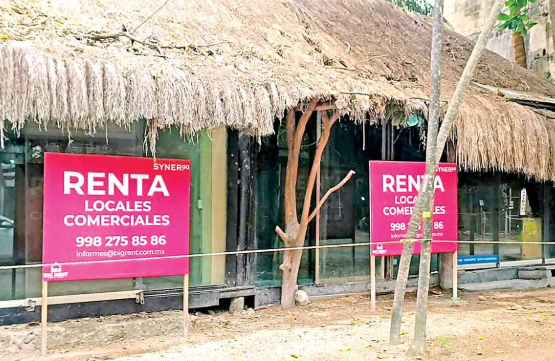
At least 30 businesses in the iconic hotel zone have recently disappeared. The official narrative speaks of market dynamics, but on the streets, the diagnosis is far more sinister.
Víctor Chávez de la Torre looks at the landscape he has called home for more than 40 years and does not see a random crisis; he sees a perfectly designed plan.
“It is a strategic downturn orchestrated by millionaires because there are real estate cartels. They are creating chaos so they can buy cheaply, because they want to build a large-scale development like Cancún or Miami.”
Businesses in Tulum’s hotel zone stand empty.
For Chávez de la Torre, the pressure is no longer a theoretical possibility but a daily form of harassment that alters the rhythm of his life. Global economic power groups want the beachfront properties, the strategic plots of land, and the corners where the myth of Tulum was born. To achieve this, he believes they are willing to wear down local residents through opaque legal disputes, administrative obstacles, and the creation of unsustainable economic uncertainty.
“There is so much money at a global level that they want all of us to leave, they want me to leave, and they are making my life impossible. They want me to sell, whether cheaply or expensively, but they want me to sell. This is my life, and this is where I am.”
He remains determined in a territory that has become increasingly hostile to its own founders.
A few kilometers away, in downtown Tulum, the geopolitics of large-scale developments translates into a purely arithmetic drama: the numbers no longer add up. Leopoldo Cocom, a businessman trying to protect his livelihood in the urban center of the destination, wipes down an empty counter while the clock keeps moving and not a single customer walks through the door.
“Things are in very bad shape. We are not even at 15% in terms of tourism. Sometimes we do not sell a single peso. Many people are closing because no one can afford the rent, taxes, and everyday expenses.”
The paralysis creates a domino effect that strikes the weakest links in the chain the hardest. At the entrances to the archaeological zone, where the wind carries the sound of waves crashing against the Mayan cliffs, artisans watch visitors pass by with folded arms. Their stalls, full of color and carved woodwork, have become museums where people enter only to look.
Luis Delgado, an artisan at the site, summarizes each day as a lesson in survival economics:
“Everything was dead, as always. We make one sale, two sales, maybe three at most, and that is it. Sometimes we do not sell anything at all. People come in to look, but not to buy.”
Two worlds in the same paradise
The contrast is striking. In international travel magazines and digital marketing campaigns, Tulum continues to be promoted as the untamed jewel of the Mexican Caribbean, an Eden of residential hotel expansion, luxury developments with infinity pools, and exclusive presales priced in dollars. Yet behind that image of prosperity, the economy of the people who sustain the destination is rapidly collapsing.
The accelerated growth of recent years has built a two-tiered Tulum: one belonging to global investors who plan condominium towers in the jungle, and another belonging to local residents who can no longer afford basic services or even the land beneath their feet.
Tulum now finds itself at a historic and painful crossroads. It is not simply a matter of surviving a low season or waiting for mass tourism flights to return. The real debate taking place on the beaches and avenues of the destination concerns identity and ownership: a silent struggle over whether the future of the Mexican Caribbean will belong to the community that built it step by step, or whether it will ultimately be consumed by new owners of capital who patiently wait for paradise to break completely so they can buy it at bargain prices.
Source: excelsior