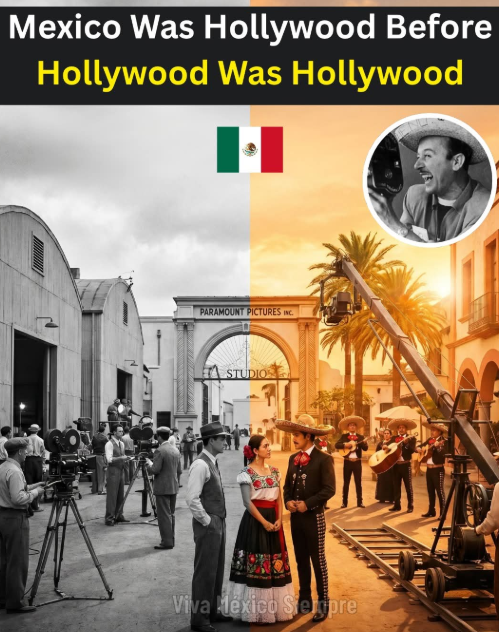

Most people think of Hollywood when they think of Golden Age cinema. But between the 1930s and the 1960s, there was another film capital quietly dominating the entire Spanish-speaking world — and it was right here in México.
They called it “El Cine de Oro.” The Golden Age of Mexican Cinema. And what Mexico built during those decades was nothing short of extraordinary.
🎥 IT STARTED WITH A REVOLUTION ON SCREEN
The year was 1936. A film called ¡Vámonos con Pancho Villa! hit theaters — and it changed everything. Unlike Hollywood’s romanticized, happy-ending versions of Mexican history, this film told the truth. Raw. Honest. Unapologetic. Mexican audiences had never seen themselves portrayed with such dignity and power on screen.
That film lit a fire that would burn for three decades.
Within just a few years, Mexico wasn’t just making movies — Mexico was making the movies that the entire Latin American world was watching.
🌎 MEXICO BECAME THE HOLLYWOOD OF LATIN AMERICA
At its peak, the Mexican film industry was the most successful Spanish-language film industry on the entire planet. Not in Latin America. On the ENTIRE PLANET.
Mexico City’s studios — Clasa, Azteca Films, Filmadora Calderón — were running at full capacity. Directors, screenwriters, actors, and cinematographers were producing films at a pace that rivaled anything coming out of California.
And the world noticed.
Mexican films were being screened at Cannes. They were winning international awards. They were selling out theaters from Buenos Aires to Los Angeles.
🌍 WORLD WAR II GAVE MEXICO ITS MOMENT — AND MEXICO DELIVERED
Here’s the part of history that most people never learn in school.
When World War II broke out, the film industries of France, Italy, Spain, and even the United States shifted all their resources toward war films and propaganda. Their studios went quiet. Their stories narrowed.
Mexico saw the opening — and seized it.
Because Mexico joined the Allied forces, the United States actually supplied Mexico with raw film stock and cinematic equipment. The Mexican government created the Banco Cinematográfico — a national cinema bank — to fund private film productions. And with Europe’s studios silenced by war, Mexico stepped into the vacuum and became the dominant film supplier for the entire Spanish-speaking world.
The 1940s became the brightest decade in Mexican cinema history. Films of extraordinary technical and artistic quality were being released one after another. Director Emilio “El Indio” Fernández was producing masterpieces back to back. María Candelaria (1943) earned international acclaim at both Cannes and the Locarno Film Festival — one of the first Latin American films ever to do so.
Mexico wasn’t just making movies. Mexico was making history.
⭐ THE STARS MEXICO GAVE THE WORLD
Every great film industry needs its icons. And Mexico had them in abundance.
There was María Félix — “La Doña” — one of the most powerful and magnetic actresses in the history of Latin American cinema. Fierce, independent, and impossible to look away from. She refused to play weak women at a time when Hollywood demanded exactly that.
There was Pedro Infante — the working-class hero with a voice like warm honey and a smile that made the whole continent fall in love. When he died in a plane crash in 1957, Mexico went into national mourning. Schools closed. Streets emptied. An entire country wept.
There was Jorge Negrete — “El Charro Cantor” — the symbol of Mexican masculinity, pride, and cultural identity, whose films carried the spirit of Mexico to every corner of the Spanish-speaking world.
And then there was Cantinflas.
Mario Moreno Reyes — known to the world as Cantinflas — became one of the most beloved comedic figures in the history of cinema. His fast-talking, quick-witted, working-class character made audiences laugh from Mexico City to Madrid. Charlie Chaplin himself once called Cantinflas the greatest comedian alive. Not in Latin America. In the WORLD.
These weren’t just actors. They were cultural ambassadors. They carried Mexican identity, pride, and soul to screens around the globe at a time when the world had never paid attention to México before.
🏆 MEXICO ON THE WORLD STAGE
The international recognition was real and well-earned.
Mexican films were competing — and winning — at the most prestigious film festivals in the world. Directors like Luis Buñuel, who chose Mexico as his creative home, were pushing the boundaries of what cinema could be. His film Los Olvidados (1950), shot entirely in Mexico City, won the Best Director prize at Cannes and shocked the world with its unflinching, poetic portrayal of street children living in poverty.
Mexico wasn’t imitating Hollywood. Mexico was challenging it.
🎭 THE GENRES MEXICO INVENTED AND OWNED
What made El Cine de Oro so special wasn’t just its quantity — it was the originality of what Mexico created.
The Comedia Ranchera — musical films set on Mexican ranches, dripping with mariachi, horses, romance, and revolutionary pride — became one of the most beloved film genres in Latin American history. Films like Allá en el Rancho Grande were the blockbusters of their day, playing to packed houses across the continent.
The Cabaretera films — dramatic stories centered on nightclub dancers and working-class women navigating a complex, morally ambiguous modern world — gave voice to women’s stories in ways that Hollywood rarely dared to explore.
Mexico even developed its own version of Film Noir — dark, brooding, morally complex crime dramas that captured a country wrestling with the contradictions of modernization and tradition. Films charged with vitality, confidence, and cultural pride — haunted by the shadows of a rapidly changing world.
These weren’t copies of American cinema. They were something entirely Mexican.
💔 WHY THE GOLDEN AGE ENDED — AND WHAT IT LEFT BEHIND
By the late 1950s, the Golden Age began to fade. Television arrived in Mexican homes. The state monopoly system that had funded the industry began to collapse. Private financing dried up. By the mid-1990s, Mexico was producing fewer than 10 films per year — a heartbreaking fall for an industry that had once lit up the world.
But the films remained.
Preserved in archives, screened in film schools, honored in retrospectives around the world — El Cine de Oro never truly died. It waited.
And then, in the early 2000s, Mexico’s cinema was reborn. A new generation of filmmakers — Alfonso Cuarón, Guillermo del Toro, Alejandro González Iñárritu — carried the soul of El Cine de Oro into the 21st century and brought it to the Academy Awards stage. Three Mexican directors. Multiple Oscars for Best Director. A tradition of excellence that started in 1936, never broken — only interrupted.
🇲🇽 THIS IS THE LEGACY YOU CARRY
When you watch Roma. When you see Pan’s Labyrinth. When Iñárritu holds up an Oscar — know that he is standing on the shoulders of María Félix, Pedro Infante, Cantinflas, and every single filmmaker who built something magnificent in the middle of the 20th century, when the world wasn’t watching.
México didn’t wait for Hollywood to tell its stories.
México picked up a camera and told them itself.
And the whole world listened. 🎬🇲🇽
Source: mexicodailypost