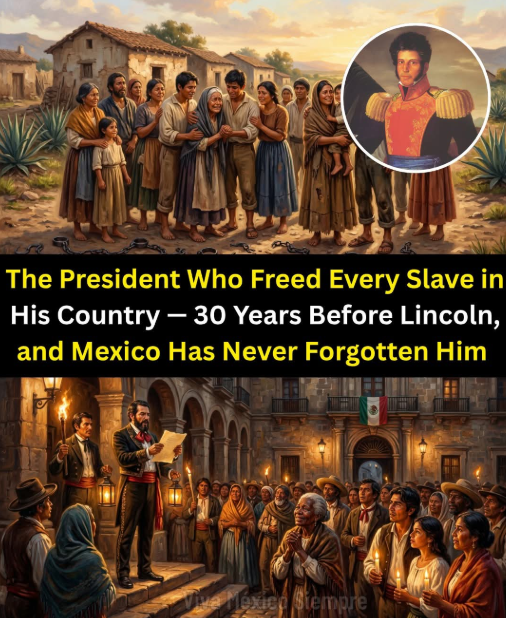

In 1829, President Vicente Guerrero — a man widely understood to be of African and Indigenous descent — signed a decree abolishing slavery across the Republic of Mexico. That’s more than 30 years before Lincoln’s Emancipation Proclamation.
It didn’t stop there. By the late 1840s and into the 1850s, the principle was simple and absolute: any enslaved person who set foot on Mexican soil was free. No paperwork. No conditions. Free soil.
Word of this traveled fast through Texas, Louisiana, and across the South. For enslaved people living near the border, Mexico wasn’t a rumor — it was a real, reachable place where freedom waited on the other side of a river.
The United States noticed too. Throughout the 1850s, U.S. officials pushed Mexico again and again to sign an extradition treaty that would force the return of escaped slaves. Mexico said no. Not once, but repeatedly, across multiple administrations, even while under significant diplomatic pressure from its much more powerful neighbor.
So people ran south instead of north. Historians estimate thousands of enslaved people made the journey into Mexico — crossing the Rio Grande, slipping aboard cargo ships bound for Veracruz, walking for hundreds of miles through hostile territory with nothing but the hope of what was on the other side.
One of the most remarkable stories belongs to John Horse, a Black Seminole leader whose people had already fought for their freedom in Florida for generations. In the late 1840s and into 1850, Horse led a group of Black Seminoles out of Indian Territory and into the Mexican state of Coahuila. In exchange for helping defend the northern frontier, the Mexican government granted them land. They founded a settlement that became known as El Nacimiento — and their descendants, the Mascogos, still live there today, nearly two centuries later.
Mexico held its ground on this issue for decades. It wasn’t until 1862 — after the U.S. Civil War had already begun — that an extradition treaty was finally signed.
This is a piece of history that rarely makes it into textbooks on either side of the border: a young nation, still finding its own footing, that chose to say no to slavery again and again, even when it would have been far easier to say yes.
Source: mexicodailypost