
Justo Sierra would write of him: “He remained permanently faithful to his ideals; he fought and died for a cause identified with his immeasurable religious faith, and he believed himself to be a soldier of Christ when he fought for the reaction and the Empire. For him, there was never an opportunity to separate Catholicism from the homeland; he possessed the spirit of the Crusaders and martyrs. He could have saved his life, but he did not wish to do so unless his companions were saved with him. Any Mexican, regardless of their beliefs, should salute his grave with pride and respect.”
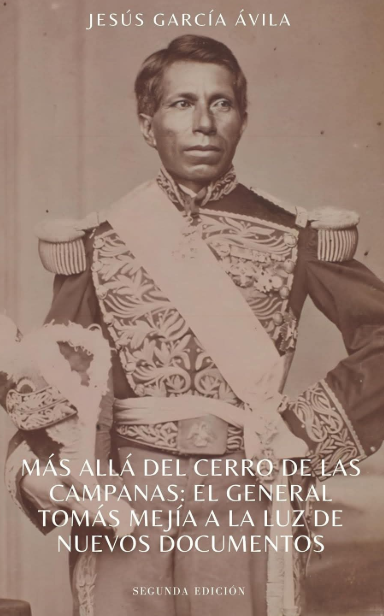
Beyond Cerro de las Campanas: General Tomás Mejía in Light of New Documents by Jesús García Ávila
June 19 marks the anniversary of the death of José Tomás de la Luz Mejía Camacho.
The book delves into the life of the conservative general of Otomí origin, Tomás Mejía, who was born on September 17, 1820, in Pinal de Amoles, Querétaro, and was executed in 1867 alongside Maximilian of Habsburg and Miguel Miramón. Through rigorous legal and historiographical research, the author succeeds in recovering the memory of a key historical figure whom the official narrative transformed into a mere antagonist of the Juárez Republic.
The principal value of the work lies in its contribution of valuable unpublished documentary material collected by the researcher. These primary sources make it possible to understand Mejía’s military career not as a betrayal of the nation, but as the legitimate defense of his ideological convictions and of the Indigenous peoples of central Mexico. García Ávila uses his legal training to analyze the trials and political decisions that sealed the general’s fate in Querétaro.
A central theme of the narrative addresses the tragic fate suffered by the general’s remains and family after the republican firing squads carried out the execution. The work highlights the ordeal endured by his wife, Agustina Castro, and his direct descendants, who suffered persecution and social stigma. The author conducts a meticulous historical and physical investigation to determine the final resting place of Mejía’s body, demonstrating that the consequences of the war extended far beyond the executions themselves.
Among these revelations, the research debunks the popular belief that President Benito Juárez paid for the military leader’s burial. The book clearly establishes that it was Mejía’s widow herself who paid for the funeral, despite facing severe economic hardship, and not the Juárez administration as some historical myths have claimed. Jesús García Ávila also explains how the general built strong regional leadership based on the loyalty of Indigenous communities in the Sierra Gorda, an aspect frequently ignored by traditional school textbooks.
Very little is known with certainty about what happened after June 20, 1867, to Tomás Mejía’s widow, Agustina Castro Martínez, and their children. Even scholars who have dedicated themselves to studying the Querétaro general have paid little attention to the third widow of Cerro de las Campanas and her difficult circumstances. From this historical neglect emerges another little-known fact: that Porfirio Díaz, after becoming President of the Republic, personally visited her and secured a scholarship for her son, Tomás Mejía Castro, enabling him to enter the Military College.
Ultimately, the book establishes itself as an essential reference for those interested in the military and legal history of nineteenth-century Mexico. The title directly refers to Cerro de las Campanas in Querétaro, the symbolic site where Emperor Maximilian of Habsburg and his two most loyal generals, Miguel Miramón and Tomás Mejía, were executed on June 19, 1867.
García Ávila’s research demonstrates that the impact of the execution and the political stigma of the conservative defeat did not end with the firing squads. Instead, they extended “beyond” that moment in time, continuing to affect the intimate circle of the Indigenous Otomí general. This invites reflection on how collective memory and historical justice are constructed.
Source: mexicodailypost