
His political stance and profile are close to those of Donald Trump, Javier Milei, Daniel Noboa, and Nayib Bukele.
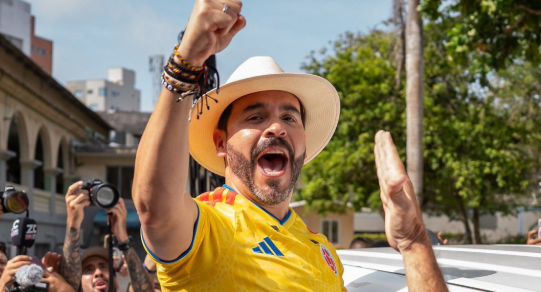
Abelardo de la Espriella has emerged as the country’s next president for the 2026–2030 term, according to preliminary results from Colombia’s National Civil Registry, with more than 99.9 percent of voting stations counted. The 47-year-old lawyer and businessman obtained approximately 49.65% of the vote, equivalent to around 12.95 million ballots, narrowly defeating Senator Iván Cepeda of the Pacto Histórico and candidate aligned with Gustavo Petro, who secured 48.70% with approximately 12.70 million votes. The difference was under 250,000 votes, making this one of the closest contests in Colombia’s recent history.
Historic Voter Turnout
Colombians were called to the election and ultimately surpassed the historic turnout recorded in the first round on May 31. Polling stations operated in a climate of intense political polarization but under an unprecedented security operation that deployed approximately 248,000 police officers and military personnel. International observers, including the European Union Election Observation Mission, highlighted the orderly conduct of the voting process despite prior tensions caused by threats from armed groups and the country’s deep political divisions.
De la Espriella will take office promising a hard-line approach against insecurity, drug trafficking, and illegal mining, along with strengthening institutions, drastically reducing the size of the state, and implementing an economic model inspired by figures such as Javier Milei, combined with security policies similar to those of Nayib Bukele. Following his victory, he received congratulations from leaders including Donald Trump, Javier Milei, Daniel Noboa, Rodrigo Paz, and Flavio Bolsonaro, among others.
For his part, Iván Cepeda acknowledged the preliminary results but emphasized that they are not legally binding and announced plans to challenge approximately 33,000 polling stations. Nevertheless, he called for public calm and stated that he would respect the final outcome. Although analysts and observers consider the trend effectively irreversible, the official count will determine the final certification of the election.
A Significant Shift in Colombian Politics
The result marks a major shift in Colombian politics after four years of the first left-wing government in the country’s modern history. Gustavo Petro’s administration achieved progress in reducing monetary poverty to historic lows, increasing the minimum wage, and advancing higher education and agrarian reform efforts. However, it has also faced criticism over what opponents describe as an unsustainable fiscal policy.
For Mexico, this also represents a significant change. President Claudia Sheinbaum had reportedly favored a victory by Iván Cepeda, whom she had previously met personally. The Mexican president would now lose a strong regional ally and maintain a close relationship primarily with Luiz Inácio Lula da Silva, while other regional leaders remain more distant from her political, geopolitical, and economic vision. In fact, one of the first public congratulations received by De la Espriella came from Ricardo Salinas Pliego, which some observers interpret as a signal regarding the direction of his future relationship with Mexico.
The situation could become increasingly challenging for Sheinbaum in regional political terms, particularly as pressure from Donald Trump continues to grow. Some analysts suggest that another major development could come in October, when Brazil holds its elections, where some polls project Flavio Bolsonaro as a potential second-round winner.
Source: revistafortuna