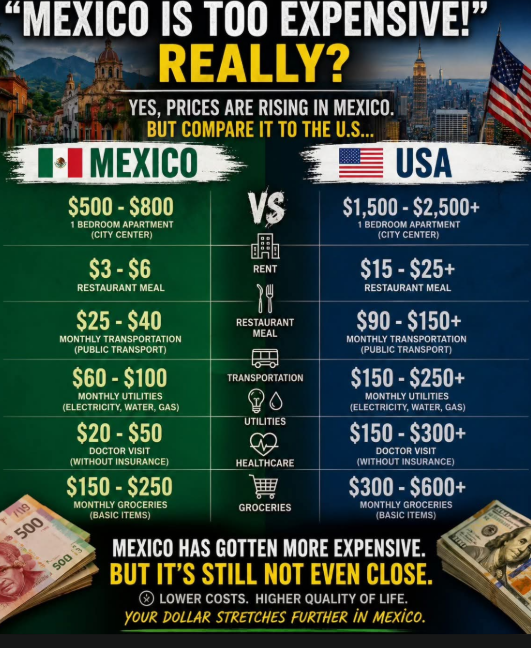

But It’s Still Nowhere Near U.S. Prices
Over the last few years, one complaint has become more common among Americans living in or moving to Mexico: “Mexico isn’t cheap anymore.” Rent has gone up in many popular expat areas. Grocery bills feel higher than they did a few years ago. Restaurants, utilities, and everyday services have also seen price increases in many parts of the country.
And to be fair, they are not imagining it. Mexico has become more expensive, especially in cities and neighborhoods that have attracted large numbers of foreign residents, remote workers, retirees, and tourism-driven investment. Places such as Mexico City, Puerto Vallarta, San Miguel de Allende, Los Cabos, and parts of the Riviera Maya have all felt the pressure of rising housing costs and higher prices for everyday life.
But here’s the part that often gets lost in the conversation:
Even after those increases, Mexico is still far cheaper than the United States for most everyday living expenses.
That does not mean Mexico is “cheap” for everyone. It is not. Rising prices affect Mexican families far more directly than they affect many foreigners earning in dollars. But when Americans complain that the cost of living in Mexico is “out of control,” the reality is that U.S. prices are still on a completely different level.
The real comparison: Mexico has gotten pricier — the U.S. is still dramatically more expensive
Current cost-of-living comparisons still show a very large gap between the two countries. Overall consumer prices in Mexico remain well below U.S. levels, and the biggest differences continue to be rent, restaurant prices, transportation, utilities, and healthcare. Numbeo’s 2026 country comparison, for example, shows the United States with much higher rent and restaurant prices than Mexico, while broader cost-of-living estimates also continue to place Mexico well below the U.S. overall.
Take housing alone. In many U.S. cities, a one-bedroom apartment can easily run $1,300 to $1,700+ per month outside the luxury market, and in major metros it can be much more. In Mexico, even though rents have risen sharply in desirable neighborhoods, the average rent is still substantially lower than in the U.S. overall. The same pattern shows up again and again: eating out, local transportation, domestic help, and many services that feel financially out of reach for middle-class Americans are still more accessible in Mexico.
What Americans are really reacting to
A lot of the frustration is not actually about Mexico being “as expensive as the U.S.” It’s about Mexico no longer feeling as cheap as Americans expected it to be.
That’s an important distinction.
For years, Mexico was sold to many foreigners as a place where you could dramatically cut your expenses, live near the beach, enjoy good weather, and still spend far less than in California, Texas, New York, or Arizona. That image still has truth to it — but it is no longer as simple as it once was.
If someone moved to Mexico expecting 2018 prices while renting in a trendy part of Roma, Condesa, Puerto Vallarta, Tulum, or San Miguel in 2026, of course they are going to feel sticker shock. Mexico has changed. Landlords know foreign demand is there. Short-term rentals have distorted housing markets in some cities. Imported products, electronics, premium groceries, and “expat lifestyle” spending can erase some of the savings very quickly.
But that still doesn’t make Mexico comparable to the U.S. in overall cost.
The biggest thing Americans forget: U.S. life comes with costs Mexico still doesn’t match
The average American is not just paying more for rent and groceries. They are also dealing with a whole layer of expenses that can be brutal in the United States:
health insurance premiums
medical deductibles and out-of-pocket bills
higher car insurance costs
childcare that can rival a second rent payment
higher utility and service costs in many markets
restaurant prices inflated by labor, rent, and tipping culture
property taxes and housing-related costs that keep climbing
That’s why so many Americans feel squeezed at home even with higher incomes. The cost of living in the U.S. is not just “a little higher.” In many cases, it is structurally more expensive from top to bottom. Mexico may have become more expensive than it used to be, but for most people it still does not come close to the total financial pressure of living in the United States.
There is also a bigger issue: who is really being priced out?
This is where the conversation needs honesty.
When Americans complain about rising costs in Mexico, they are usually talking about how it affects their comfort, their budget, or their expectations. But the people facing the most serious consequences are often Mexican residents earning local wages, not foreigners earning in dollars.
A rent increase that feels “annoying” to a remote worker paid in U.S. currency can be devastating for a local family. A neighborhood that becomes attractive to foreign renters can quickly become unaffordable for the people who have lived there for years. So yes, Mexico is getting more expensive — but the real concern should not be whether an American can still get a nice apartment for less than in Austin or Los Angeles. The bigger question is what rising housing and consumer costs are doing to the people who live and work in those communities full-time.
Mexico is more expensive than before. It is still not America-expensive.
That is the bottom line.
Yes, Americans are right about one thing: the cost of living in Mexico has gone up. In some places, it has gone up fast. Rent in popular areas has climbed. Certain groceries, imported goods, and lifestyle expenses can surprise people. Mexico is not the bargain it was a decade ago.
But it is still misleading to talk about Mexico as if it has become “basically the same” as the United States.
It hasn’t.
Not when U.S. rent is still dramatically higher.
Not when U.S. healthcare can destroy a household budget.
Not when eating out, insurance, childcare, and daily services cost so much more north of the border.
And not when many Americans move to Mexico precisely because, even after recent increases, their dollar still stretches further there than it does back home.
So yes — Mexico is more expensive than it used to be.
But no, it is still not even close to American prices in the categories that hit hardest: housing, healthcare, services, and everyday living costs.
That’s the reality.
Source: mexicodailypost