
Although Chiapas is not among the Mexican states with the highest number of recorded massacres, violence linked to organized crime has left episodes that have marked the state and exposed the deterioration of security in different regions.
According to the civil organization Causa en Común, between January 2020 and March 2026, a total of 3,306 massacres were documented across Mexico.
During the first four months of 2026 alone, approximately 60 cases were recorded. Guanajuato, Guerrero, and Michoacán lead the national list with 535, 237, and 233 incidents, respectively.
Although Chiapas remains outside the states with the highest incidence, episodes of extreme violence have not been absent. One of the most shocking occurred in late June 2024, when approximately 20 bodies were found in the bed of a dump truck abandoned on a dirt road in the municipality of La Concordia.
At that time, during the administration of Rutilio Escandón Cadenas, the conflict between the Jalisco New Generation Cartel (CJNG) and the Sinaloa Cartel (CDS) had placed the state in one of its most critical moments. Days later, a video circulated showing an alleged CDS member firing at the already lifeless bodies.
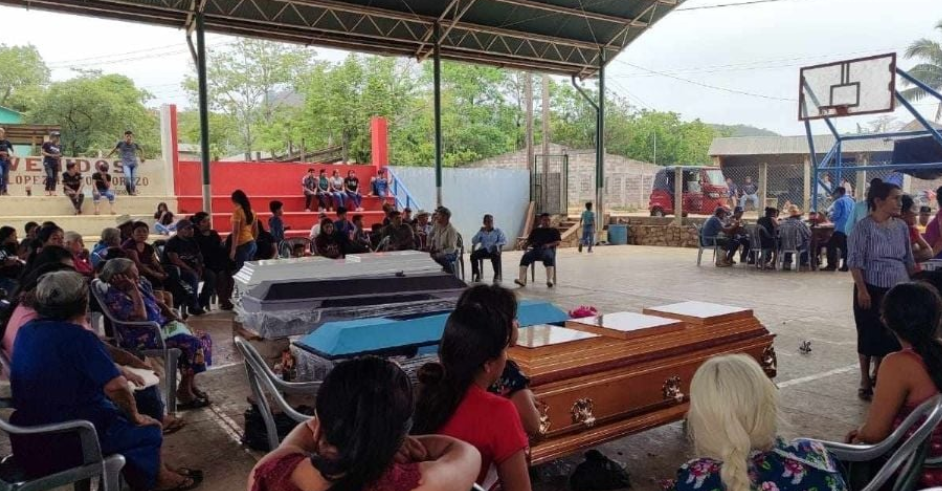
However, the massacre that most shocked Chiapas occurred on May 13, 2024, in the Nueva Morelia ejido, municipality of Chicomuselo, where 11 members of a family were murdered by an armed group. Some of the victims were burned.
The Fray Bartolomé de Las Casas Human Rights Center (Frayba) condemned the events and noted that the massacre took place after a series of confrontations in nearby communities such as Lázaro Cárdenas.
Since January of that year, nearly 700 residents of Nueva Morelia had already been displaced due to violence.
Police Officers Ambushed and Burned
Violence continued throughout 2025. In June of that year, five State Police officers were ambushed while conducting a patrol on a highway connecting Las Champas and Ciudad Cuauhtémoc in Frontera Comalapa, a municipality bordering Guatemala.
The officers died from gunshot wounds, and the attackers later set the patrol vehicle on fire with their bodies inside. Among the victims was a female police officer.
The attack represented one of the most significant blows to the administration of Eduardo Ramírez Aguilar, who had focused on strengthening security through the creation of the Pakal Immediate Reaction Force (FRIP), composed of approximately 500 personnel.
Villaflores, Another Center of Violence
Despite security operations and the deployment of law enforcement forces, violence intensified again in December when an armed group entered the bars “Anubis” and “La Cábala Sport Bar” in Villaflores and abducted at least eight people. The establishments were later set on fire.
Days later, employees and owners of both businesses were found dead in the community of Santa Julia, municipality of Cintalapa. Two female employees survived with severe burns and remained hospitalized in Tuxtla Gutiérrez.
Subsequently, the State Attorney General’s Office reported the arrest of four alleged members of the so-called Chiapas and Guatemala Cartel. Nevertheless, fear once again spread throughout one of the municipalities most affected by organized crime.
Another recent incident occurred on April 13, when four men were shot and killed inside the bar “El Profe” in Ocozocoautla de Espinosa. According to state authorities, the attack was linked to a dispute between groups involved in local drug trafficking.
On the same day, a young woman was abducted. She was later found alive following efforts by family members and friends.
For Causa en Común, these patterns reflect territories where criminal disputes, illegal economies, and institutional weaknesses converge, creating conditions that facilitate the reproduction of extreme violence.
The Other Crisis: Missing Persons
Jorge Luis López, a member of the Litigants Group for the Protection and Defense of Human Rights, argued that the classification of Mexican cartels as terrorist organizations by the United States does not benefit Mexico and has resulted in increased control of the southern border.
He stated that although official statistics show progress in security matters, the reality on the ground is different. He also warned that disappearances represent a crisis comparable to the social impact caused by massacres.
Data from the Chiapas Citizen Observatory and the Executive Secretariat of the National Public Security System show an upward trend in intentional homicides. In 2022, 421 cases were recorded; in 2023, the figure increased to 535; and by 2024, it had reached 620 murders, making it one of the most violent years for the state.
However, during 2025, intentional homicides declined to 355, nearly half the number recorded the previous year.
At the same time, the National Registry of Missing and Unlocated Persons reports approximately 1,900 missing persons in Chiapas, a problem that specialists and organizations consider increasingly alarming.
Source: lasillarota