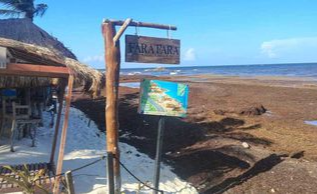

Over the last decade, the arrival of sargassum in the Riviera Maya has increased year after year, heavily impacting the economy. However, in 2026 the situation has worsened, as twice as much of this macroalgae has been reported compared to 2025.
Business owners, hotels, and restaurants are concerned because this year the sargassum arrived earlier than expected, staining the seas and beaches of the region, especially in Tulum and Playa del Carmen, two tourist paradises that are now under pressure.
Tulum is one of the municipalities that has suffered the most damage, as there are additional factors affecting its economy.
In recent days, restaurants, hotels, and other businesses have closed because they can no longer withstand the lack of tourists.
During a tour conducted by MILENIO, hundreds of signs advertising houses, apartments, commercial spaces, and even entire buildings for sale could be seen.
According to local residents, multiple factors are responsible, including the municipality’s poor reputation for mistreating tourists, excessive service prices, alleged police extortion, insecurity, and, on top of all that, the arrival of thousands of tons of sargassum accumulating on its beaches.
“Instead of helping, the government practically dedicated itself to extorting everyone, and that money is not reported anywhere. Then we add the real estate bubble, abusive taxi drivers, and the bad reputation for prices. For example, right ahead is Velvet. I don’t doubt they have good ice cream, but it’s not possible to pay 500 pesos for ice cream. I don’t think even in France you would pay those prices. I’ve been to France and prices like that don’t exist for ice cream,” commented a Tulum merchant who continues operating in what sometimes resembles a ghost town.
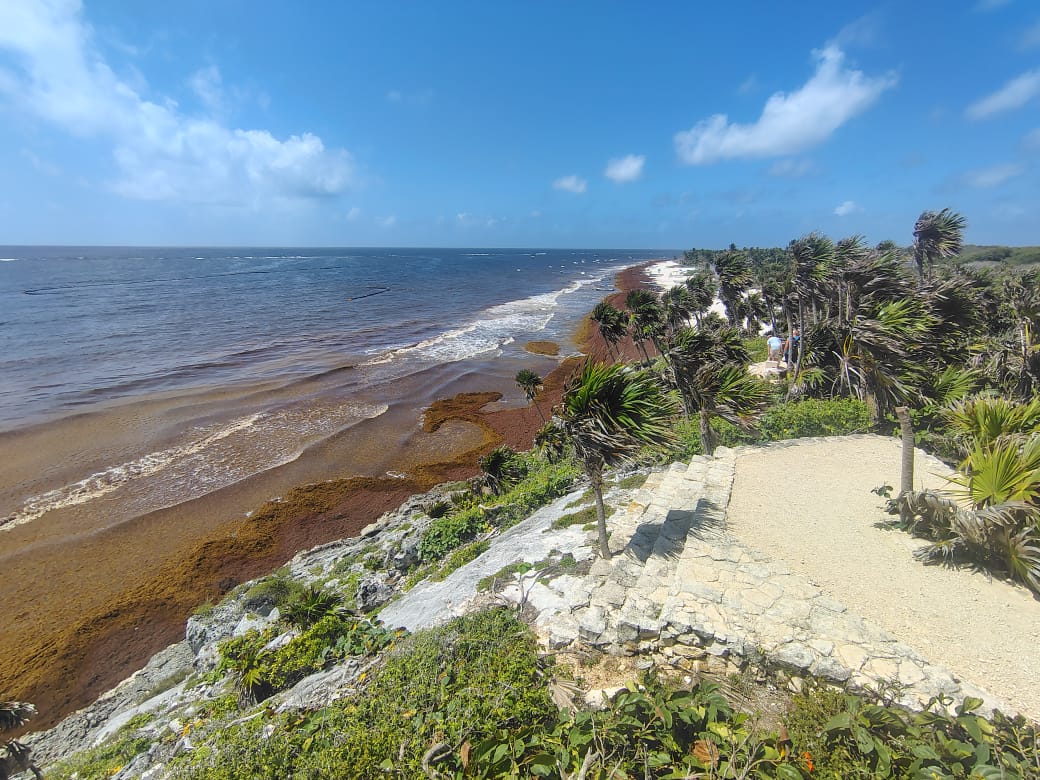
Walking along Boca Paila Avenue, one of the main roads crossing the most exclusive area, visitors can smell decomposing sargassum from a distance. Once the beach comes into view, the scene is harsh: tons of algae trapped where there is usually white sand and turquoise water, now turned brown.
One of the main problems associated with this situation, according to local business owners, is the invasion of beachfront hotels and properties. Certain groups have allegedly dedicated themselves to this activity, and when cases reach the courts, little progress is made, resulting in business closures and leaving no one responsible for cleaning up the accumulated sargassum.
However, cleanliness is not only a problem on the beach. Trash and construction debris can also be seen on the streets. The combination of all these issues led Tulum business owners to say “enough is enough” to local authorities.
“I am not going to talk about noise, taxi drivers, police, developers, or even sargassum, because I already spoke about sargassum in its day. Let’s create a serious awareness campaign. Let’s keep the destination energetically clean, and maybe that will allow each of us to take responsibility for our own messes, with all due respect. Let’s clean the house before continuing to promote a destination that is currently dirty,” said Javier, a Spanish businessman living in Tulum, during a meeting held at a local restaurant.
Representatives of Mayor Diego Castañón attended the meeting. The mayor has gained a poor reputation for allegedly neglecting the municipality and even residing in another state.
The officials listened to business owners who generate thousands of jobs in part of Quintana Roo, including Franchesca, an Italian woman who has operated a small hotel for decades.
“The sargassum problem—I’m not sure everyone knows this—but hotel owners have been paying an environmental sanitation fee for several years now. To date, we have seen no benefits from it. We do not know what is happening with that money, how it is being used, or whether it is being used at all. We are only told that a signature is missing for the trust fund. I think that is truly outrageous,” she complained, referring to a trust fund that should have been created two years ago but was never established by the municipality, with no transparency regarding where the collected tax revenue has gone.
Gradually, frustration increased.
“How long have we had this sargassum problem? Ten or twelve years. In other words, even with the sargassum issue, we had managed to move forward. However, that has not been the case in recent years,” said a restaurant owner who preferred not to reveal her name.
When it was the authorities’ turn to respond, officials focused on promises and avoided certain direct questions.
For example, Municipal Inspection Director Sergio Canto responded to questions about the environmental sanitation tax by asking who was operating legally and who was not.
“We can spend the entire administration discussing what percentage is operating irregularly and what percentage is operating legally. If we start honestly by identifying who is compliant and who is not, then we can question where the resources are going,” he stated.
David Bucana, head of the Federal Maritime Land Zone (Zofemat), also defended the administration.
“This is an unusual year, a very complicated year. More than double the amount from last year is arriving. What is happening now is not something we could control or predict. We expected the sargassum to begin arriving at the end of March or beginning of April, and it started arriving in January.”
In Tulum, the municipality has collected nearly 2,500 tons of sargassum so far this year, compared to 1,300 tons during the same period in 2025.
A Similar Situation in Playa del Carmen
A few kilometers to the north, the situation is not very different. Playa del Carmen is experiencing a similar scenario, although it has been able to overcome some challenges thanks to tourist activity in the streets, even if not on the beaches.
The continuous arrival of the macroalgae is already harming the hotel and restaurant sectors, as well as fishing and service industries, where workers have begun experiencing health problems.
“People suffer lung damage, leg injuries, and other health effects because they are not accustomed to dealing with decomposing sargassum. This problem must be taken seriously. Since it has not been given the seriousness it deserves, investments have been made only little by little. A major investment is necessary to build infrastructure that will allow us to remain free of sargassum,” José Gómez Burgos, president of the Caribbean Sea Tourism Cooperative, told MILENIO.
The fishing industry leader said that a major project is needed to install a barrier that could function as an artificial reef.
“If nothing is done, this will collapse. The city will collapse. In fact, you can already see it. Restaurants are closing, hotels are becoming vacant, and people are leaving. They cannot tolerate the pressure and anxiety of living under this constant threat,” he emphasized.
The Mexican Navy has reported a significant increase in the arrival of sargassum and estimates that it could collect more than 100,000 tons in Quintana Roo during 2026.
Source: milenio