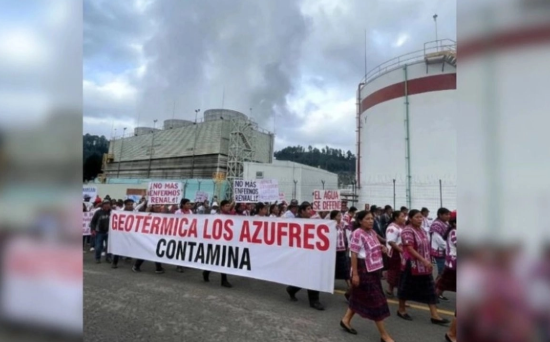

Citing environmental damage to air, land, and water, residents of the Otomí community of San Matías el Grande (in the municipality of Hidalgo) filed a complaint this Tuesday with the National Human Rights Commission. They are seeking to hold the Federal Electricity Commission (CFE) accountable for the consequences resulting from the Los Azufres geothermal power plant in this eastern region of Michoacán.
The complainants maintain that in the 44 years since the geothermal plant was installed, dozens of people have fallen ill and died from kidney failure. They attribute this to the fact that their drinking water is contaminated with toxic chemicals—a problem that did not exist previously.
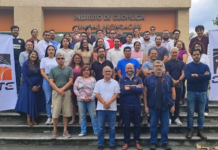
Led by members of the Supreme Indigenous Council of Michoacán (CSIM), the group filed the complaint alleging a violation of the right to a healthy and ecologically balanced environment. This fundamental human right is enshrined in Article 4 of the Political Constitution of the United Mexican States—which establishes that “everyone has the right to a healthy environment for their development and well-being”—as well as in various international treaties signed and ratified by the Mexican State.
“We insist on denouncing the CFE for violating environmental laws; in its reports to Profepa [the Federal Attorney for Environmental Protection], the commission states that it operates a total of 33 cooling ponds. Of these, 18 are lined with reinforced concrete, three with geomembranes, and 12 still lack any type of lining.” This means that 36.3 percent of their ponds are highly polluting and fail to meet international standards, noted Pavel Guzmán, a leader of the indigenous organization.
In short, throughout the 44 years the geothermal plant has been in operation, the CFE has failed to adequately line the ponds that hold highly toxic fluids; these ponds remain exposed to the elements, negatively affecting local aquifers and the environment. A technical report titled “Chronic Kidney Disease in the Eastern Region of Michoacán and Its Relationship with Natural Conditions and Environmental and Psychosocial Impacts” was presented to the National Human Rights Commission (CNDH). The report was produced by researchers from the Universidad Michoacana de San Nicolás de Hidalgo (UMSNH), alongside other upper-secondary educational and specialized research institutions.
The university’s study demonstrates that springs in Ciudad Hidalgo and Zitácuaro exhibit toxicity levels of between 35% and 50% due to the presence of heavy metals. Furthermore, studies conducted on children aged 10 to 12 reveal that 32.79% of students at schools in San Matías el Grande are showing early signs of kidney disease.
It is also noted that the State Human Rights Commission has referred two complaints against the geothermal power plant to the CNDH—under file numbers CEDH/24448/2025-Q and CEDH/5719/2026-ACT—and we demand that these not be dismissed and that the appropriate legal proceedings be carried out.
Pavel Guzmán emphasized that the harm suffered by dozens of families is evident; they have even faced serious difficulties in accessing dialysis and hemodialysis treatments, entailing significant expenses for the area’s residents, the majority of whom live in poverty.
Source: jornada