
US Builds a “Smart Wall” Along the Border With Mexico
For decades, the only thing separating the United States from Mexico was a barbed-wire fence.
Now, after receiving a massive funding boost from Congress, President Donald Trump’s administration is rapidly building what it calls a “smart wall”: a combination of 9-meter-high steel fencing equipped with sensors, cameras, and surveillance towers that allow the U.S. Border Patrol to monitor the area.
The project has come under intense scrutiny because of the billions of dollars allocated to it at a time when border crossings are at their lowest level in decades. Critics argue that the United States is militarizing the border with increasingly sophisticated surveillance technology, affecting local communities.
“We’re seeing a huge expansion of surveillance and surveillance technology across the border region,” said Ricky Garza, border policy advisor for the Southern Border Communities Coalition. “The wall, in all its forms, is harmful to communities.”
Authorities argue that the technology complements the physical barrier and allows agents to dedicate more time to other responsibilities.
“It’s a smart wall. It’s not just a barrier,” said U.S. Customs and Border Protection (CBP) Commissioner Rodney Scott during recent congressional testimony. “It maximizes the use of our most valuable resource, which is our agents.”
Contracts Signed to Build Hundreds of Kilometers of Wall
The border wall has been one of President Trump’s top priorities since his first presidential campaign.
During former President Joe Biden’s administration, the border became a major point of tension due to the high number of people attempting to cross into the United States each day. Those numbers began declining shortly before Trump’s return to the White House and later reached historic lows, as his immigration policies discouraged many migrants from attempting the journey.
With a $46 billion budget approved by Congress to complete the wall as part of immigration enforcement funding, CBP is awarding contracts worth tens of billions of dollars to advance the administration’s flagship project.
Homeland Security Secretary Markwayne Mullin recently stated that the first phase of the wall will be completed “by this time next year.” Scott added that the agency is currently building approximately 10 kilometers of wall each week.
Before Trump’s return to office, hundreds of kilometers had already been completed. As of mid-June 2026, CBP had constructed an additional 119 kilometers and plans to build several hundred more. The agency does not intend to install a wall along approximately 861 kilometers of the nearly 3,200-kilometer border because the rugged terrain already serves as a natural barrier. In those areas, it will rely on ground sensors and surveillance towers.
CBP is also upgrading hundreds of kilometers of existing wall by adding more technology, lighting, and patrol roads. Along the river separating Texas from Mexico, the agency is deploying cylindrical buoys measuring between 3.7 and 4.5 meters in length to prevent migrants and smugglers from crossing.
Technology Takes a Bigger Role in Border Security
Technology is playing an increasingly important role in the Trump administration’s strategy to prevent unauthorized border crossings. It is part of CBP’s transformation following the September 11, 2001 terrorist attacks into an agency with expanded intelligence and surveillance capabilities extending beyond the border itself.
Critics argue that this model poses risks to border communities.
The Southern Border Communities Coalition says surveillance technologies force migrants into more dangerous routes to avoid detection.
Garza also warned that these systems infringe on the privacy of border residents, noting that some homeowners have discovered ground sensors installed on their properties without permission.
Nayda Alvarez and her family own land along the Rio Grande, about 200 kilometers from the Gulf of Mexico. She said she found cameras installed on her property and recently noticed a surveillance tower about 500 meters from her home.
“Are we expecting a war or something?” she asked. “It doesn’t make me feel any safer.”
Dave Maass, director of investigations at the Electronic Frontier Foundation, an organization focused on digital civil liberties, said the technology has turned the border into “a hostile environment” for both residents and migrants.
The organization has published a guide identifying the various types of surveillance towers installed along the southern U.S. border to help local communities better understand the systems.
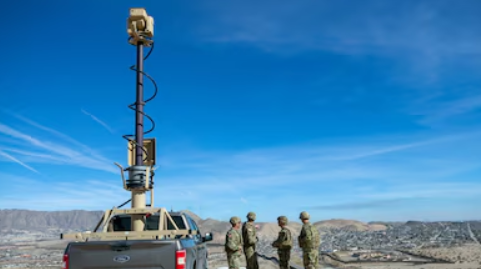
These include fixed towers equipped with cameras, infrared sensors, and radar capable of monitoring areas up to approximately 13 kilometers away, as well as mobile units mounted on trucks that can be relocated as needed.
The towers are becoming increasingly autonomous. They can scan the terrain, analyze images using artificial intelligence, and alert Border Patrol agents when suspicious activity is detected. Supporters argue that this allows agents to remain in the field rather than monitoring computer screens. However, experts have raised concerns about potential bias and errors associated with artificial intelligence.
The tax and spending legislation approved by Congress last summer requires CBP to purchase only autonomous surveillance towers, and the agency is currently deploying 95 additional units.
Beneath the ground, fiber-optic cables capable of detecting movement are also being installed. The information collected is analyzed using artificial intelligence systems.
“We follow the contour of the land. We go through the trees. We go down to the riverbanks. We can go absolutely anywhere,” explained Magnus McEwen-King, CEO of Sintela, one of the companies contracted by CBP to install the fiber-optic network.
CBP also uses ground sensors and trail cameras to detect routes commonly used by smugglers and migrants.
Questions Raised About Costs and Future Plans
The organization Taxpayers for Common Sense has questioned the enormous cost of the border wall and is calling for stricter evaluations of the effectiveness of the technologies being funded with taxpayer money.
In 2011, during President Barack Obama’s administration, then-Homeland Security Secretary Janet Napolitano canceled a proposed “virtual wall” project involving radar, sensors, and cameras along the border because of cost overruns, technological failures, and delays.
Josh Sewell, director of research and policy at Taxpayers for Common Sense, said the organization wants stronger evaluations of border technologies to avoid repeating those problems. He also criticized oversight of spending during the Trump administration, an accusation that CBP rejected, stating that it has proper oversight mechanisms in place.
In the Big Bend region of southern Texas, plans to expand the wall have faced opposition from both Democrats and Republicans, particularly near the state park, national park, and wildlife conservation areas.
CBP has announced that it no longer plans to build a 9-meter steel wall in that region. Instead, it will construct patrol roads, install vehicle barriers, and deploy technological detection systems.
Clara Benson, one of the founders of the No Big Bend Wall coalition, warned that the planned lighting installations could negatively affect the area’s renowned dark skies, one of its main attractions.
“There is still a great deal of fear and concern that the plan could remain quite harmful,” she said.
Source: elfinanciero