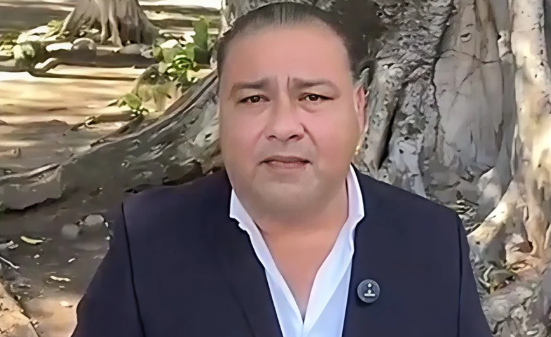

Journalist David Jonathann Estrada Castillo left the state of Quintana Roo to protect his life and the safety of his family after publicly presenting evidence of threats against his wife and daughter, while also facing a series of judicial and electoral actions aimed at limiting his journalistic work and his critical reporting about Governor Mara Lezama and her husband, Omar Terrazas García.
Escalating Pressure Against His Journalistic Work
The harassment is part of an escalation that Estrada has faced for exercising his rights to freedom of expression and freedom of the press.
In April 2025, Judge Octavio Ascencio Fernández of the Third Civil Court in Cancún ordered up to 36 hours of detention against Estrada, owner of Cancún Channel, Contrapunto Noticias, and Chetumal TV.
The measure was issued as part of a civil lawsuit filed by the governor’s husband, based on allegations that Estrada had failed to comply with a court order by not providing tax declarations. However, the sanction imposed by the judge also prohibited the journalist from speaking about the governor’s husband.
According to reporting by Los Ángeles Press, Estrada’s legal defense argued that the requested tax documents were unrelated to the civil case and that no final court ruling required their submission.
Estrada filed a constitutional injunction (amparo) to prevent the arrest order from being enforced and warned that his physical safety would be at risk if he were detained.
The legal dispute originated from a lawsuit alleging moral and economic damages related to publications concerning an alleged corruption network in Quintana Roo.
Electoral Complaint Filed by the Governor’s Legal Office
The pressure later expanded into the electoral arena.
The Legal Counsel’s Office of the Executive Branch of Quintana Roo, headed by Carlos Felipe Fuentes del Río and acting as the legal representative of Governor Mara Lezama, filed a complaint before the Electoral Institute of Quintana Roo (IEQROO) accusing Estrada of alleged political violence against women based on gender.
The complaint was based on videos published on Facebook through the account “Jonathann Estrada.”
The IEQROO opened case IEQROO/PESVPG/001/2026 and issued precautionary measures.
The Complaints and Reports Commission ordered the removal of two publications and instructed Estrada to refrain from making statements about Mara Lezama and her family while the case was being resolved.
The electoral authority clarified that the measure should not be interpreted as a general restriction on the right to criticize public officials. However, its immediate effect was the removal of published content and the placement of the journalist’s public expression under preventive restrictions.
Request to Continue Legal Defense from Abroad
On June 16, after leaving Quintana Roo, Estrada requested that the IEQROO grant him digital access to the case file, electronic notifications, and procedural accommodations so he could continue his legal defense while outside the country.
In his filing, the journalist formally documented his vulnerable legal situation.
Additional Complaint and New Precautionary Measures
The state government’s Legal Counsel’s Office intervened again on June 25.
It requested enforcement measures against Estrada over a June 17 broadcast of the program La Hora del Chaquiste, which was transmitted through Cancún Channel Internacional.
Governor Lezama’s legal representatives argued that Estrada had violated the previously imposed precautionary measures and maintained that he had already been notified of both the complaint and the restrictions.
The new IEQROO resolution ordered the removal of the disputed video, formally warned Estrada, and stated that any future noncompliance could result in additional enforcement measures and a new administrative sanctioning procedure.
The Commission also ordered that the case file be forwarded to the Attorney General’s Office of the State of Quintana Roo so that it could review the facts and take any action within its legal authority.
By that time, Estrada had already left Quintana Roo.
His legal defense before the IEQROO has since been conducted by email, through requests for digital access to the case file and procedural accommodations that would allow him to respond from abroad.
Source: losangelespress.org