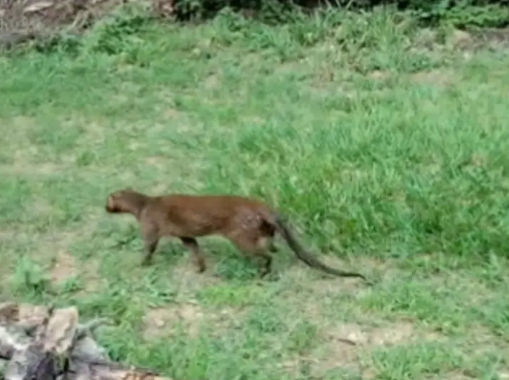

The dense silence of the Sierra Madre de Oaxaca was gently interrupted by the crunch of dry leaves. In a moment that seemed frozen in time, a young female jaguarundi paused, scented the humid air, and confidently walked into the forest until she disappeared completely among the vegetation. This quiet journey, documented and shared by Mexico’s Federal Attorney for Environmental Protection (Profepa), marked the culmination of an extensive rescue process and a victory for an ecosystem that has regained one of its most discreet predators.
The Rescue: From Urban Captivity to the Wild
The story of this jaguarundi began far from the shelter of the forest canopy. The feline was originally found inside a private home, a confined environment completely unsuitable for the biological and behavioral needs of its species. Keeping wild animals in urban settings not only violates environmental laws but also directly threatens their development and survival.
After authorities secured the animal, it underwent a thorough physical and behavioral evaluation. A multidisciplinary team of biologists and veterinarians assessed its health, ensuring that it had retained its natural hunting instincts, ability to avoid threats, and capacity to seek shelter. The final assessment was positive: the young jaguarundi was healthy and fully capable of surviving on its own in the wild, allowing authorities to proceed with its release.
The Daytime Hunter of the Forest
The jaguarundi (Herpailurus yagouaroundi), also commonly known as the otter cat, eyra cat, or leoncillo in parts of Mexico, has a distinctive appearance that often surprises those who encounter it. Unlike jaguars or ocelots, it lacks the characteristic spotted coat, instead displaying solid-colored fur ranging from reddish-brown to gray and deep black. It has a long, slender body, short legs, and an unusually long tail.
Its behavior also differs from that of many other wild cats. The jaguarundi is primarily active during the day and feeds on small mammals, birds, reptiles, and amphibians.
An Ideal Home: Benito Juárez National Park
To maximize the chances of a successful reintroduction, authorities carefully selected the Benito Juárez National Park, a protected natural area located north of Oaxaca City in the Sierra San Felipe. Established in 1937, the park covers approximately 3,000 hectares of ecologically rich landscape.
The area features extensive pine and oak forests, along with patches of tropical dry forest. Beyond its remarkable biodiversity, the park plays a crucial role in supplying fresh water to Oaxaca City. Streams originating from its mountains—including Cerro San Felipe, which rises to nearly 3,500 meters (11,500 feet) above sea level—provide essential water resources for the region.
Today, the park serves not only as a biological sanctuary but also as a center for environmental education and sustainable tourism. Facilities such as the La Mesita Conservation Center and its butterfly sanctuary promote environmental awareness in nearby communities such as San Pablo Etla and Donají, where residents actively help protect the surrounding ecosystems through activities like hiking and mountain biking.
What to Do If You Encounter Wildlife
The jaguarundi’s return to Oaxaca’s mountains increases the possibility that visitors may encounter this or other native wildlife while exploring the park. Experts emphasize that the protected area is first and foremost the animals’ home.
If you see a jaguarundi or another wild predator, the most important recommendation is to remain calm. Do not attempt to approach the animal, feed it, or get close for photographs. Respecting its space and reporting the sighting to authorized park personnel helps ensure that these animals continue to thrive in their natural environment.
This successful reintroduction highlights the importance of reporting the illegal possession of wild animals and preserving healthy wildlife corridors. Thanks to coordinated conservation efforts, the Sierra Madre de Oaxaca once again has one of its rightful inhabitants, helping maintain the delicate ecological balance of Mexico’s natural ecosystems.
Source: nvinoticias