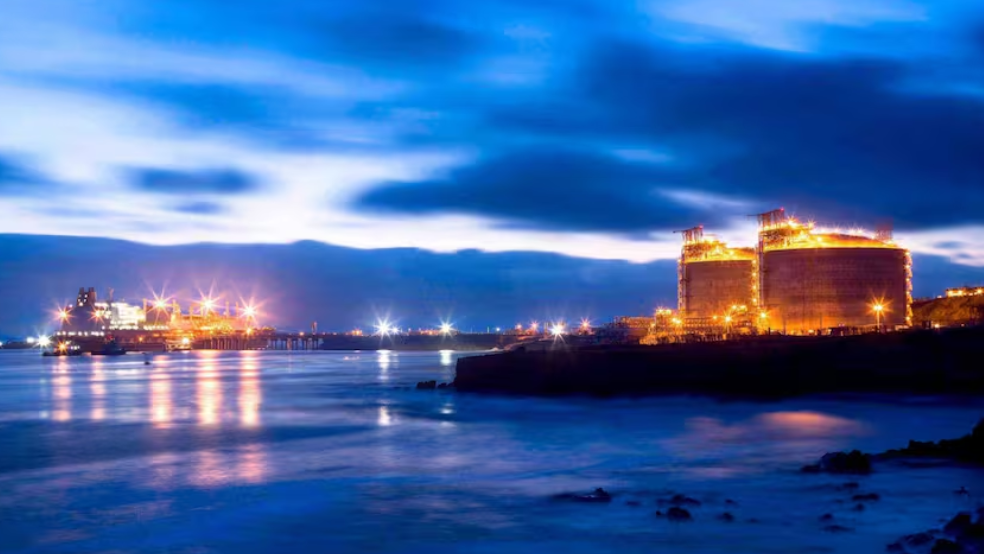

The first shipment of liquefied natural gas (LNG) from the Energía Costa Azul terminal to Asia inaugurates a new energy corridor. Mexico doesn’t supply the gas itself, but it does provide the infrastructure and the location.
Mexico has begun exporting liquefied natural gas to Asia from its Pacific coast. The first shipment produced at the Energía Costa Azul (ECA LNG) terminal in Baja California set sail this week bound for the Asian market, a milestone that strengthens the country’s role as a strategic platform for North American energy trade.
The shipment was made by TotalEnergies, one of the world’s largest LNG traders, as part of a 20-year, 1.7 million-ton annual supply contract signed with Sempra Infrastructure, the developer of the terminal located in Ensenada.
The shipment marks the beginning of a new energy corridor between North America and Asia. The plant’s location on the Pacific coast allows for reduced shipping times and logistical costs compared to exports originating from the U.S. Gulf Coast, many of which must cross the Panama Canal to reach their destinations.
In this case, the gas is not of Mexican origin. It comes from the Permian Basin in Texas and New Mexico, from where it is transported by pipeline to Baja California to be liquefied and shipped to markets such as Japan, South Korea, and other Asian countries with growing energy demand.
“This first shipment represents an important step in our integrated LNG strategy,” TotalEnergies stated when announcing the operation, highlighting that the project will strengthen its capacity to supply customers in the Asia-Pacific region.
For Mexico, this move confirms the strategic value that its energy infrastructure has acquired. The first phase of ECA LNG will have the capacity to produce approximately 3.25 million tons of liquefied natural gas (LNG) per year and is part of a strategy to transform the Pacific coast into a new gateway for North American energy exports.
Just a few weeks ago, the terminal produced its first LNG during the testing phase. The shipment announced now represents the first commercial delivery and brings the project closer to full operation.
This shipment also reveals the direction the regional energy business is heading. While the United States supplies the raw material and Asia accounts for a significant portion of the demand, Mexico is seeking to capture a share of the value through infrastructure, transportation, and logistics services—a strategy that could attract new investment but will also depend on regulatory certainty for future projects.
Source: cronista