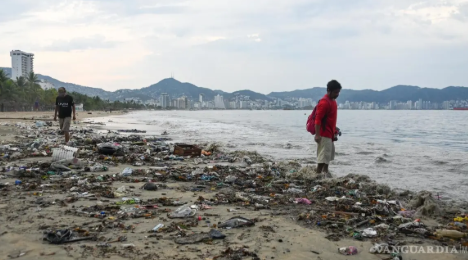

The Federal Commission for Protection against Sanitary Risks (Cofepris) identified five beaches in the country that exceeded permissible limits for microbiological contamination and were classified as unsuitable for recreational use by swimmers during the summer holidays.
Analytical results from pre-vacation monitoring confirmed that Tijuana Beach in Baja California; Cuale Beach in Puerto Vallarta, Jalisco; Principal Beach in Puerto Escondido, Oaxaca; as well as José Martí and Tumbao II beaches in the port of Veracruz, show harmful concentrations of enterococci bacteria.
WHAT IS FOUND AT MEXICO’S MOST CONTAMINATED BEACHES?
The official report detailed that laboratory samples from these five coastal locations yielded values exceeding the maximum risk threshold established by the World Health Organization (WHO), which sets the limit at 200 enterococci per 100 milliliters of water.
The most critical situation was recorded in the port of Veracruz, where José Martí Beach reported a level of 978 bacterial units, while the reading at Tumbao II showed 202 units.
“Cofepris recommends that swimmers refrain from swimming or engaging in other recreational activities involving direct contact with the water at the beaches designated as unsuitable. Preserving healthy environments and protecting public health is a shared commitment,” the federal agency warned.
Following this negative assessment, the Commission noted that the administrations of the four affected states, in coordination with their respective Clean Beach Committees, have begun implementing contingency plans and installing warning signs to mitigate health risks to the public.
The overall outlook from the national “Clean Beaches 2026” program determined that 98.3 percent of the country’s coastal areas are in optimal condition, confirming the safety of 284 of the 289 sites evaluated. The technical operation involved collecting 2,279 seawater samples from 393 strategic monitoring points across the country’s 17 coastal states.
In contrast to coastal locations identified as contaminated, the Sinaloa State Commission for Protection against Sanitary Risks announced that all 22 of its beach destinations are safe for tourist enjoyment during the upcoming holiday period.
Data from the comprehensive monitoring program was shared with the Secretariat of Environment and Natural Resources (Semarnat) to update official public-access digital platforms before the start of the vacation season.
Source:; vanguardia