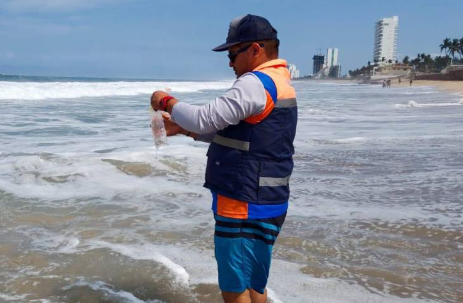

The 22 beaches monitored across Sinaloa’s main tourist destinations meet water quality standards and are suitable for recreational use by swimmers, according to the latest monitoring results conducted by the State Commission for the Protection against Sanitary Risks of Sinaloa (Coepriss).
The agency reported that analyses confirmed all evaluated beaches fall within permissible parameters for enjoyment during the holiday season, posing no health risk to visitors.
These efforts are part of a coordinated initiative involving Coepriss, the Federal Commission for the Protection against Sanitary Risks (Cofepris), and the National Network of Public Health Laboratories, aimed at maintaining constant water quality surveillance in areas with high tourist traffic, noted Beatriz Aguiar Monroy, head of Coepriss.
“The monitoring results from Cofepris confirm that Sinaloa’s beaches are suitable for recreational use, so the public can enjoy them with peace of mind, provided they continue to observe measures for environmental care and preservation.”
She also emphasized that maintaining the beaches in optimal condition is a shared responsibility among authorities, service providers, and visitors; she therefore urged the public to help preserve these areas by avoiding littering, using waste bins, and respecting the natural environment.
Through these actions, Coepriss reaffirmed its commitment to protecting against health risks and promoting safe spaces where families can enjoy Sinaloa’s beaches with confidence and peace of mind.
The report highlights that the state’s main tourist destinations meet sanitary criteria to provide safe environments for visitors and families during the holiday season, assuring the public that swimming poses no risk. Pre-vacation monitoring of seawater quality at the 22 recreational beaches in the state is part of the Seawater Surveillance Program for Primary-Contact Recreational Use. Coepriss conducts ongoing sanitary monitoring of beaches across Sinaloa’s main tourist destinations to verify that water quality meets established criteria for protecting public health.
To this end, seawater sampling and microbiological analysis are performed to detect the presence of contamination-indicator bacteria, such as enterococci.
The results obtained during this period show that the monitored beaches fall within the limits set by current health regulations, thereby offering safe conditions for primary-contact recreational activities.
Source: noroeste